


A working trial lawyer’s tour of the strange world of multi-state bar admissions — with primary sources.
By John M. Phillips
Phillips, Hunt & Walker
I have eight active bar admissions. The U.S. Supreme Court. Nine federal courts. People sometimes ask how I got there. Recently I got curious about the other direction: who has more, and how did they do it?
Fifteen minutes of searching turned up a story I have not seen pulled together anywhere else. So here it is, with citations.
My path, in chronological order
I went to law school at the University of Alabama and planned to stay. So I sat for and passed the Alabama Bar exam.
I lived in Mobile, which sits on the Florida-Alabama line. To handle cases on either side of that border, I sat for and passed the Florida Bar exam. Florida does not give reciprocity — there is no shortcut, you sit for the full exam — and that fact is going to matter later in this story.
A year later, I moved to Jacksonville. The Georgia border was twenty minutes away. So I sat for and passed Georgia’s attorneys’ examination.
That made three full bar exams in three states.
After a long stretch of practice, I represented Omarosa Manigault Newman in litigation involving the Trump campaign. I needed to control my own destiny in those proceedings, so I added Washington, D.C. by motion and New York by motion. The D.C. application uses a 3-year provision (more on that in a minute). The New York application required me to come through a “reciprocal jurisdiction.” I came through Georgia, not Florida — Florida is not on New York’s reciprocal list.
A while later, I picked up Illinois by motion. Big reciprocal state, allies and referral relationships in Chicago.
Then Tiger King arrived. I represented Joseph Maldonado-Passage. I added Texas and Oklahoma by motion to handle that work.
Eight admissions: Alabama, Florida, Georgia, D.C., New York, Illinois, Texas, Oklahoma. Three of them earned by exam. The other five earned by motion in service of specific representation.
I started thinking about the additions like an electoral college: which big-population states actually move the needle when you have to show up and litigate? That framing, it turns out, is the opposite of how the people with the highest counts have approached it.
The ABA cannot tell you who has the most
Before getting to the leaderboard, the most authoritative national lawyer-counting body needs a footnote. The American Bar Association’s 2024 Profile of the Legal Profession puts the U.S. lawyer population at 1,322,649 active lawyers as of January 1, 2024. That number is generated by the ABA National Lawyer Population Survey, which has been running since 1878.
Buried in the methodology section is this admission, in their own words:
“Many lawyers are licensed in more than one state… The survey asks each state or territory for the number of active and resident lawyers only… Given the impossibility of eliminating all duplicates, it is likely that the total number of active resident lawyers counted by the National Lawyer Population Survey is high.”
Translation: even the ABA cannot tell you which lawyers are admitted in which states or how many states the average multi-state lawyer holds. There is no national per-attorney admissions database. State bars do not share data in a way that produces one. So if you have ever wondered whether the lawyer with the most U.S. bar admissions is published anywhere — there is one place that tracks it, and it is not the ABA.
The Guinness World Record
Yes, Guinness has a record for “Most active bar memberships for an attorney.” I had to look it up to believe it.
The record has changed hands publicly three times that I can document:
| Date Verified | Holder | Count | Where |
|---|---|---|---|
| January 30, 2023 | Jason Sullivan | 28 | Cleveland, Ohio |
| August 10, 2023 | Michael Sauer | 47 | Bozeman, Montana |
| September 12, 2025 | Geoffrey Polk | 48 | Jackson, Mississippi |
The current page on Guinness’s site shows Geoffrey Polk at 48, set on September 12, 2025. The Wayback Machine preserves the prior versions if you want to see the progression yourself.
A short profile of each:
Jason Sullivan is a founding partner at Rathbone Group LLC in Cleveland. His practice is insurance subrogation and recovery for institutional clients. He passed the Ohio bar in 2006 and built his admissions out from there, mostly between 2018 and 2022.
Michael Sauer is Of Counsel at Koegle Law Group in California. He started in patent practice in New York’s financial district, then moved to corporate and M&A work. His firm bio still describes his goal as becoming the first attorney admitted in all 50 states. His list, per his bio, runs 40 states plus D.C. and the U.S. Virgin Islands.
Geoffrey Polk is the founder and president of Presidential Title Group, a multi-state title insurance and closing services company headquartered in River Forest, Illinois. He has been admitted in Illinois since 2006 and added the bulk of his states in 2024 and 2025. His 48th admission, in Mississippi, set the record.
There is also William Mattar, a personal injury lawyer in Western New York whose firm calls itself the largest motor vehicle accident law firm in the state. According to his firm bio he holds bar admissions in 16 states plus D.C. plus Ontario, Canada. He passed only one bar exam — New York, in 1989 — and earned the rest by reciprocity over the following thirty-six years.
If you look at the practice patterns of the four highest-count attorneys I could verify, they have something in common.
The pattern: institutional clients, not trial work
Sullivan does subrogation for insurance carriers. Sauer does corporate and M&A. Polk runs a title closing business. Mattar runs a high-volume PI firm.
None of them is a general-practice trial lawyer who walks into criminal courts in eight states or tries plaintiffs’ cases in front of juries across multiple jurisdictions. That is not a knock — it is a structural reality. The reason their counts can climb past fifteen, twenty, thirty, forty admissions is that the practice patterns they run let them use a category of admission that trial lawyers usually cannot.
That category is the in-house counsel registration.
The loophole: ABA Model Rule 5.5(d) and the in-house counsel exception
There are three ways to be authorized to practice in a U.S. state:
- Plenary admission. You sat for the bar exam, or you got admitted on motion as an experienced attorney from a reciprocal jurisdiction. You can represent any client, in any matter, including in court. This is the credential most lawyers think of when they think “admitted to the bar.”
- Limited license for in-house counsel. Under ABA Model Rule 5.5(d) and analogous state rules — Delaware Supreme Court Rule 55.1, Pennsylvania Rule 302, Virginia Corporate Counsel rules, and similar provisions in 33 states — an attorney admitted in one state can register as in-house counsel in another state to provide legal services only to one employer. No bar exam. No new clients. Cannot appear in court without pro hac vice. Application fees range from $0 to $1,300.
- Multijurisdictional practice. Narrow, transactional, temporary, project-by-project.
The ABA has published a state-by-state survey of in-house registration rules. It exists. It is heavily used. And it is the structural mechanism that makes a count of 48 possible while a working trial lawyer typically tops out below 20.
The Delaware Supreme Court actually denied Geoffrey Polk’s application for a Rule 55.1 in-house certificate on October 22, 2024 — In re Denial of Application of Geoffrey Polk, Esquire for Certificate of Limited Practice Under Rule 55.1, Del. Supr. Docket No. 79, 2024. The opinion is part of a 2024 Delaware tightening pass on Rule 55.1 applicants whose only connection to the state was that their employer was incorporated there. That is a real, citable case. It is the only published opinion I found that puts hard guardrails on this kind of multi-state collection.
It is fair to call the in-house registration carve-out a loophole. It serves a real purpose — corporate counsel for multi-state companies need a way to advise their employer across state lines without taking thirty bar exams. But it is also the engine that drives the highest counts. When you add up “bar memberships,” some of those memberships are full state bars where the attorney can stand up in court and try a case. Others are in-house registrations to advise a single corporate employer. They are not interchangeable.
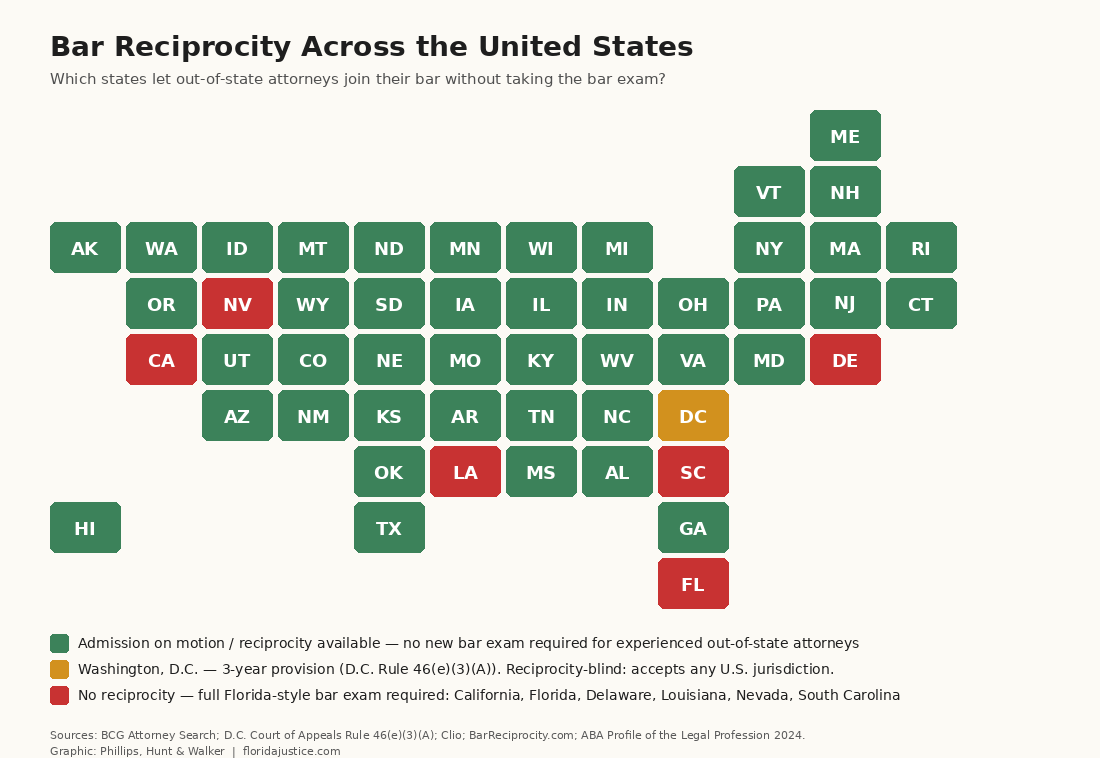
The reciprocity highway: D.C., New York, and the cascade
The other engine of multi-state admission for non-corporate lawyers is the reciprocity cascade.
D.C. Court of Appeals Rule 46(e)(3)(A) lets any attorney admitted in any U.S. jurisdiction for at least three years apply for D.C. bar admission on motion. Notice the phrase: any U.S. jurisdiction. D.C.’s 3-year provision is reciprocity-blind — it does not care whether your home state would extend the same courtesy to D.C. lawyers. That makes D.C. the lowest-threshold open door in the country.
New York’s admission on motion (22 NYCRR § 520.10) then accepts D.C. as a reciprocal jurisdiction. New York requires:
- 5 of the preceding 7 years of active practice;
- Admission in at least one reciprocal jurisdiction;
- Graduation from an ABA-approved law school.
New York maintains a list of 32 states plus D.C. as reciprocal.
So a determined attorney, anywhere in the country, can build the following ladder:
- Pass any state’s bar exam.
- Practice for three years.
- Apply to D.C. on motion. (Rule 46(e)(3)(A), reciprocity-blind.)
- Once you have D.C. plus your 5/7 years anywhere reciprocal, apply to New York on motion. (22 NYCRR § 520.10.)
- From New York, you have a passport to most of the country’s reciprocal jurisdictions.
This is how William Mattar got to seventeen U.S. jurisdictions while only ever sitting for the New York bar exam.
The Florida wall
Then there is Florida. I want to spend a minute on Florida because it is where I practice, it is where I sat for the bar exam, and it explains a lot about the structure of multi-state admission as a national phenomenon.
Florida does not give reciprocity. Period. The Florida Board of Bar Examiners’ policy is short and direct:
“There is no reciprocity between Florida and any other jurisdiction. Submission to the Florida Bar Examination and completion of all admission requirements is mandatory for all applicants.”
The Florida Bar Board of Governors voted unanimously against admission by motion at its October 16, 2016 meeting at Atlantic Beach, after the Vision 2016 committee changed its position and recommended against. They voted again, and again, and most recently in 2023, against any reciprocity proposal. The stated reasons are familiar to anyone who has practiced here: Florida real estate, probate, and corporate law have unique features; market protection for Florida lawyers in a competitive market; and revenue from bar exam fees that funds the regulatory apparatus.
Because Florida gives nothing, Florida gets nothing. Florida is not on New York’s reciprocal list. It is not on Illinois’s reciprocal list. It is not on most reciprocal lists. The symmetry is structural and intentional. A Florida-only lawyer who wants to add a second state has to go around Florida — find another jurisdiction whose admission opens reciprocity doors elsewhere.
That is exactly what I did. When I wanted New York for the Omarosa litigation, my Florida bar admission was useless to New York. Georgia got me there. New York accepts Georgia as a reciprocal jurisdiction; New York does not accept Florida.
If you scan the Guinness record-holders’ state lists, the Florida wall is visible by absence. Sauer’s bio lists 40 states — Florida is not one of them. Polk has Florida (he sat for it in 2018, the only way you can get it). Mattar’s list of 17 jurisdictions does not include Florida, California, Nevada, Louisiana, South Carolina, Delaware, or Hawaii — every one of the no-reciprocity states.
The other no-reciprocity states form the same wall. California, Florida, Delaware, Louisiana, Nevada, South Carolina are the six that are most consistently called out in legal portability guides. Each forces the bar exam. Collectively they are the hardest portion of the U.S. legal map for a multi-state collector to fill in, and they are the most likely to be missing from any high-count attorney’s list.
What nobody writes about: the maintenance burden
Here is the part of multi-state admission that the breathless career-strategy articles tend to skip.
Eight admissions means eight separate annual or biennial fee cycles, each with different due dates, different inactive-status rules, different waivers. It means eight CLE schemes — Florida requires substantive ethics, technology, and bias coursework on its own clock; Illinois has a multi-credit annual scheme; Georgia has separate hour requirements; New York has its own. It means eight character-and-fitness updating obligations, each with its own reporting triggers. If you handle client money in any of those states, it means eight IOLTA / trust account compliance regimes.
Miss any one of these and the consequence is administrative suspension. A Cure-by-Letter is usually possible, but a public discipline record is forever. So you build infrastructure: a calendar of admissions, a CLE tracker, a compliance staffer or vendor.
I have not seen any article that quantifies what the maintenance burden actually costs at higher admission counts. At eight, it is several thousand dollars a year and a meaningful chunk of administrative attention. At thirty or forty, it is essentially a part-time job. Which is part of why the highest-count attorneys are typically solo or boutique-firm practitioners — they need to amortize the cost across their practice and they need to control their own administrative staff.
What the count actually means
Here is where I land, after fifteen minutes of research and a couple of hours pulling the threads:
A bar license count is one number. What those licenses authorize you to do is another. The two are not the same.
The current Guinness record-holder runs a title closing business. The prior holder ran an M&A and corporate practice. The one before that does insurance subrogation. They are skilled lawyers at what they do. None of them is in court trying jury cases in eight states.
There is no shame in that. It is what their practice areas demand. But it is worth saying clearly: when you see an attorney described as “licensed in 30 states” or “admitted in 48 jurisdictions,” the question to ask is what kind of admissions and what kind of practice. If the answer is “in-house counsel registrations to advise a single corporate employer,” that is a different credential than “plenary trial-bar admission with the right to walk into any courtroom in that state and represent any client.”
I am not going to be on the Guinness page. Eight states and three bar exams is what I have, and it took me twenty-five years and a couple of nationally watched cases to get there. What I can do is stand up in the courtrooms in those eight states, on behalf of any client, and try the case. That is what I built it for.
If you have read this far and you are a lawyer thinking about going multi-state, I will say what nobody told me when I started: be honest about why you are doing it. The reciprocity highway is wide and well-paved. The bar exams in the no-reciprocity states are hard but durable. The maintenance burden is real and growing. And the highest-count attorneys in the country are not, as a class, doing the thing most clients picture when they hear “licensed in fifty states.”
Pick your states like an electoral college, not a stamp collection.
Sources
- Guinness World Records — Most active bar memberships for an attorney: guinnessworldrecords.com
- Wayback Machine snapshot, June 27, 2023 (showing Sullivan as holder at 28): web.archive.org
- Michael Sauer firm bio — Koegle Law Group: koeglelaw.com
- Geoffrey B. Polk — North Dakota Court System: ndcourts.gov
- Geoffrey Polk — Presidential Title Group: presidentialtitlegroup.com
- Jason Sullivan — Rathbone Group: rathbonegroup.com
- William Mattar firm bio: williammattar.com
- In re Denial of Application of Geoffrey Polk, Esquire for Certificate of Limited Practice Under Rule 55.1, Del. Supr. Docket No. 79, 2024: law.justia.com
- ABA 2024 Profile of the Legal Profession — Demographics and methodology: americanbar.org
- ABA Model Rule 5.5(d) — In-house corporate counsel registration rules chart: americanbar.org PDF
- 50-state survey — Exceptions to bar admissions for in-house counsel (Butler Snow): butlersnow.com PDF
- D.C. Court of Appeals Rule 46(e)(3)(A) — 3-Year Provision: dcappeals.gov
- New York Board of Law Examiners — Admission on Motion: nybarexam.org
- Florida Bar — Board rejects admission by motion (2016): floridabar.org
- ABA Journal — Florida Bar refuses to ease admission of out-of-state lawyers: abajournal.com
- BCG Attorney Search — States With No General Bar Reciprocity: bcgsearch.com
John M. Phillips is a founding partner of Phillips, Hunt & Walker. He is Board Certified in Civil Trial Law by The Florida Bar and admitted to practice in Alabama, Florida, Georgia, the District of Columbia, New York, Illinois, Texas, Oklahoma, the Supreme Court of the United States, and nine federal courts. He is not in the running for the Guinness record.