



Fla. R. Civ. P. 1.350 — Production of Documents and Things
Last verified from official source: April 30, 2026 · Source: Florida Bar — Florida Rules of Civil Procedure (eff. April 1, 2026), p. 112
Rule Text (Verbatim)
The text below is mirrored verbatim from the Florida Bar’s official publication, with FRCP’s hierarchical indentation preserved. Public domain.
(a) Request; Scope. Any party may request any other party:
(1) to produce and permit the party making the request, or someone acting in the requesting party’s behalf, to inspect and copy any designated documents, including electronically stored information, writings, drawings, graphs, charts, photographs, audio, visual, and audiovisual recordings, and other data compilations from which information can be obtained, translated, if necessary, by the party to whom the request is directed through detection devices into reasonably usable form, that constitute or contain matters within the scope of rule 1.280(c) and that are in the possession, custody, or control of the party to whom the request is directed;
(2) to inspect and copy, test, or sample any tangible things that constitute or contain matters within the scope of rule 1.280(c) and that are in the possession, custody, or control of the party to whom the request is directed; or
(3) to permit entry on designated land or other property in the possession or control of the party on whom the request is served for the purpose of inspection and measuring, surveying, photographing, testing, or sampling the property or any designated object or operation on it within the scope of rule 1.280(c).
(b) Procedure.
(1) Without leave of court the request may be served on the plaintiff after commencement of the action and on any other party with or after service of the process and initial pleading on that party.
(2) Requests must be served on all parties. The request must set forth the items to be inspected, either by individual item or category, and describe each item and category with reasonable particularity.
(3) The request must specify a reasonable time, place, and manner of making the inspection or performing the related acts. The party to whom the request is directed must serve a written response within 30 days after service of the request, except that a defendant may serve a response within 45 days after service of the process and initial pleading on that defendant. The court may allow a shorter or longer time.
(4) Requests must be served on all parties. For each item or category the response must state that inspection and related activities will be permitted as requested or state with specificity the grounds for objecting to the request, including the reasons.
(5) If an objection is made to part of an item or category, the objection must state with specificity the grounds for objecting, including the reasons.
(6) An objection must state whether any responsive materials are being withheld on the basis of that objection. An objection to part of a request must specify the part and permit inspection of the rest.
(7) When producing documents, the producing party must either produce them as they are kept in the usual course of business or must identify them to correspond with the categories in the request.
(8) A request for electronically stored information may specify the form or forms in which electronically stored information is to be produced. If the responding party objects to a requested form, or if no form is specified in the request, the responding party must state the form or forms it intends to use. If a request for electronically stored information does not specify the form of production, the producing party must produce the information in a form or forms in which it is ordinarily maintained or in a reasonably usable form or forms.
(9) The party submitting the request may move for an order under rule 1.380 concerning any objection, failure to respond to the request, or any part of it, or failure to permit the inspection as requested.
(c) Persons Not Parties. This rule does not preclude an independent action against a person not a party for production of documents and things and permission to enter on land.
(d) Filing of Documents. Unless required by the court, a party must not file any of the documents or things produced with the response. Documents or things may be filed in compliance with Florida Rule of General Practice and Judicial Administration 2.425 and rule 1.280(h) when they should be considered by the court in determining a matter pending before the court.
Committee Notes
View Committee Notes (legislative history)
1972 Amendment. Derived from Federal Rule of Civil Procedure 34 as amended in 1970. The new rule eliminates the good cause requirement of the former rule, changes the time for making the request and responding to it, and changes the procedure for the response. If no objection to the discovery is made, inspection is had without a court order. While the good cause requirement has been eliminated, the change is not intended to overrule cases limiting discovery under this rule to the scope of ordinary discovery, nor is it intended to overrule cases limiting unreasonable requests such as those reviewed in Van Devere v. Holmes, 156 So. 2d 899 (Fla. 3d DCA 1963); IBM v. Elder, 187 So. 2d 82 (Fla. 3d DCA 1966); and Miami v. Florida Public Service Commission, 226 So. 2d 217 (Fla. 1969). It is intended that the court review each objection and weigh the need for discovery and the likely results of it against the right of privacy of the party or witness or custodian. 1980 Amendment. Subdivision (b) is amended to require production of documents as they are kept in the usual course of business or in accordance with the categories in the request. 2011 Amendment. A reference to Florida Rule of Judicial Administration 2.425 and rule 1.280(f) is added to require persons filing discovery materials with the court to make sure that good cause exists prior to filing discovery materials and that certain specific personal information is redacted.
2012 Amendment. Subdivision (a) is amended to address the production of electronically stored information. Subdivision (b) is amended to set out a procedure for determining the form to be used in producing electronically stored information.
Plain-English Summary
Florida Rule of Civil Procedure 1.350 governs requests for production of documents, electronically stored information, and tangible things, plus entry on land or other property for inspection. It’s how parties get at the documentary record of a case.
The rule allows requests to inspect, copy, test, or sample documents, ESI, or tangible things in the responding party’s possession, custody, or control. The 30-day response deadline runs from service. Each request must describe the items with reasonable particularity. Responses must state either compliance or objection, and objections must specify the part of the request to which the objection relates and the grounds.
Rule 1.350 interacts heavily with Rule 1.280‘s scope and ESI provisions. Form-of-production decisions, redaction logs, and privilege logs all flow from this rule. The rule also authorizes entry on land for inspection — useful in slip-and-fall, premises-liability, and construction cases where the physical scene matters.
Strategy under 1.350 is about specificity. Vague requests draw vague productions and easy objections. Tightly scoped requests with definitions and time periods are difficult to evade.
Practitioner Notes — From the Trial Lawyers at Florida Justice
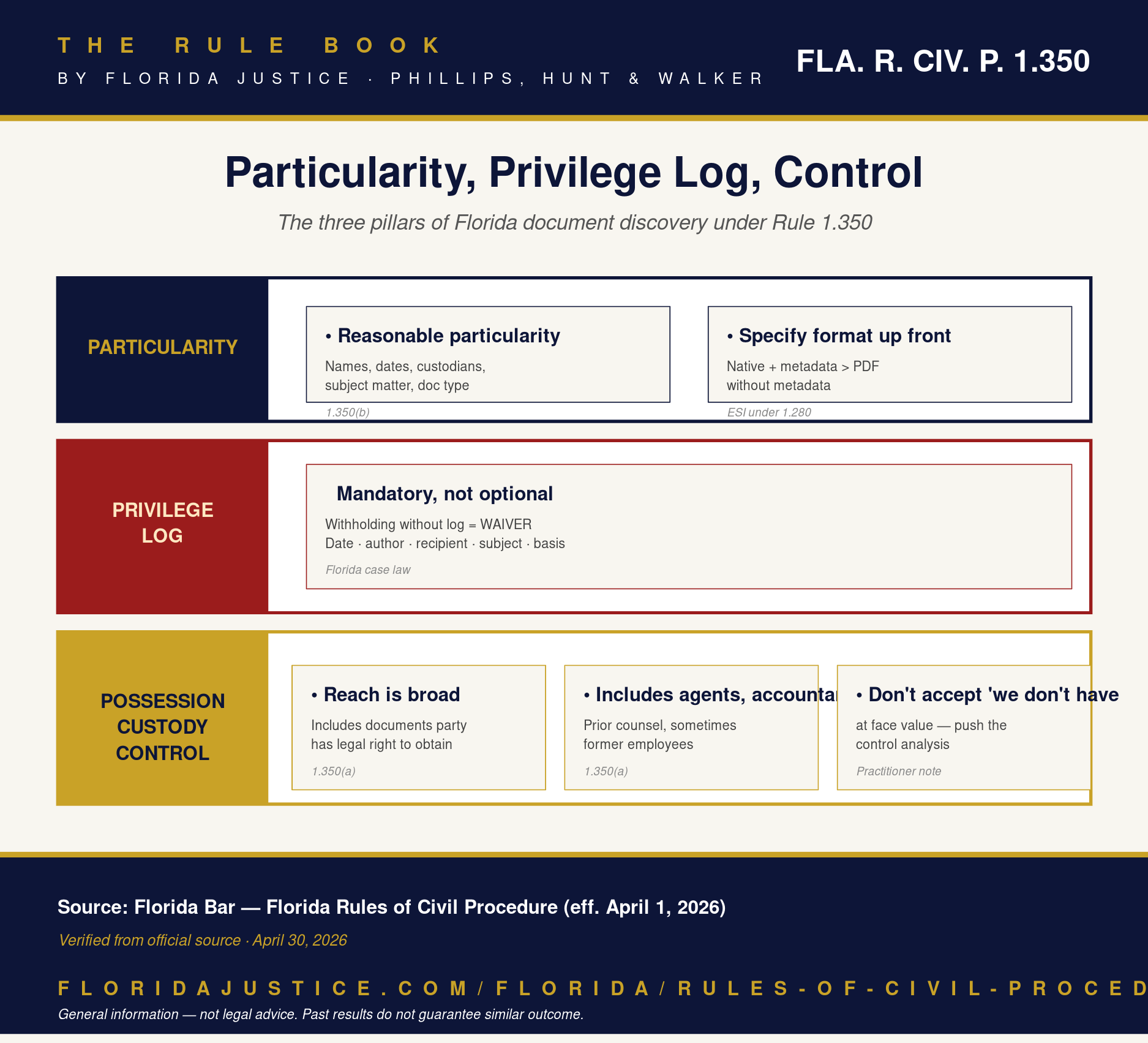
Reasonable particularity is a real standard. 1.350(b) requires requests to describe items with “reasonable particularity.” “All documents related to this case” fails. “All emails between Smith and Jones from January 1, 2024 through April 30, 2024 referencing the contract dated December 15, 2023” passes. Build particularity through dates, custodians, subject matter, and document type.
Demand format of production up front. Florida tracks federal practice on ESI. If you don’t specify format (PDF, native, with metadata), the producing party picks. Native format with metadata is the lawyer’s friend; PDF without metadata strips evidentiary value. Specify in the request.
Privilege log is mandatory, not optional. Withholding documents on privilege grounds without a privilege log waives the privilege. The log must identify each document by date, author, recipient, subject, and basis for privilege — enough information for the requesting party to assess the claim. Generic logs (“various correspondence — privileged”) fail.
Possession, custody, or control reaches further than people assume. 1.350(a) reaches documents in the party’s “possession, custody, or control.” Control includes documents the party has the legal right to obtain — including from agents, accountants, prior counsel, and in some cases former employees. Don’t accept a “we don’t have those” answer at face value.
Entry on land — coordinate with experts. 1.350(a)(2) permits entry on land for inspection, photographing, testing, or sampling. In premises-liability and construction cases, coordinate the entry with your engineering, accident-reconstruction, or environmental expert. A single failed entry attempt can cost weeks of expert availability.
Related Rules in The Rule Book
- Rule 1.280 — General Provisions Governing Discovery (scope and ESI rules)
- Rule 1.340 — Interrogatories to Parties (complementary discovery tool)
- Rule 1.351 — Production from Non-Parties Without Deposition (subpoena for non-party documents)
- Rule 1.380 — Failure to Make Discovery; Sanctions (consequences for incomplete production)
Lawyer-to-Lawyer Co-Counsel Referrals
If you’re a lawyer with a Florida case outside your normal practice — complex civil, catastrophic injury, federal court litigation, multi-state coordination — co-counsel referrals are a core part of what we do. You keep the client. We take the trial-side work. Fee split per Fla. Bar Rule 4-1.5 with full client consent.
Call John directly: (904) 444-4444
This page summarizes a Florida Rule of Civil Procedure for educational purposes. The rule text and Committee Notes are mirrored from the Florida Bar’s official publication and are public domain. The plain-English summary, practitioner notes, and video commentary are the opinion of Phillips, Hunt & Walker and are general information only — not legal advice. Reading this page does not create an attorney-client relationship. Past results do not guarantee a similar outcome in your case.
Subsection-by-Subsection Practitioner Notes — Rule 1.350
Subsection (a) — Scope and Particularity
(a) lets a party serve a request for production on any other party. The party served must be in possession, custody, or control of the items requested. “Control” is broader than physical possession — documents the responding party has the legal right to obtain are within the rule, even if held by an affiliate, subsidiary, or third party. Each request must describe the items with reasonable particularity. “All documents related to” requests are routinely held overbroad; “all communications between Plaintiff and Defendant from January 1 through December 31” tends to pass.
Subsection (b) — Procedure and Response Time
(b) sets the response window: 30 days after service of the request (or 45 days if served with the complaint). The response must either produce the documents or state objections with specificity. Boilerplate “general objections” — over-breadth, undue burden, vague — are increasingly disfavored. Florida courts expect particularized objections that explain why this specific request, applied to this specific case, is over-broad or unduly burdensome.
Format of Production — ESI
The 2012 ESI amendments require production of electronically stored information in the form requested unless the responding party has a basis to object. If no form is specified, the responding party must produce ESI in a form in which it is ordinarily maintained or in a reasonably usable form. The metadata question — produce native files with metadata, or produce in PDF without — is determined by the request and any negotiation between counsel. Plaintiffs in document-intensive cases should specify native production; defendants may negotiate for PDF if the case allows.
Proportionality Crossover with 1.280(b)
The 2024 proportionality amendment to Rule 1.280 changes how 1.350 disputes are resolved. The proponent of a production request must now address proportionality — relevance plus the proportionality factors. The defender has a real argument that a request, while relevant, is disproportionate to the case. Motion-to-compel practice has shifted accordingly: proponents should pre-empt the proportionality argument in the request itself by tailoring scope; defenders should articulate the burden specifically.
Privilege Logs
Documents withheld on privilege grounds must be identified on a privilege log with sufficient detail for the requesting party to assess the claim — typically date, author, recipients, document type, subject matter (without revealing the privileged substance). Generic logs (“Email — attorney-client”) are routinely held insufficient and can result in waiver of the claimed privilege.
Subsection (c) — Production from Non-Parties
(c) provides for production from non-parties via subpoena duces tecum under Rule 1.410. Rule 1.351 provides a separate streamlined procedure for non-party production without deposition.
Cross-references: See Rule 1.280 (proportionality), Rule 1.285 (privilege clawback), Rule 1.351 (non-party production), and Rule 1.380 (sanctions).
Infographic
Rule Text (verbatim from the Florida Supreme Court)
(a) Request; Scope. Any party may request any other party:
(1) to produce and permit the party making the request, or someone acting in the requesting party’s behalf, to inspect and copy any designated documents, including electronically stored information, writings, drawings, graphs, charts, photographs, audio, visual, and audiovisual recordings, and other data compilations from which information can be obtained, translated, if necessary, by the party to whom the request is directed through detection devices into reasonably usable form, that constitute or contain matters within the scope of rule 1.280(c) and that are in the possession, custody, or control of the party to whom the request is directed; (2) to inspect and copy, test, or sample any tangible things that constitute or contain matters within the scope of rule 1.280(c) and that are in the possession, custody, or control of the party to whom the request is directed; or (3) to permit entry on designated land or other property in the possession or control of the party on whom the request is served for the purpose of inspection and measuring, surveying, photographing, testing, or sampling the property or any designated object or operation on it within the scope of rule 1.280(c). (b) Procedure. (1) Without leave of court the request may be served on the plaintiff after commencement of the action and on any other party with or after service of the process and initial pleading on that party. (2) Requests must be served on all parties. The request must set forth the items to be inspected, either by individual item or category, and describe each item and category with reasonable particularity. (3) The request must specify a reasonable time, place, and manner of making the inspection or performing the related acts. The party to whom the request is directed must serve a written response within 30 days after service of the request, except that a defendant may serve a response within 45 days after service of the
process and initial pleading on that defendant. The court may allow a shorter or longer time. (4) Requests must be served on all parties. For each item or category the response must state that inspection and related activities will be permitted as requested or state with specificity the grounds for objecting to the request, including the reasons. (5) If an objection is made to part of an item or category, the objection must state with specificity the grounds for objecting, including the reasons. (6) An objection must state whether any responsive materials are being withheld on the basis of that objection. An objection to part of a request must specify the part and permit inspection of the rest. (7) When producing documents, the producing party must either produce them as they are kept in the usual course of business or must identify them to correspond with the categories in the request. (8) A request for electronically stored information may specify the form or forms in which electronically stored information is to be produced. If the responding party objects to a requested form, or if no form is specified in the request, the responding party must state the form or forms it intends to use. If a request for electronically stored information does not specify the form of production, the producing party must produce the information in a form or forms in which it is ordinarily maintained or in a reasonably usable form or forms. (9) The party submitting the request may move for an order under rule 1.380 concerning any objection, failure to respond to the request, or any part of it, or failure to permit the inspection as requested.
(c) Persons Not Parties. This rule does not preclude an independent action against a person not a party for production of documents and things and permission to enter on land. (d) Filing of Documents. Unless required by the court, a party must not file any of the documents or things produced with the response. Documents or things may be filed in compliance with Florida Rule of General Practice and Judicial Administration 2.425 and rule 1.280(h) when they should be considered by the court in determining a matter pending before the court.
Educational reference. This page summarizes a Florida Rule of Civil Procedure for educational purposes. The rule text and Committee Notes are mirrored from the Florida Bar's official publication and are public domain. The plain-English summary, practitioner notes, and video commentary are the opinion of Phillips, Hunt & Walker and are general information only — not legal advice. Reading this page does not create an attorney-client relationship. Past results do not guarantee a similar outcome in your case.
What this rule means in plain English
Florida Rule of Civil Procedure 1.350 governs requests for production of documents, electronically stored information, and tangible things, plus entry on land or other property for inspection. It’s how parties get at the documentary record of a case.
The rule allows requests to inspect, copy, test, or sample documents, ESI, or tangible things in the responding party’s possession, custody, or control. The 30-day response deadline runs from service. Each request must describe the items with reasonable particularity. Responses must state either compliance or objection, and objections must specify the part of the request to which the objection relates and the grounds.
Rule 1.350 interacts heavily with Rule 1.280’s scope and ESI provisions. Form-of-production decisions, redaction logs, and privilege logs all flow from this rule. The rule also authorizes entry on land for inspection — useful in slip-and-fall, premises-liability, and construction cases where the physical scene matters.
Strategy under 1.350 is about specificity. Vague requests draw vague productions and easy objections. Tightly scoped requests with definitions and time periods are difficult to evade.
Practitioner notes
Reasonable particularity is a real standard. 1.350(b) requires requests to describe items with “reasonable particularity.” “All documents related to this case” fails. “All emails between Smith and Jones from January 1, 2024 through April 30, 2024 referencing the contract dated December 15, 2023” passes. Build particularity through dates, custodians, subject matter, and document type.
Demand format of production up front. Florida tracks federal practice on ESI. If you don’t specify format (PDF, native, with metadata), the producing party picks. Native format with metadata is the lawyer’s friend; PDF without metadata strips evidentiary value. Specify in the request.
Privilege log is mandatory, not optional. Withholding documents on privilege grounds without a privilege log waives the privilege. The log must identify each document by date, author, recipient, subject, and basis for privilege — enough information for the requesting party to assess the claim. Generic logs (“various correspondence — privileged”) fail.
Possession, custody, or control reaches further than people assume. 1.350(a) reaches documents in the party’s “possession, custody, or control.” Control includes documents the party has the legal right to obtain — including from agents, accountants, prior counsel, and in some cases former employees. Don’t accept a “we don’t have those” answer at face value.
Entry on land — coordinate with experts. 1.350(a)(2) permits entry on land for inspection, photographing, testing, or sampling. In premises-liability and construction cases, coordinate the entry with your engineering, accident-reconstruction, or environmental expert. A single failed entry attempt can cost weeks of expert availability.
Committee Notes (verbatim)
1972 Amendment. Derived from Federal Rule of Civil Procedure 34 as amended in 1970. The new rule eliminates the good cause requirement of the former rule, changes the time for making the request and responding to it, and changes the procedure for the response. If no objection to the discovery is made, inspection is had without a court order. While the good cause requirement has been eliminated, the change is not intended to overrule cases limiting discovery under this rule to the scope of ordinary discovery, nor is it intended to overrule cases limiting unreasonable requests such as those reviewed in Van Devere v. Holmes, 156 So. 2d 899 (Fla. 3d DCA 1963); IBM v. Elder, 187 So. 2d 82 (Fla. 3d DCA 1966); and Miami v. Florida Public Service Commission, 226 So. 2d 217 (Fla. 1969). It is intended that the court review each objection and weigh the need for discovery and the likely results of it against the right of privacy of the party or witness or custodian. 1980 Amendment. Subdivision (b) is amended to require production of documents as they are kept in the usual course of business or in accordance with the categories in the request. 2011 Amendment. A reference to Florida Rule of Judicial Administration 2.425 and rule 1.280(f) is added to require persons filing discovery materials with the court to make sure that good cause exists prior to filing discovery materials and that certain specific personal information is redacted.
2012 Amendment. Subdivision (a) is amended to address the production of electronically stored information. Subdivision (b) is amended to set out a procedure for determining the form to be used in producing electronically stored information.