
Educational reference. This page summarizes a Florida Rule of Civil Procedure for educational purposes. The rule text and Committee Notes are mirrored from the Florida Bar's official publication and are public domain. The plain-English summary is the opinion of Phillips, Hunt & Walker and is general information only — not legal advice. Reading this page does not create an attorney-client relationship. Past results do not guarantee a similar outcome in your case.
What this rule means in plain English
Florida Rule of Civil Procedure 1.460 — Motions to Continue Trial — sets out the procedural requirements for this aspect of Florida civil practice. (a) Generally. Motions to continue trial are disfavored and should rarely be granted and then only upon good cause shown. Successive continuances are highly disfavored. Lack of due diligence in preparing for trial is not grounds to continue the case.
Rule Text (verbatim from the Florida Supreme Court)
(a) Generally. Motions to continue trial are disfavored and should rarely be granted and then only upon good cause shown. Successive continuances are highly disfavored. Lack of due diligence in preparing for trial is not grounds to continue the case. Motions for continuance based on parental leave are governed by Florida Rule of General Practice and Judicial Administration 2.570. (b) Motion; Requirements. A motion to continue trial must be in writing unless made at a trial and, except for good cause shown, must be signed by the named party requesting the continuance. (c) Motion; Timing of Filing. A motion to continue trial must be filed promptly after the appearance of good cause to
support such motion. Failure to promptly request a continuance may be a basis for denying the motion to continue. (d) Motion; Contents. All motions for continuance, even if agreed, must state with specificity: (1) the basis of the need for the continuance, including when the basis became known to the movant; (2) whether the motion is opposed; (3) the action and specific dates for the action that will enable the movant to be ready for trial by the proposed date, including, but not limited to, confirming the specific date any required participants such as third-party witnesses or experts are available; and (4) the proposed date by which the case will be ready for trial and whether that date is agreed by all parties. (e) Efforts to Avoid Continuances. To avoid continuances, trial courts should use all appropriate methods to address the issues causing delay, including requiring depositions to preserve testimony, allowing remote appearances, and resolving conflicts with other judges as provided in the Florida Rules of General Practice and Judicial Administration. (f) Setting Trial Date. When possible, continued trial dates must be set in collaboration with attorneys and self-represented litigants as opposed to the issuance of unilateral dates by the court. (g) Dilatory Conduct. If a continuance is granted based on the dilatory conduct of an attorney or named party, the court may impose sanctions on the attorney, the party, or both. (h) Order on Motion for Continuance. When ruling on a motion to continue, the court must state, either on the record or in a written order, the factual basis for the ruling. An order granting a motion to continue must either set a new trial period or set a case management conference. If the trial is continued, the new trial must
be set for the earliest date practicable, given the needs of the case and resources of the court. The order must reflect what further activity will or will not be permitted.
Florida Rule 1.460 governs motions to continue trial — when a party can ask the court to postpone a scheduled trial, the showing required, and the limited grounds Florida courts will accept for granting one.
▶ Watch: Rule 1.460 — Motions to Continue Trial

Fla. R. Civ. P. 1.460 — Motions to Continue Trial
Last verified from official source: April 30, 2026 · Source: Florida Bar — Florida Rules of Civil Procedure (eff. April 1, 2026), p. 156
Rule Text (verbatim)
(a) Generally. Motions to continue trial are disfavored and should rarely be granted and then only upon good cause shown. Successive continuances are highly disfavored. Lack of due diligence in preparing for trial is not grounds to continue the case. Motions for continuance based on parental leave are governed by Florida Rule of General Practice and Judicial Administration 2.570.
(b) Motion; Requirements. A motion to continue trial must be in writing unless made at a trial and, except for good cause shown, must be signed by the named party requesting the continuance.
(c) Motion; Timing of Filing. A motion to continue trial must be filed promptly after the appearance of good cause to
April 1, 2026 Florida Rules of Civil Procedure 156 support such motion. Failure to promptly request a continuance may be a basis for denying the motion to continue.
(d) Motion; Contents. All motions for continuance, even if agreed, must state with specificity:
(1) the basis of the need for the continuance, including when the basis became known to the movant;
(2) whether the motion is opposed;
(3) the action and specific dates for the action that will enable the movant to be ready for trial by the proposed date, including, but not limited to, confirming the specific date any required participants such as third-party witnesses or experts are available; and
(4) the proposed date by which the case will be ready for trial and whether that date is agreed by all parties.
(e) Efforts to Avoid Continuances. To avoid continuances, trial courts should use all appropriate methods to address the issues causing delay, including requiring depositions to preserve testimony, allowing remote appearances, and resolving conflicts with other judges as provided in the Florida Rules of General Practice and Judicial Administration.
(f) Setting Trial Date. When possible, continued trial dates must be set in collaboration with attorneys and self-represented litigants as opposed to the issuance of unilateral dates by the court.
(g) Dilatory Conduct. If a continuance is granted based on the dilatory conduct of an attorney or named party, the court may impose sanctions on the attorney, the party, or both.
(h) Order on Motion for Continuance. When ruling on a motion to continue, the court must state, either on the record or in a written order, the factual basis for the ruling. An order granting a motion to continue must either set a new trial period or set a case management conference. If the trial is continued, the new trial must
April 1, 2026 Florida Rules of Civil Procedure 157 be set for the earliest date practicable, given the needs of the case and resources of the court. The order must reflect what further activity will or will not be permitted.
Committee Notes
1980 Amendment. Subdivision (a), deleted by amendment, was initially adopted when trials were set at a docket sounding prescribed by statute. Even then, the rule was honored more in the breach than the observance. Trials are no longer uniformly set in that manner, and continuances are granted generally without reference to the rule. Under the revised rule, motions for continuance can be filed at any time that the need arises and need not be in writing if the parties are before the court.
1988 Amendment. The supreme court, by adopting Florida Rule of Judicial Administration 2.085(c), effective July 1, 1986, required all motions for continuance to be signed by the litigant requesting the continuance. The amendment conforms rule 1.460 to rule 2.085(c); but, by including an exception for good cause, it recognizes that circumstances justifying a continuance may excuse the signature of the party.
Plain-English Breakdown
Practitioner notes by John M. Phillips, Board Certified Civil Trial Lawyer — coming soon. Watch the video at the top of this page for the plain-English breakdown.
Rule Text (Verbatim)
The text below is mirrored verbatim from the Florida Bar’s official publication. Public domain.
(a) Generally. Motions to continue trial are disfavored and should rarely be granted and then only upon good cause shown. Successive continuances are highly disfavored. Lack of due diligence in preparing for trial is not grounds to continue the case. Motions for continuance based on parental leave are governed by Florida Rule of General Practice and Judicial Administration 2.570. (b) Motion; Requirements. A motion to continue trial must be in writing unless made at a trial and, except for good cause shown, must be signed by the named party requesting the continuance. (c) Motion; Timing of Filing. A motion to continue trial must be filed promptly after the appearance of good cause to
support such motion. Failure to promptly request a continuance may be a basis for denying the motion to continue. (d) Motion; Contents. All motions for continuance, even if agreed, must state with specificity: (1) the basis of the need for the continuance, including when the basis became known to the movant; (2) whether the motion is opposed; (3) the action and specific dates for the action that will enable the movant to be ready for trial by the proposed date, including, but not limited to, confirming the specific date any required participants such as third-party witnesses or experts are available; and (4) the proposed date by which the case will be ready for trial and whether that date is agreed by all parties. (e) Efforts to Avoid Continuances. To avoid continuances, trial courts should use all appropriate methods to address the issues causing delay, including requiring depositions to preserve testimony, allowing remote appearances, and resolving conflicts with other judges as provided in the Florida Rules of General Practice and Judicial Administration. (f) Setting Trial Date. When possible, continued trial dates must be set in collaboration with attorneys and self-represented litigants as opposed to the issuance of unilateral dates by the court. (g) Dilatory Conduct. If a continuance is granted based on the dilatory conduct of an attorney or named party, the court may impose sanctions on the attorney, the party, or both. (h) Order on Motion for Continuance. When ruling on a motion to continue, the court must state, either on the record or in a written order, the factual basis for the ruling. An order granting a motion to continue must either set a new trial period or set a case management conference. If the trial is continued, the new trial must
be set for the earliest date practicable, given the needs of the case and resources of the court. The order must reflect what further activity will or will not be permitted.
Committee Notes
View Committee Notes (legislative history)
1980 Amendment. Subdivision (a), deleted by amendment, was initially adopted when trials were set at a docket sounding prescribed by statute. Even then, the rule was honored more in the breach than the observance. Trials are no longer uniformly set in that manner, and continuances are granted generally without reference to the rule. Under the revised rule, motions for continuance can be filed at any time that the need arises and need not be in writing if the parties are before the court. 1988 Amendment. The supreme court, by adopting Florida Rule of Judicial Administration 2.085(c), effective July 1, 1986, required all motions for continuance to be signed by the litigant requesting the continuance. The amendment conforms rule 1.460 to rule 2.085(c); but, by including an exception for good cause, it recognizes that circumstances justifying a continuance may excuse the signature of the party.
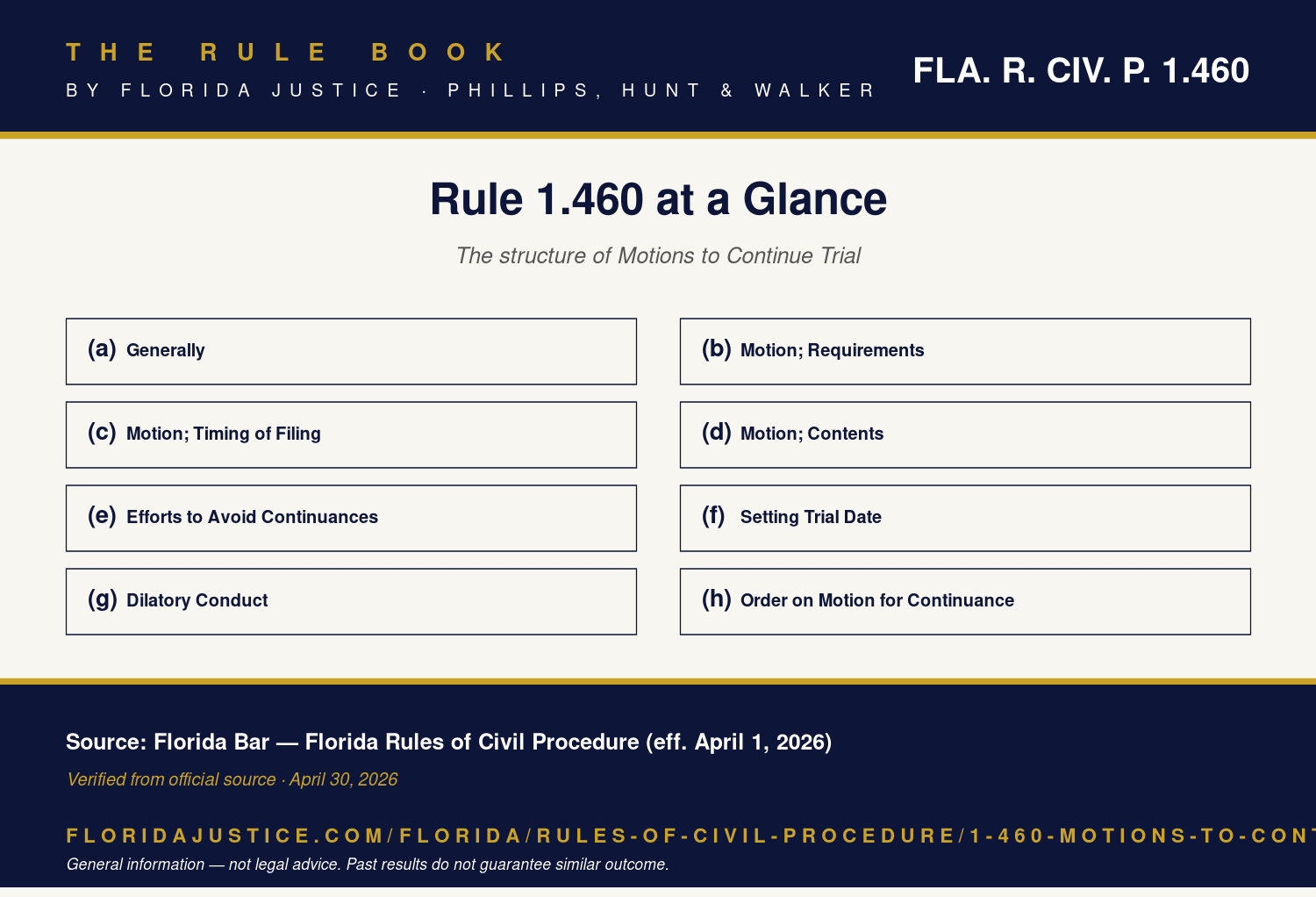
Infographic — Rule 1.460 at a Glance
Lawyer-to-Lawyer Co-Counsel Referrals
If you’re a lawyer with a Florida case outside your normal practice — complex civil, catastrophic injury, federal court litigation, multi-state coordination — co-counsel referrals are a core part of what we do. You keep the client. We take the trial-side work. Fee split per Fla. Bar Rule 4-1.5 with full client consent.
Call John directly: (904) 444-4444
This page summarizes a Florida Rule of Civil Procedure for educational purposes. The rule text and Committee Notes are mirrored from the Florida Bar’s official publication and are public domain. The plain-English summary is the opinion of Phillips, Hunt & Walker and is general information only — not legal advice. Reading this page does not create an attorney-client relationship. Past results do not guarantee a similar outcome in your case.
Committee Notes (verbatim)
1980 Amendment. Subdivision (a), deleted by amendment, was initially adopted when trials were set at a docket sounding prescribed by statute. Even then, the rule was honored more in the breach than the observance. Trials are no longer uniformly set in that manner, and continuances are granted generally without reference to the rule. Under the revised rule, motions for continuance can be filed at any time that the need arises and need not be in writing if the parties are before the court. 1988 Amendment. The supreme court, by adopting Florida Rule of Judicial Administration 2.085(c), effective July 1, 1986, required all motions for continuance to be signed by the litigant requesting the continuance. The amendment conforms rule 1.460 to rule 2.085(c); but, by including an exception for good cause, it recognizes that circumstances justifying a continuance may excuse the signature of the party.