The text below is mirrored verbatim from the Florida Bar’s official publication, with FRCP’s hierarchical indentation preserved. Public domain.
(a)Voluntary Dismissal.
(1) By Parties. Except in actions in which property has been seized or is in the custody of the court, an action, a claim, or any part of an action or claim may be dismissed by plaintiff without order of court
(A) before trial by serving, or during trial by stating on the record, a notice of dismissal at any time before a hearing on motion for summary judgment, or if none is served or if the motion is denied, before retirement of the jury in a case tried before a jury or before submission of a nonjury case to the court for decision, or
(B) by filing a stipulation of dismissal signed by all current parties to the action. Unless otherwise stated in the notice or stipulation, the dismissal is without prejudice, except that a notice of dismissal operates as an adjudication on the merits when served by a plaintiff who has once dismissed in any court an action based on or including the same claim.
(2) By Order of Court; If Counterclaim. Except as provided in subdivision (a)(1) of this rule, an action shall not be dismissed at a party’s instance except on order of the court and upon such terms and conditions as the court deems proper. If a counterclaim has been served by a defendant prior to the service upon the defendant of the plaintiff’s notice of dismissal, the action shall not be dismissed against defendant’s objections unless the counterclaim can remain pending for independent adjudication by the court. Unless otherwise specified in the order, a dismissal under this paragraph is without prejudice.
(b)Involuntary Dismissal. Any party may move for dismissal of an action or of any claim against that party for failure of an adverse party to comply with these rules or any order of court. Notice of hearing on the motion shall be served as required under rule 1.090(d). After a party seeking affirmative relief in an action tried by the court without a jury has completed the presentation of evidence, any other party may move for a dismissal on the ground that on the facts and the law the party seeking affirmative relief has shown no right to relief, without waiving the right to offer evidence if the motion is not granted. The court as trier of the facts may then determine them and render judgment against the party seeking affirmative relief or may decline to render judgment until the close of all the evidence. Unless the court in its order for dismissal otherwise specifies, a dismissal under this subdivision and any dismissal not provided for in this rule, other than a dismissal for lack of jurisdiction or for improper venue or for lack of an indispensable party, operates as an adjudication on the merits.
(c)Dismissal of Counterclaim, Crossclaim, or Third-Party Claim. The provisions of this rule apply to the dismissal of any counterclaim, crossclaim, or third-party claim.
(d)Costs. Costs in any action dismissed under this rule shall be assessed and judgment for costs entered in that action, once the action is concluded as to the party seeking taxation of costs. When one or more other claims remain pending following dismissal of any claim under this rule, taxable costs attributable solely to the dismissed claim may be assessed and judgment for costs in that claim entered in the action, but only when all claims are resolved at the trial court level as to the party seeking taxation of costs. If a party who has once dismissed a claim in any court of this state commences an action based upon or including the same claim against the same adverse party, the court shall make such order for the payment of costs of the claim previously dismissed as it may deem proper and shall stay the proceedings in the action until the party seeking affirmative relief has complied with the order.
(e)Failure to Prosecute. In all actions in which it appears on the face of the record that no activity by filing of pleadings, order of court, or otherwise has occurred for a period of 10 months, and no order staying the action has been issued nor stipulation for stay approved by the court, any interested person, whether a party to the action or not, the court, or the clerk of the court may serve notice to all parties that no such activity has occurred. If no such record activity has occurred within the 10 months immediately preceding the service of such notice, and no record activity occurs within the 60 days immediately following the service of such notice, and if no stay was issued or approved prior to the expiration of such 60-day period, the action shall be dismissed by the court on its own motion or on the motion of any interested person, whether a party to the action or not, after reasonable notice to the parties, unless a party shows good cause in writing at least 5 days before the hearing on the motion why the action should remain pending. Mere inaction for a period of less than 1 year shall not be sufficient cause for dismissal for failure to prosecute.
(f)Effect on Lis Pendens. If a notice of lis pendens has been filed in connection with a claim for affirmative relief that is dismissed under this rule, the notice of lis pendens connected with the dismissed claim is automatically dissolved at the same time. The notice, stipulation, or order shall be recorded.
1976 Amendment. Subdivision (e) has been amended to prevent the dismissal of an action for inactivity alone unless 1 year has elapsed since the occurrence of activity of record. Nonrecord activity will not toll the 1-year time period. 1980 Amendment. Subdivision (e) has been amended to except from the requirement of record activity a stay that is ordered or approved by the court. 1992 Amendment. Subdivision (f) is amended to provide for automatic dissolution of lis pendens on claims that are settled even though the entire action may not have been dismissed.
2005 Amendment. Subdivision (e) has been amended to provide that an action may not be dismissed for lack of prosecution without prior notice to the claimant and adequate opportunity for the claimant to re-commence prosecution of the action to avert dismissal. Court Commentary 1984 Amendment. A perennial real property title problem occurs because of the failure to properly dispose of notices of lis pendens in the order of dismissal. Accordingly, the reference in subdivision (a)(1) to disposition of notices of lis pendens has been deleted and a separate subdivision created to automatically dissolve notices of lis pendens whenever an action is dismissed under this rule.
Plain-English Summary
Florida Rule of Civil Procedure 1.420 controls how and when a Florida civil case ends short of judgment. It governs voluntary dismissal by the plaintiff, involuntary dismissal by the court, and dismissal for failure to prosecute. This is the rule that finishes cases — sometimes by design, sometimes by default.
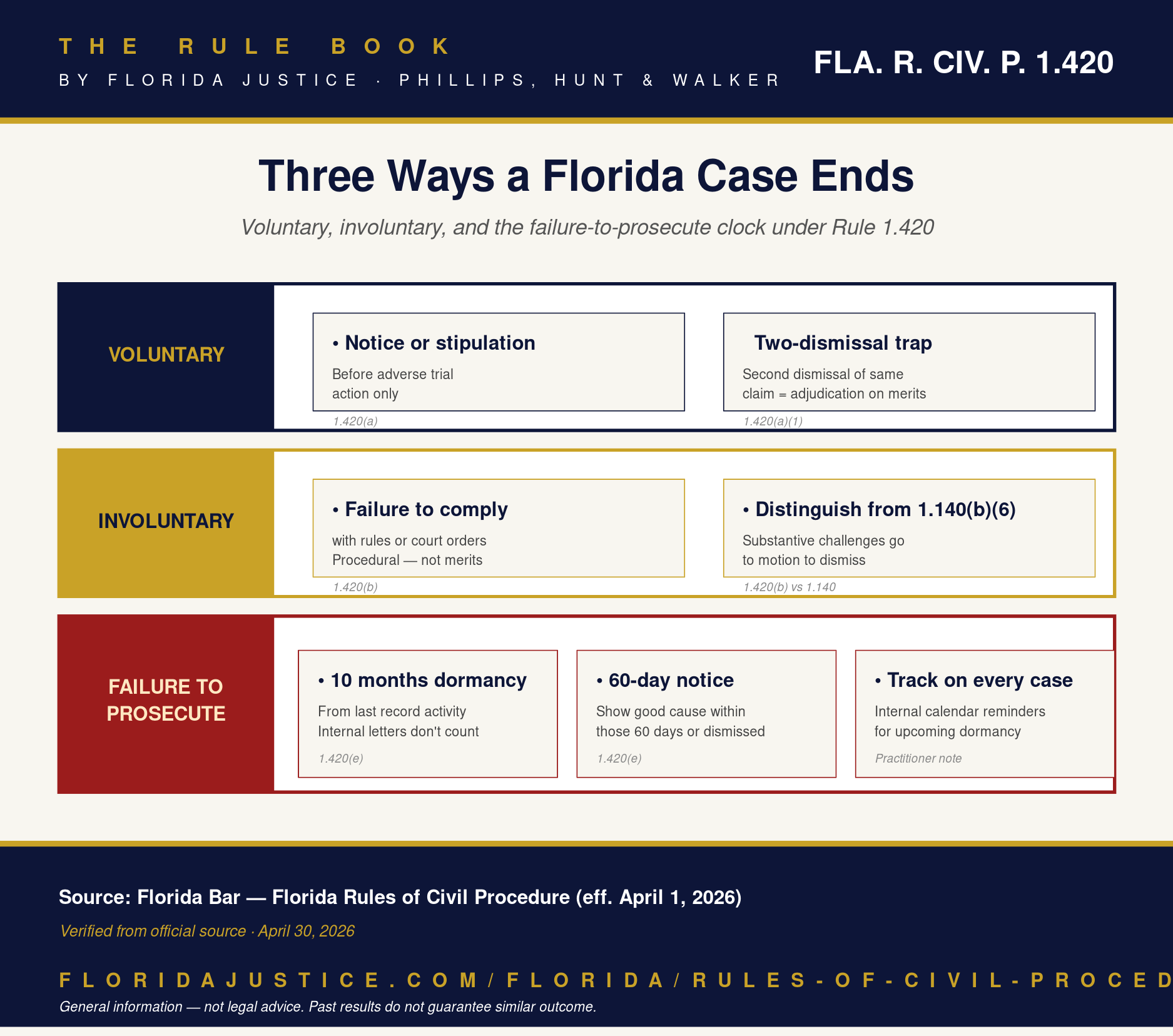
Subsection (a) lets the plaintiff voluntarily dismiss before adverse trial action by serving a notice of dismissal or by stipulation of all parties. Subsection (b) authorizes involuntary dismissal on motion when the plaintiff fails to comply with the rules or any court order. Subsection (e) is the failure-to-prosecute rule — a 10-month dormancy period followed by a 60-day notice triggers automatic dismissal unless the plaintiff shows good cause.
The two-dismissal rule under 1.420(a)(1) is the trap for plaintiffs: a second voluntary dismissal of the same claim against the same defendant operates as adjudication on the merits, foreclosing future suit. The rule also addresses dismissal’s effect on costs, sanctions, and assessment of attorney’s fees in some categories of cases.
For defendants, 1.420 supplies the involuntary-dismissal motion as a case-killing tool when the plaintiff misses deadlines, ignores orders, or lets the file go dormant.
Practitioner Notes — From the Trial Lawyers at Florida Justice
The two-dismissal rule is a trap for plaintiffs. 1.420(a)(1) treats a second voluntary dismissal of the same claim against the same defendant as adjudication on the merits — claim preclusion. Plaintiffs should never dismiss a case without verifying whether a prior dismissal exists in any forum. Defendants should pull docket history on every plaintiff and flag this if a second dismissal is filed.
Voluntary dismissal must precede adverse trial action. 1.420(a)(1) restricts voluntary dismissal to before retirement of the jury, the time at which the cause is finally submitted to the court if tried without a jury, or the entry of a summary judgment. After that point the plaintiff has lost the unilateral right. If you need to dismiss late, get a stipulation under (a)(2) or seek leave under (a)(2) governed by court discretion.
10 months of inactivity = dormancy. 1.420(e) measures dormancy from the last record activity. “Record activity” is a term of art — pleadings, motions, orders, properly filed notices. Internal letter exchanges and informal calendar discussions don’t count. Track dormancy periods on every case calendar and file a notice of activity if you’re approaching the 10-month line.
60-day notice is your last save. When the case becomes dormant, the rule requires a 60-day notice. Show good cause within those 60 days and the case survives. “Good cause” is not pristine — settlement discussions, illness of a party, and reasonable delay typically suffice. But a complete failure to respond results in dismissal.
Involuntary dismissal under (b) is procedural, not merits-based. 1.420(b) lets the court dismiss for failure to comply with rules or orders. This is a discipline tool, not a merits ruling. When responding to a motion to dismiss under (b), distinguish substantive defenses (which go to (b)(6) under 1.140) from procedural failures (which (b) addresses). Confusing the two undermines the response.
Costs and fees on dismissal — read the fine print. Under 1.420(d), costs are typically assessed against the plaintiff on voluntary dismissal. Some categories of cases (e.g., attorney’s fees provisions in contracts or statutes) shift fees to the prevailing party. Check the fee provision before voluntarily dismissing — a tactical dismissal can become an expensive one.
Related Rules in The Rule Book
Rule 1.140 — Defenses (Motion to Dismiss) (pre-answer dismissal grounds)
Rule 1.530 — Motions for New Trial and Rehearing (post-judgment relief)
Rule 1.540 — Relief from Judgment, Decrees, or Orders (relief from a dismissal order)
Lawyer-to-Lawyer Co-Counsel Referrals
If you’re a lawyer with a Florida case outside your normal practice — complex civil, catastrophic injury, federal court litigation, multi-state coordination — co-counsel referrals are a core part of what we do. You keep the client. We take the trial-side work. Fee split per Fla. Bar Rule 4-1.5 with full client consent.
Call John directly: (904) 444-4444
This page summarizes a Florida Rule of Civil Procedure for educational purposes. The rule text and Committee Notes are mirrored from the Florida Bar’s official publication and are public domain. The plain-English summary, practitioner notes, and video commentary are the opinion of Phillips, Hunt & Walker and are general information only — not legal advice. Reading this page does not create an attorney-client relationship. Past results do not guarantee a similar outcome in your case.
Subsection (a)(1) — Voluntary Dismissal Without Court Order
(a)(1) lets the plaintiff voluntarily dismiss before the adverse party serves a motion or pleading directed to the merits. The dismissal is by notice — no court order required. This is the early-stage release valve when the plaintiff realizes the case has problems or wants to refile in a different forum.
The Two-Dismissal Trap
(a)(1) contains a hidden malpractice trap. A second voluntary dismissal of the same claim against the same defendant is treated as an adjudication on the merits — claim preclusion. The case is gone permanently. Plaintiffs should never voluntarily dismiss without verifying whether a prior dismissal exists in any forum, including federal court. Pull docket history before dismissing. The two-dismissal trap can erase otherwise viable claims.
Subsection (a)(2) — Voluntary Dismissal by Stipulation or Court Order
(a)(2) governs dismissals later in the case. After the adverse party has served a motion or pleading, the plaintiff may dismiss only by stipulation of all parties who have appeared, or by court order on terms the court considers proper. The court can condition the dismissal on payment of the defendant’s fees and costs, particularly if the dismissal is on the eve of trial.
Subsection (b) — Involuntary Dismissal
(b) authorizes involuntary dismissal on motion when the plaintiff fails to comply with the rules or any court order. This is a discipline tool, not a merits ruling — though the dismissal can be with prejudice if the failure is willful or repeated. The Kozel v. Ostendorf, 629 So. 2d 817 (Fla. 1993) framework applies before dismissal with prejudice on procedural grounds.
Subsection (e) — Failure to Prosecute
(e) provides for dismissal when there has been no record activity for ten months. The clerk serves a notice of lack of record activity. The plaintiff has 60 days to either show good cause for the inactivity or to take record activity that demonstrates active prosecution. Failure to do either results in dismissal without prejudice.
What counts as record activity: Pleadings, motions, orders, properly filed notices, and other documents that move the case forward. What does not count: internal letter exchanges between counsel, informal scheduling discussions, and settlement negotiations not memorialized in court filings. Track dormancy on every case calendar — the 10-month clock runs whether or not anyone is paying attention.
With or without prejudice: Voluntary dismissals under (a) are typically without prejudice (refilable) unless designated otherwise. The two-dismissal rule converts a second dismissal to an adjudication on the merits even when the second notice does not say so. Involuntary dismissals under (b) and failure-to-prosecute dismissals under (e) are without prejudice unless the court specifies otherwise.
Cross-references: See Rule 1.090 (jurisdictional deadlines), Rule 1.540 (relief from dismissal), and Rule 1.380 (sanctions including dismissal for discovery violations).
▶ Watch: Rule 1.420 — Dismissal of Actions
Infographic
Rule Text (verbatim from the Florida Supreme Court)
(a) Voluntary Dismissal. (1) By Parties. Except in actions in which property has been seized or is in the custody of the court, an action, a claim, or any part of an action or claim may be dismissed by plaintiff without order of court (A) before trial by serving, or during trial by stating on the record, a notice of dismissal at any time before a hearing on motion for summary judgment, or if none is served or if the motion is denied, before retirement of the jury in a case tried before a jury or before submission of a nonjury case to the court for decision, or (B) by filing a stipulation of dismissal signed by all current parties to the action. Unless otherwise stated in the notice or stipulation, the dismissal is without prejudice, except that a notice of dismissal operates as an adjudication on the merits when served by a plaintiff who has once dismissed in any court an action based on or including the same claim. (2) By Order of Court; If Counterclaim. Except as provided in subdivision (a)(1) of this rule, an action shall not be dismissed at a party’s instance except on order of the court and upon such terms and conditions as the court deems proper. If a counterclaim has been served by a defendant prior to the service upon the defendant of the plaintiff’s notice of dismissal, the action shall not be dismissed against defendant’s objections unless the counterclaim can remain pending for independent adjudication by the court. Unless otherwise specified in the order, a dismissal under this paragraph is without prejudice.
(b) Involuntary Dismissal. Any party may move for dismissal of an action or of any claim against that party for failure of an adverse party to comply with these rules or any order of court. Notice of hearing on the motion shall be served as required under rule 1.090(d). After a party seeking affirmative relief in an action tried by the court without a jury has completed the presentation of evidence, any other party may move for a dismissal on the ground that on the facts and the law the party seeking affirmative relief has shown no right to relief, without waiving the right to offer evidence if the motion is not granted. The court as trier of the facts may then determine them and render judgment against the party seeking affirmative relief or may decline to render judgment until the close of all the evidence. Unless the court in its order for dismissal otherwise specifies, a dismissal under this subdivision and any dismissal not provided for in this rule, other than a dismissal for lack of jurisdiction or for improper venue or for lack of an indispensable party, operates as an adjudication on the merits. (c) Dismissal of Counterclaim, Crossclaim, or Third-Party Claim. The provisions of this rule apply to the dismissal of any counterclaim, crossclaim, or third-party claim. (d) Costs. Costs in any action dismissed under this rule shall be assessed and judgment for costs entered in that action, once the action is concluded as to the party seeking taxation of costs. When one or more other claims remain pending following dismissal of any claim under this rule, taxable costs attributable solely to the dismissed claim may be assessed and judgment for costs in that claim entered in the action, but only when all claims are resolved at the trial court level as to the party seeking taxation of costs. If a party who has once dismissed a claim in any court of this state commences an action based upon or including the same claim against the same adverse party, the court shall make such order for the payment of costs of the claim previously dismissed as it may deem proper and shall stay the proceedings in the action until the party seeking affirmative relief has complied with the order.
(e) Failure to Prosecute. In all actions in which it appears on the face of the record that no activity by filing of pleadings, order of court, or otherwise has occurred for a period of 10 months, and no order staying the action has been issued nor stipulation for stay approved by the court, any interested person, whether a party to the action or not, the court, or the clerk of the court may serve notice to all parties that no such activity has occurred. If no such record activity has occurred within the 10 months immediately preceding the service of such notice, and no record activity occurs within the 60 days immediately following the service of such notice, and if no stay was issued or approved prior to the expiration of such 60-day period, the action shall be dismissed by the court on its own motion or on the motion of any interested person, whether a party to the action or not, after reasonable notice to the parties, unless a party shows good cause in writing at least 5 days before the hearing on the motion why the action should remain pending. Mere inaction for a period of less than 1 year shall not be sufficient cause for dismissal for failure to prosecute. (f) Effect on Lis Pendens. If a notice of lis pendens has been filed in connection with a claim for affirmative relief that is dismissed under this rule, the notice of lis pendens connected with the dismissed claim is automatically dissolved at the same time. The notice, stipulation, or order shall be recorded.
Educational reference. This page summarizes a Florida Rule of Civil Procedure for educational purposes. The rule text and Committee Notes are mirrored from the Florida Bar's official publication and are public domain. The plain-English summary, practitioner notes, and video commentary are the opinion of Phillips, Hunt & Walker and are general information only — not legal advice. Reading this page does not create an attorney-client relationship. Past results do not guarantee a similar outcome in your case.
What this rule means in plain English
Florida Rule of Civil Procedure 1.420 controls how and when a Florida civil case ends short of judgment. It governs voluntary dismissal by the plaintiff, involuntary dismissal by the court, and dismissal for failure to prosecute. This is the rule that finishes cases — sometimes by design, sometimes by default.
Subsection (a) lets the plaintiff voluntarily dismiss before adverse trial action by serving a notice of dismissal or by stipulation of all parties. Subsection (b) authorizes involuntary dismissal on motion when the plaintiff fails to comply with the rules or any court order. Subsection (e) is the failure-to-prosecute rule — a 10-month dormancy period followed by a 60-day notice triggers automatic dismissal unless the plaintiff shows good cause.
The two-dismissal rule under 1.420(a)(1) is the trap for plaintiffs: a second voluntary dismissal of the same claim against the same defendant operates as adjudication on the merits, foreclosing future suit. The rule also addresses dismissal’s effect on costs, sanctions, and assessment of attorney’s fees in some categories of cases.
For defendants, 1.420 supplies the involuntary-dismissal motion as a case-killing tool when the plaintiff misses deadlines, ignores orders, or lets the file go dormant.
Committee Notes (verbatim)
1976 Amendment. Subdivision (e) has been amended to prevent the dismissal of an action for inactivity alone unless 1 year has elapsed since the occurrence of activity of record. Nonrecord activity will not toll the 1-year time period. 1980 Amendment. Subdivision (e) has been amended to except from the requirement of record activity a stay that is ordered or approved by the court. 1992 Amendment. Subdivision (f) is amended to provide for automatic dissolution of lis pendens on claims that are settled even though the entire action may not have been dismissed.
2005 Amendment. Subdivision (e) has been amended to provide that an action may not be dismissed for lack of prosecution without prior notice to the claimant and adequate opportunity for the claimant to re-commence prosecution of the action to avert dismissal. Court Commentary 1984 Amendment. A perennial real property title problem occurs because of the failure to properly dispose of notices of lis pendens in the order of dismissal. Accordingly, the reference in subdivision (a)(1) to disposition of notices of lis pendens has been deleted and a separate subdivision created to automatically dissolve notices of lis pendens whenever an action is dismissed under this rule.
Practitioner notes
The two-dismissal rule is a trap for plaintiffs. 1.420(a)(1) treats a second voluntary dismissal of the same claim against the same defendant as adjudication on the merits — claim preclusion. Plaintiffs should never dismiss a case without verifying whether a prior dismissal exists in any forum. Defendants should pull docket history on every plaintiff and flag this if a second dismissal is filed.
Voluntary dismissal must precede adverse trial action. 1.420(a)(1) restricts voluntary dismissal to before retirement of the jury, the time at which the cause is finally submitted to the court if tried without a jury, or the entry of a summary judgment. After that point the plaintiff has lost the unilateral right. If you need to dismiss late, get a stipulation under (a)(2) or seek leave under (a)(2) governed by court discretion.
10 months of inactivity = dormancy. 1.420(e) measures dormancy from the last record activity. “Record activity” is a term of art — pleadings, motions, orders, properly filed notices. Internal letter exchanges and informal calendar discussions don’t count. Track dormancy periods on every case calendar and file a notice of activity if you’re approaching the 10-month line.
60-day notice is your last save. When the case becomes dormant, the rule requires a 60-day notice. Show good cause within those 60 days and the case survives. “Good cause” is not pristine — settlement discussions, illness of a party, and reasonable delay typically suffice. But a complete failure to respond results in dismissal.
Involuntary dismissal under (b) is procedural, not merits-based. 1.420(b) lets the court dismiss for failure to comply with rules or orders. This is a discipline tool, not a merits ruling. When responding to a motion to dismiss under (b), distinguish substantive defenses (which go to (b)(6) under 1.140) from procedural failures (which (b) addresses). Confusing the two undermines the response.
Costs and fees on dismissal — read the fine print. Under 1.420(d), costs are typically assessed against the plaintiff on voluntary dismissal. Some categories of cases (e.g., attorney’s fees provisions in contracts or statutes) shift fees to the prevailing party. Check the fee provision before voluntarily dismissing — a tactical dismissal can become an expensive one.
X
Manage Consent
To provide the best experiences, we use technologies like cookies to store and/or access device information. Consenting to these technologies will allow us to process data such as browsing behavior or unique IDs on this site. Not consenting or withdrawing consent, may adversely affect certain features and functions.
Functional
Always active
The technical storage or access is strictly necessary for the legitimate purpose of enabling the use of a specific service explicitly requested by the subscriber or user, or for the sole purpose of carrying out the transmission of a communication over an electronic communications network.
Preferences
The technical storage or access is necessary for the legitimate purpose of storing preferences that are not requested by the subscriber or user.
Statistics
The technical storage or access that is used exclusively for statistical purposes.The technical storage or access that is used exclusively for anonymous statistical purposes. Without a subpoena, voluntary compliance on the part of your Internet Service Provider, or additional records from a third party, information stored or retrieved for this purpose alone cannot usually be used to identify you.
Marketing
The technical storage or access is required to create user profiles to send advertising, or to track the user on a website or across several websites for similar marketing purposes.




Committee Notes (verbatim)
1976 Amendment. Subdivision (e) has been amended to prevent the dismissal of an action for inactivity alone unless 1 year has elapsed since the occurrence of activity of record. Nonrecord activity will not toll the 1-year time period. 1980 Amendment. Subdivision (e) has been amended to except from the requirement of record activity a stay that is ordered or approved by the court. 1992 Amendment. Subdivision (f) is amended to provide for automatic dissolution of lis pendens on claims that are settled even though the entire action may not have been dismissed.
2005 Amendment. Subdivision (e) has been amended to provide that an action may not be dismissed for lack of prosecution without prior notice to the claimant and adequate opportunity for the claimant to re-commence prosecution of the action to avert dismissal. Court Commentary 1984 Amendment. A perennial real property title problem occurs because of the failure to properly dispose of notices of lis pendens in the order of dismissal. Accordingly, the reference in subdivision (a)(1) to disposition of notices of lis pendens has been deleted and a separate subdivision created to automatically dissolve notices of lis pendens whenever an action is dismissed under this rule.