



Fla. R. Civ. P. 1.560 — Discovery in Aid of Execution
Last verified from official source: April 30, 2026 · Source: Florida Bar — Florida Rules of Civil Procedure (eff. April 1, 2026), p. 179
Rule Text (verbatim)
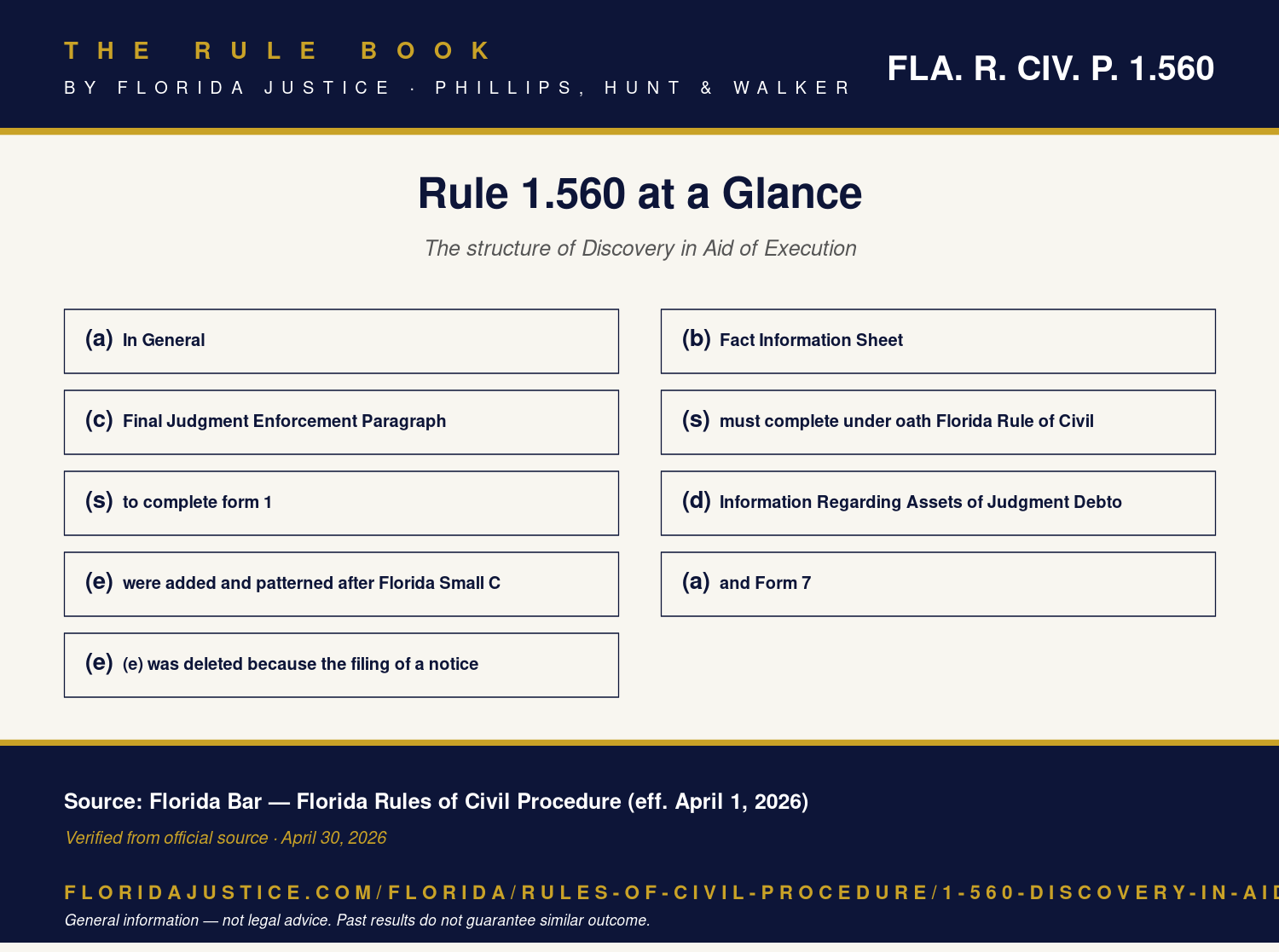
(a) In General. In aid of a judgment, decree, or execution the judgment creditor or the successor in interest, when that interest appears of record, may obtain discovery from any person, including the judgment debtor, in the manner provided in these rules.
(b) Fact Information Sheet. In addition to any other discovery available to a judgment creditor under this rule, the court, at the request of the judgment creditor, must order the judgment debtor or debtors to complete form 1.977, including all required attachments, within 45 days of the order or other reasonable time as determined by the court. Failure to obey the order may be considered contempt of court.
(c) Final Judgment Enforcement Paragraph. In any final judgment, the judge must include the following enforcement paragraph if requested by the prevailing party or attorney:
“It is further ordered and adjudged that the judgment debtor(s) must complete under oath Florida Rule of Civil Procedure Form 1.977 (Fact Information Sheet), including all required attachments, and serve it on the judgment creditor’s attorney, or the judgment creditor if the judgment creditor is not represented by an attorney, within 45 days from the date of this final judgment, unless the final judgment is satisfied or post-judgment discovery is stayed.
Jurisdiction of this case is retained to enter further orders that are proper to compel the judgment debtor(s) to complete form 1.977, including all required attachments, and serve it on the judgment creditor’s attorney, or the judgment creditor if the judgment creditor is not represented by an attorney.”
(d) Information Regarding Assets of Judgment Debtor’s Spouse. In any final judgment, if requested by the judgment
April 1, 2026 Florida Rules of Civil Procedure 179 creditor, the court must include the additional Spouse Related Portion of the fact information sheet on a showing that a proper predicate exists for discovery of separate income and assets of the judgment debtor’s spouse.
Committee Notes
1972 Amendment. The rule is expanded to permit discovery in any manner permitted by the rules and conforms to the 1970 change in Federal Rule of Civil Procedure 69(a).
2000 Amendment. Subdivisions (b)–(e) were added and patterned after Florida Small Claims Rule 7.221(a) and Form 7.343. Although the judgment creditor is entitled to broad discovery into the judgment debtor’s finances, Fla. R. Civ. P. 1.280(b); Jim Appley’s Tru-Arc, Inc. v. Liquid Extraction Systems, 526 So. 2d 177, 179 (Fla. 2d DCA 1988), inquiry into the individual assets of the judgment debtor’s spouse may be limited until a proper predicate has been shown. Tru-Arc, Inc., 526 So. 2d at 179; Rose Printing Co. v. D’Amato, 338 So. 2d 212 (Fla. 3d DCA 1976).
Failure to complete form 1.977 as ordered may be considered contempt of court.
2013 Amendment. Subdivision (e) was deleted because the filing of a notice of compliance is unnecessary for the judgment creditor to seek relief from the court for noncompliance with this rule, and because the Fact Information Sheet itself should not be filed with the clerk of the court.
Plain-English Breakdown
Practitioner notes by John M. Phillips, Board Certified Civil Trial Lawyer — coming soon. Watch the video below for the plain-English breakdown.
Committee Notes
View Committee Notes (legislative history)
1972 Amendment. The rule is expanded to permit discovery in any manner permitted by the rules and conforms to the 1970 change in Federal Rule of Civil Procedure 69(a). 2000 Amendment. Subdivisions (b)–(e) were added and patterned after Florida Small Claims Rule 7.221(a) and Form 7.343. Although the judgment creditor is entitled to broad discovery into the judgment debtor’s finances, Fla. R. Civ. P. 1.280(b); Jim Appley’s Tru-Arc, Inc. v. Liquid Extraction Systems, 526 So. 2d 177, 179 (Fla. 2d DCA 1988), inquiry into the individual assets of the judgment debtor’s spouse may be limited until a proper predicate has been shown. Tru-Arc, Inc., 526 So. 2d at 179; Rose Printing Co. v. D’Amato, 338 So. 2d 212 (Fla. 3d DCA 1976). Failure to complete form 1.977 as ordered may be considered contempt of court. 2013 Amendment. Subdivision (e) was deleted because the filing of a notice of compliance is unnecessary for the judgment creditor to seek relief from the court for noncompliance with this rule, and because the Fact Information Sheet itself should not be filed with the clerk of the court.
Lawyer-to-Lawyer Co-Counsel Referrals
If you’re a lawyer with a Florida case outside your normal practice — complex civil, catastrophic injury, federal court litigation, multi-state coordination — co-counsel referrals are a core part of what we do. You keep the client. We take the trial-side work. Fee split per Fla. Bar Rule 4-1.5 with full client consent.
Call John directly: (904) 444-4444
Committee Notes (verbatim)
1972 Amendment. The rule is expanded to permit discovery in any manner permitted by the rules and conforms to the 1970 change in Federal Rule of Civil Procedure 69(a). 2000 Amendment. Subdivisions (b)–(e) were added and patterned after Florida Small Claims Rule 7.221(a) and Form 7.343. Although the judgment creditor is entitled to broad discovery into the judgment debtor’s finances, Fla. R. Civ. P. 1.280(b); Jim Appley’s Tru-Arc, Inc. v. Liquid Extraction Systems, 526 So. 2d 177, 179 (Fla. 2d DCA 1988), inquiry into the individual assets of the judgment debtor’s spouse may be limited until a proper predicate has been shown. Tru-Arc, Inc., 526 So. 2d at 179; Rose Printing Co. v. D’Amato, 338 So. 2d 212 (Fla. 3d DCA 1976). Failure to complete form 1.977 as ordered may be considered contempt of court. 2013 Amendment. Subdivision (e) was deleted because the filing of a notice of compliance is unnecessary for the judgment creditor to seek relief from the court for noncompliance with this rule, and because the Fact Information Sheet itself should not be filed with the clerk of the court.