
Skip to Main Content

Fla. R. Civ. P. 1.202 — Conferral Prior to Filing Motions

Educational reference. This page summarizes a Florida Rule of Civil Procedure for educational purposes. The rule text and Committee Notes are mirrored from the Florida Bar's official publication and are public domain. The plain-English summary is the opinion of Phillips, Hunt & Walker and is general information only — not legal advice. Reading this page does not create an attorney-client relationship. Past results do not guarantee a similar outcome in your case.

What this rule means in plain English

Florida Rule of Civil Procedure 1.202 — Conferral Prior to Filing Motions — sets out the procedural requirements for this aspect of Florida civil practice. (a) Duty. Before filing a non-dispositive motion, the movant must confer with the opposing party in a good-faith effort to resolve the issues raised in the motion. (b) Certificate of Conferral.

Rule Text (verbatim from the Florida Supreme Court)

(a) Duty. Before filing a non-dispositive motion, the movant must confer with the opposing party in a good-faith effort to resolve the issues raised in the motion. (b) Certificate of Conferral. At the end of the motion and above the signature block, the movant must include a certificate of conferral in substantially the following form: “I certify that prior to filing this motion, I discussed the relief requested in this motion by [method of communication and date] with the opposing party and [the opposing party (agrees or disagrees) on the resolution of all or part of the motion] OR [the opposing party did not respond (describing with particularity all of

the efforts undertaken to accomplish dialogue with the opposing party prior to filing the motion)].” OR “I certify that conferral prior to filing is not required under rule 1.202.” (c) Applicability; Exemptions. The requirements of this rule do not apply when the movant or the nonmovant is unrepresented by counsel (pro se). Conferral is not required prior to filing the following motions: (1) for time to extend service of initial process; (2) for default; (3) for injunctive relief; (4) for judgment on the pleadings; (5) for summary judgment; (6) to dismiss for failure to state a claim on which relief can be granted; (7) to permit maintenance of a class action; (8) to involuntarily dismiss an action; (9) to dismiss for failure to prosecute; (10) for directed verdict and motions filed under rule 1.530; (11) for garnishment, attachment, or other motions for enforcement of a judgment under rule 1.570; (12) for writ of possession under rule 1.580;

(13) filed in actions proceeding under section 51.011, Florida Statutes; and (14) that do not require notice to the other party under statute or rule. (d) Sanctions. Failure to comply with the requirements of this rule may result in an appropriate sanction, including denial of a motion without prejudice. The purposeful evasion of communication under this rule may result in an appropriate sanction.

Florida Rule 1.202 establishes the meet-and-confer requirement for non-dispositive motions in Florida civil cases. Skip the conferral and the motion gets denied even when you would have won on the merits.

▶ Watch: Rule 1.202 — Conferral Prior to Filing Motions

The Rule Book — Florida Rules of Civil Procedure, by Florida Justice / Phillips, Hunt & Walker


The Rule Book → Florida → Civil Procedure → 1.202

Fla. R. Civ. P. 1.202 — Conferral Prior to Filing Motions

Last verified from official source: April 30, 2026 · Source: Florida Bar — Florida Rules of Civil Procedure (eff. April 1, 2026), p. 64

Rule Text (verbatim)

(a) Duty. Before filing a non-dispositive motion, the movant must confer with the opposing party in a good-faith effort to resolve the issues raised in the motion.

(b) Certificate of Conferral. At the end of the motion and above the signature block, the movant must include a certificate of conferral in substantially the following form:

“I certify that prior to filing this motion, I discussed the relief requested in this motion by [method of communication and date] with the opposing party and [the opposing party (agrees or disagrees) on the resolution of all or part of the motion] OR [the opposing party did not respond (describing with particularity all of

April 1, 2026 Florida Rules of Civil Procedure 64 the efforts undertaken to accomplish dialogue with the opposing party prior to filing the motion)].”

OR

“I certify that conferral prior to filing is not required under rule 1.202.”

(c) Applicability; Exemptions. The requirements of this rule do not apply when the movant or the nonmovant is unrepresented by counsel (pro se). Conferral is not required prior to filing the following motions:

(1) for time to extend service of initial process;

(2) for default;

(3) for injunctive relief;

(4) for judgment on the pleadings;

(5) for summary judgment;

(6) to dismiss for failure to state a claim on which relief can be granted;

(7) to permit maintenance of a class action;

(8) to involuntarily dismiss an action;

(9) to dismiss for failure to prosecute;

(10) for directed verdict and motions filed under rule 1.530;

(11) for garnishment, attachment, or other motions for enforcement of a judgment under rule 1.570;

(12) for writ of possession under rule 1.580;

April 1, 2026 Florida Rules of Civil Procedure 65 (13) filed in actions proceeding under section 51.011, Florida Statutes; and

(14) that do not require notice to the other party under statute or rule.

(d) Sanctions. Failure to comply with the requirements of this rule may result in an appropriate sanction, including denial of a motion without prejudice. The purposeful evasion of communication under this rule may result in an appropriate sanction.

Plain-English Breakdown

Practitioner notes by John M. Phillips, Board Certified Civil Trial Lawyer — coming soon. Watch the video coming soon for the plain-English breakdown.

Rule Text (Verbatim)

The text below is mirrored verbatim from the Florida Bar’s official publication. Public domain.

(a) Duty. Before filing a non-dispositive motion, the movant must confer with the opposing party in a good-faith effort to resolve the issues raised in the motion. (b) Certificate of Conferral. At the end of the motion and above the signature block, the movant must include a certificate of conferral in substantially the following form: “I certify that prior to filing this motion, I discussed the relief requested in this motion by [method of communication and date] with the opposing party and [the opposing party (agrees or disagrees) on the resolution of all or part of the motion] OR [the opposing party did not respond (describing with particularity all of

the efforts undertaken to accomplish dialogue with the opposing party prior to filing the motion)].” OR “I certify that conferral prior to filing is not required under rule 1.202.” (c) Applicability; Exemptions. The requirements of this rule do not apply when the movant or the nonmovant is unrepresented by counsel (pro se). Conferral is not required prior to filing the following motions: (1) for time to extend service of initial process; (2) for default; (3) for injunctive relief; (4) for judgment on the pleadings; (5) for summary judgment; (6) to dismiss for failure to state a claim on which relief can be granted; (7) to permit maintenance of a class action; (8) to involuntarily dismiss an action; (9) to dismiss for failure to prosecute; (10) for directed verdict and motions filed under rule 1.530; (11) for garnishment, attachment, or other motions for enforcement of a judgment under rule 1.570; (12) for writ of possession under rule 1.580;

(13) filed in actions proceeding under section 51.011, Florida Statutes; and (14) that do not require notice to the other party under statute or rule. (d) Sanctions. Failure to comply with the requirements of this rule may result in an appropriate sanction, including denial of a motion without prejudice. The purposeful evasion of communication under this rule may result in an appropriate sanction.

Committee Notes

View Committee Notes (legislative history)

No Committee Notes for this rule version.

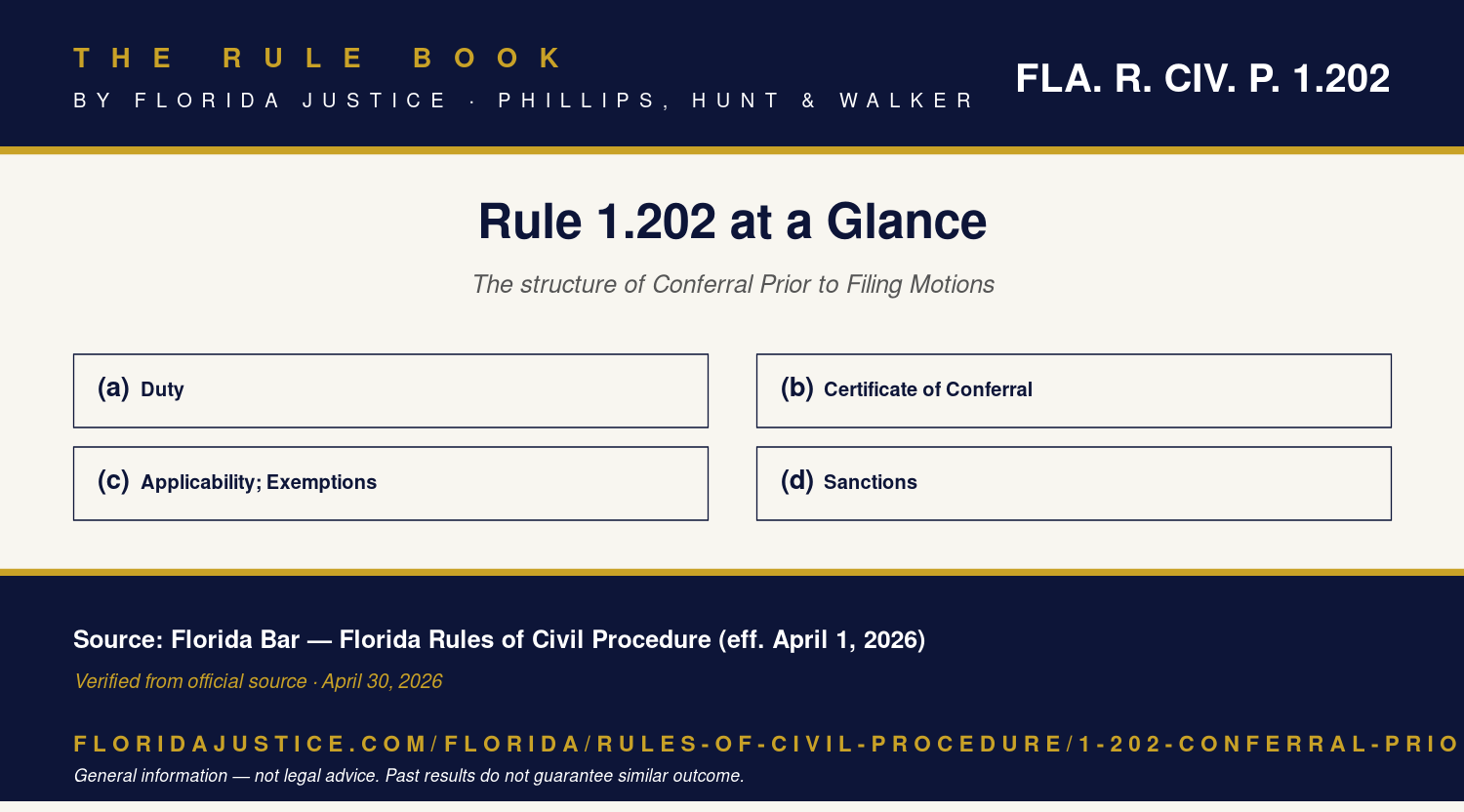
Infographic — Rule 1.202 at a Glance

Florida Rule 1.202 infographic

Lawyer-to-Lawyer Co-Counsel Referrals

If you’re a lawyer with a Florida case outside your normal practice — complex civil, catastrophic injury, federal court litigation, multi-state coordination — co-counsel referrals are a core part of what we do. You keep the client. We take the trial-side work. Fee split per Fla. Bar Rule 4-1.5 with full client consent.

Call John directly: (904) 444-4444
This page summarizes a Florida Rule of Civil Procedure for educational purposes. The rule text and Committee Notes are mirrored from the Florida Bar’s official publication and are public domain. The plain-English summary is the opinion of Phillips, Hunt & Walker and is general information only — not legal advice. Reading this page does not create an attorney-client relationship. Past results do not guarantee a similar outcome in your case.

X