

Fla. R. Civ. P. 1.180 — Third-party Practice
Last verified from official source: April 30, 2026 · Source: Florida Bar — Florida Rules of Civil Procedure (eff. April 1, 2026), p. 46
Rule Text (verbatim)
(a) When Available. At any time after commencement of the action a defendant may have a summons and complaint served on a person not a party to the action who is or may be liable to the defendant for all or part of the plaintiff’s claim against the defendant, and may also assert any other claim that arises out of the transaction or occurrence that is the subject matter of the plaintiff’s claim. The defendant need not obtain leave of court if the defendant files the third-party complaint not later than 20 days after the defendant serves the original answer. Otherwise, the defendant must obtain leave on motion and notice to all parties to the action. The person served with the summons and third-party complaint, herein called the third-party defendant, shall make defenses to the defendant’s claim as provided in rules 1.110 and 1.140 and counterclaims against the defendant and crossclaims against other third-party defendants as provided in rule 1.170. The third-party defendant may assert against the plaintiff any defenses that the defendant has to the plaintiff’s claim. The third-party defendant may also assert any claim against the plaintiff arising out of the transaction or occurrence that is the subject matter of the
April 1, 2026 Florida Rules of Civil Procedure 46 plaintiff’s claim against the defendant. The plaintiff may assert any claim against the third-party defendant arising out of the transaction or occurrence that is the subject matter of the plaintiff’s claim against the defendant, and the third-party defendant thereupon shall assert a defense as provided in rules 1.110 and 1.140 and counterclaims and crossclaims as provided in rule 1.170. Any party may move to strike the third-party claim or for its severance or separate trial. A third-party defendant may proceed under this rule against any person not a party to the action who is or may be liable to the third-party defendant for all or part of the claim made in the action against the third-party defendant.
(b) When Plaintiff May Bring in Third Party. When a counterclaim is asserted against the plaintiff, the plaintiff may bring in a third party under circumstances which would entitle a defendant to do so under this rule.
Court Commentary
1984 Amendment. Subdivision (a) is amended to permit the defendant to have the same right to assert claims arising out of the transaction or occurrence that all of the other parties to the action have. It overrules the decisions in Miramar Construction, Inc. v. El Conquistador Condominium, 303 So. 2d 81 (Fla. 3d DCA 1974), and Richard’s Paint Mfg. Co. v. Onyx Paints, Inc., 363 So. 2d 596 (Fla. 4th DCA 1978), to that extent. The term defendant is used throughout instead of third-party plaintiff for clarity and brevity reasons and refers to the defendant serving the summons and third-party complaint on a third-party defendant or, when applicable, to the similar summons and fourth party.
Plain-English Breakdown
Practitioner notes by John M. Phillips, Board Certified Civil Trial Lawyer — coming soon. Watch the video below for the plain-English breakdown.
Rule Text (Verbatim)
The text below is mirrored verbatim from the Florida Bar’s official publication. Public domain.
(a) When Available. At any time after commencement of the action a defendant may have a summons and complaint served on a person not a party to the action who is or may be liable to the defendant for all or part of the plaintiff’s claim against the defendant, and may also assert any other claim that arises out of the transaction or occurrence that is the subject matter of the plaintiff’s claim. The defendant need not obtain leave of court if the defendant files the third-party complaint not later than 20 days after the defendant serves the original answer. Otherwise, the defendant must obtain leave on motion and notice to all parties to the action. The person served with the summons and third-party complaint, herein called the third-party defendant, shall make defenses to the defendant’s claim as provided in rules 1.110 and 1.140 and counterclaims against the defendant and crossclaims against other third-party defendants as provided in rule 1.170. The third-party defendant may assert against the plaintiff any defenses that the defendant has to the plaintiff’s claim. The third-party defendant may also assert any claim against the plaintiff arising out of the transaction or occurrence that is the subject matter of the
plaintiff’s claim against the defendant. The plaintiff may assert any claim against the third-party defendant arising out of the transaction or occurrence that is the subject matter of the plaintiff’s claim against the defendant, and the third-party defendant thereupon shall assert a defense as provided in rules 1.110 and 1.140 and counterclaims and crossclaims as provided in rule 1.170. Any party may move to strike the third-party claim or for its severance or separate trial. A third-party defendant may proceed under this rule against any person not a party to the action who is or may be liable to the third-party defendant for all or part of the claim made in the action against the third-party defendant. (b) When Plaintiff May Bring in Third Party. When a counterclaim is asserted against the plaintiff, the plaintiff may bring in a third party under circumstances which would entitle a defendant to do so under this rule. Court Commentary 1984 Amendment. Subdivision (a) is amended to permit the defendant to have the same right to assert claims arising out of the transaction or occurrence that all of the other parties to the action have. It overrules the decisions in Miramar Construction, Inc. v. El Conquistador Condominium, 303 So. 2d 81 (Fla. 3d DCA 1974), and Richard’s Paint Mfg. Co. v. Onyx Paints, Inc., 363 So. 2d 596 (Fla. 4th DCA 1978), to that extent. The term defendant is used throughout instead of third-party plaintiff for clarity and brevity reasons and refers to the defendant serving the summons and third-party complaint on a third-party defendant or, when applicable, to the similar summons and fourth party.
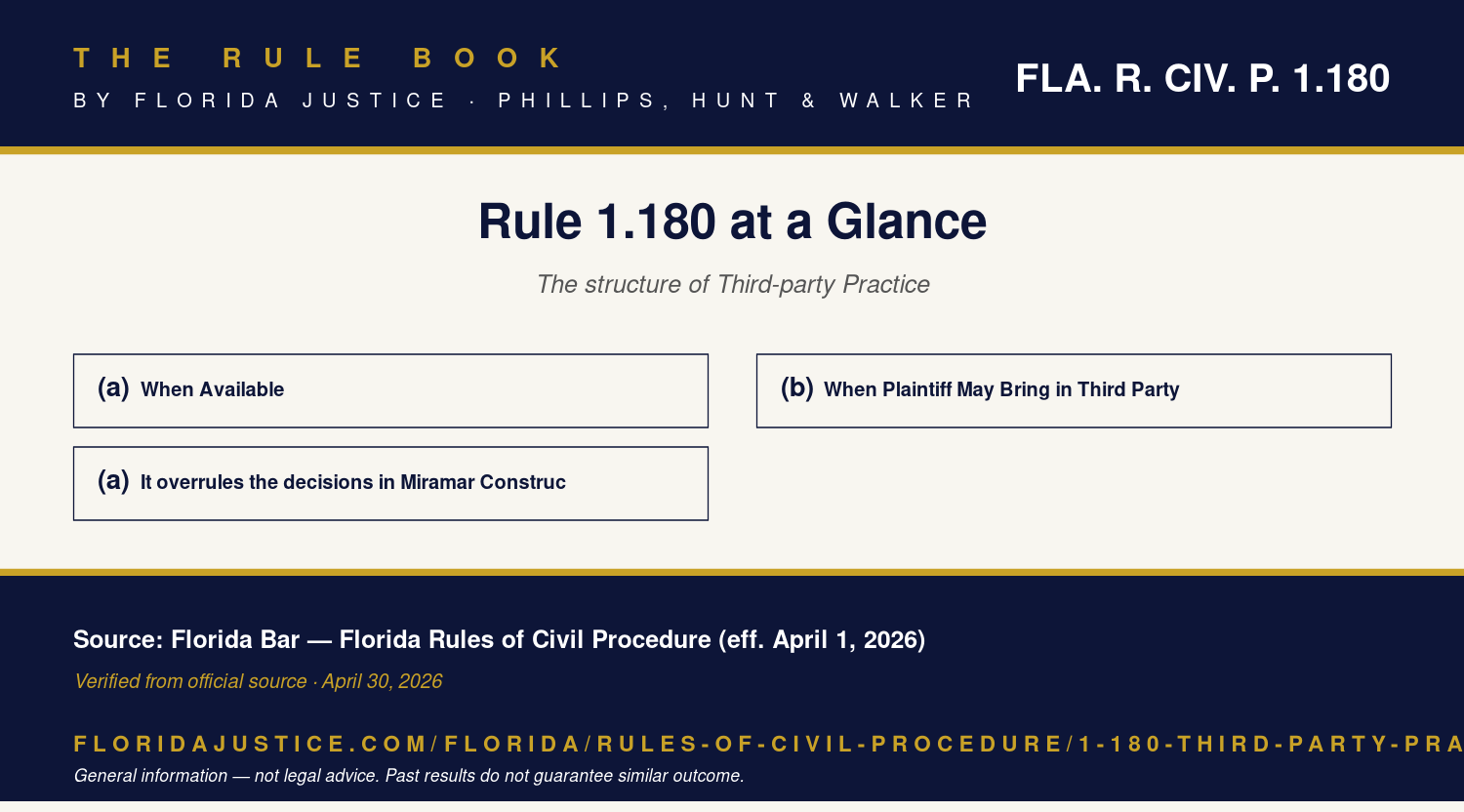
Infographic — Rule 1.180 at a Glance
Committee Notes
View Committee Notes (legislative history)
No Committee Notes for this rule version.
Lawyer-to-Lawyer Co-Counsel Referrals
If you’re a lawyer with a Florida case outside your normal practice — complex civil, catastrophic injury, federal court litigation, multi-state coordination — co-counsel referrals are a core part of what we do. You keep the client. We take the trial-side work. Fee split per Fla. Bar Rule 4-1.5 with full client consent.
Call John directly: (904) 444-4444
This page summarizes a Florida Rule of Civil Procedure for educational purposes. The rule text and Committee Notes are mirrored from the Florida Bar’s official publication and are public domain. The plain-English summary is the opinion of Phillips, Hunt & Walker and is general information only — not legal advice. Reading this page does not create an attorney-client relationship. Past results do not guarantee a similar outcome in your case.
Rule Text (verbatim from the Florida Supreme Court)
(a) When Available. At any time after commencement of the action a defendant may have a summons and complaint served on a person not a party to the action who is or may be liable to the defendant for all or part of the plaintiff’s claim against the defendant, and may also assert any other claim that arises out of the transaction or occurrence that is the subject matter of the plaintiff’s claim. The defendant need not obtain leave of court if the defendant files the third-party complaint not later than 20 days after the defendant serves the original answer. Otherwise, the defendant must obtain leave on motion and notice to all parties to the action. The person served with the summons and third-party complaint, herein called the third-party defendant, shall make defenses to the defendant’s claim as provided in rules 1.110 and 1.140 and counterclaims against the defendant and crossclaims against other third-party defendants as provided in rule 1.170. The third-party defendant may assert against the plaintiff any defenses that the defendant has to the plaintiff’s claim. The third-party defendant may also assert any claim against the plaintiff arising out of the transaction or occurrence that is the subject matter of the
plaintiff’s claim against the defendant. The plaintiff may assert any claim against the third-party defendant arising out of the transaction or occurrence that is the subject matter of the plaintiff’s claim against the defendant, and the third-party defendant thereupon shall assert a defense as provided in rules 1.110 and 1.140 and counterclaims and crossclaims as provided in rule 1.170. Any party may move to strike the third-party claim or for its severance or separate trial. A third-party defendant may proceed under this rule against any person not a party to the action who is or may be liable to the third-party defendant for all or part of the claim made in the action against the third-party defendant. (b) When Plaintiff May Bring in Third Party. When a counterclaim is asserted against the plaintiff, the plaintiff may bring in a third party under circumstances which would entitle a defendant to do so under this rule. Court Commentary 1984 Amendment. Subdivision (a) is amended to permit the defendant to have the same right to assert claims arising out of the transaction or occurrence that all of the other parties to the action have. It overrules the decisions in Miramar Construction, Inc. v. El Conquistador Condominium, 303 So. 2d 81 (Fla. 3d DCA 1974), and Richard’s Paint Mfg. Co. v. Onyx Paints, Inc., 363 So. 2d 596 (Fla. 4th DCA 1978), to that extent. The term defendant is used throughout instead of third-party plaintiff for clarity and brevity reasons and refers to the defendant serving the summons and third-party complaint on a third-party defendant or, when applicable, to the similar summons and fourth party.
Educational reference. This page summarizes a Florida Rule of Civil Procedure for educational purposes. The rule text and Committee Notes are mirrored from the Florida Bar's official publication and are public domain. The plain-English summary is the opinion of Phillips, Hunt & Walker and is general information only — not legal advice. Reading this page does not create an attorney-client relationship. Past results do not guarantee a similar outcome in your case.
What this rule means in plain English
Florida Rule of Civil Procedure 1.180 — Third-party Practice — sets out the procedural requirements for this aspect of Florida civil practice. (a) When Available. At any time after commencement of the action a defendant may have a summons and complaint served on a person not a party to the action who is or may be liable to the defendant for all or part of the plaintiff’s claim against the defendant, and may also assert any other claim that…