



Fla. R. Civ. P. 1.610 — Injunctions
Last verified from official source: April 30, 2026 · Source: Florida Bar — Florida Rules of Civil Procedure (eff. April 1, 2026), p. 183
Rule Text (verbatim)
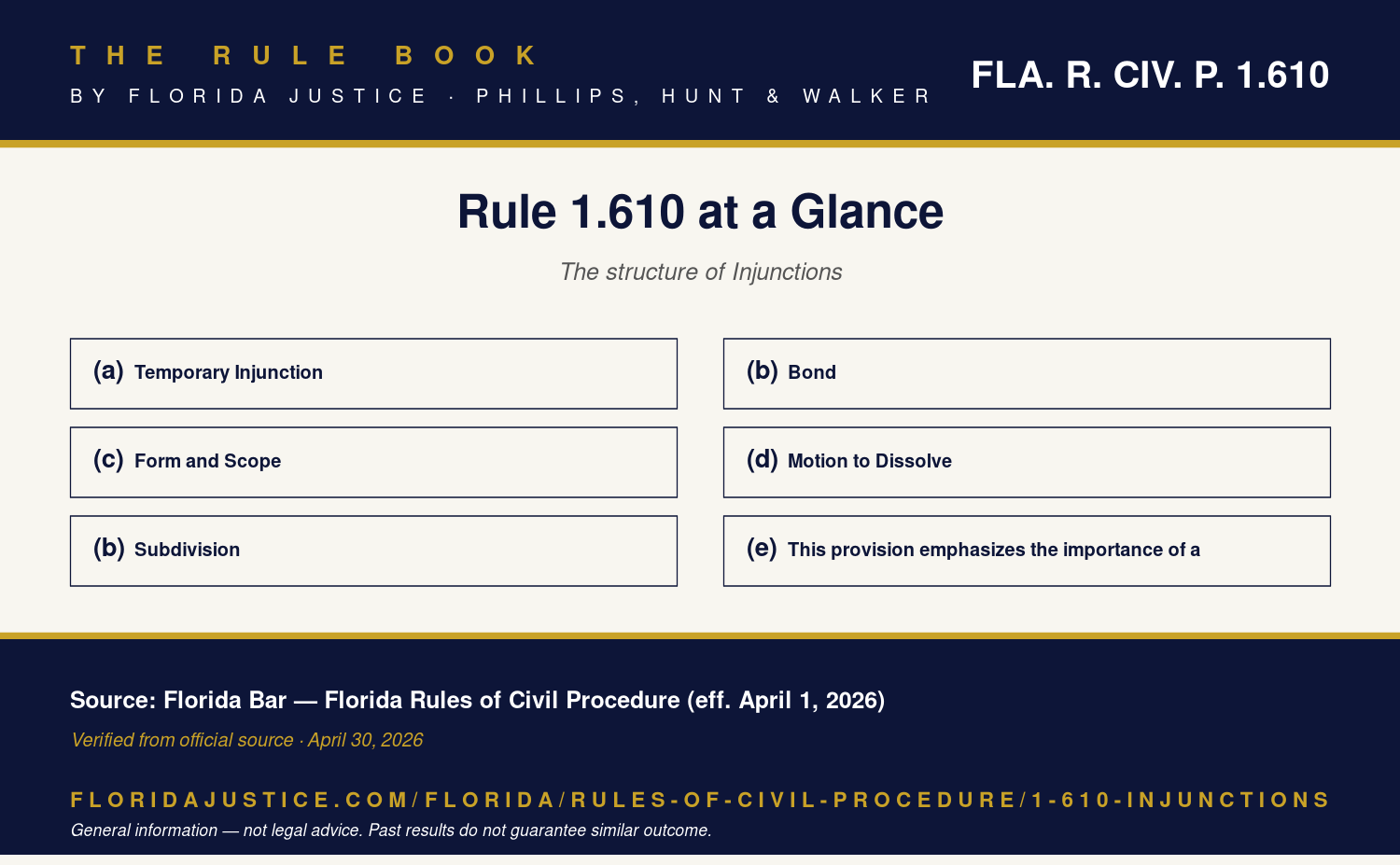
(a) Temporary Injunction.
(1) A temporary injunction may be granted without written or oral notice to the adverse party only if:
(A) it appears from the specific facts shown by affidavit or verified pleading that immediate and irreparable injury, loss, or damage will result to the movant before the adverse party can be heard in opposition; and
April 1, 2026 Florida Rules of Civil Procedure 183 (B) the movant’s attorney certifies in writing any efforts that have been made to give notice and the reasons why notice should not be required.
(2) No evidence other than the affidavit or verified pleading shall be used to support the application for a temporary injunction unless the adverse party appears at the hearing or has received reasonable notice of the hearing. Every temporary injunction granted without notice shall be endorsed with the date and hour of entry and shall be filed forthwith in the clerk’s office and shall define the injury, state findings by the court why the injury may be irreparable, and give the reasons why the order was granted without notice if notice was not given. The temporary injunction shall remain in effect until the further order of the court.
(b) Bond. No temporary injunction shall be entered unless a bond is given by the movant in an amount the court deems proper, conditioned for the payment of costs and damages sustained by the adverse party if the adverse party is wrongfully enjoined. Unless otherwise specified by the court, the bond shall be posted within 5 days of entry of the order setting the bond. When any injunction is issued on the pleading of a municipality or the state or any officer, agency, or political subdivision thereof, the court may require or dispense with a bond, with or without surety, and conditioned in the same manner, having due regard for the public interest. No bond shall be required for issuance of a temporary injunction issued solely to prevent physical injury or abuse of a natural person.
(c) Form and Scope. Every injunction shall specify the reasons for entry, shall describe in reasonable detail the act or acts restrained without reference to a pleading or another document, and shall be binding on the parties to the action, their officers, agents, servants, employees, and attorneys and on those persons in active concert or participation with them who receive actual notice of the injunction.
(d) Motion to Dissolve. A party against whom a temporary injunction has been granted may move to dissolve or modify it at any time. If a party moves to dissolve or modify, the motion shall be
April 1, 2026 Florida Rules of Civil Procedure 184 heard within 5 days after the movant applies for a hearing on the motion.
Committee Notes
1980 Amendment. This rule has been extensively amended so that it is similar to Federal Rule of Civil Procedure 65. The requirement that an injunction not be issued until a complaint was filed has been deleted as unnecessary. A pleading seeking an injunction or temporary restraining order must still be filed before either can be entered. The rule now provides for a temporary restraining order without notice that will expire automatically unless a hearing on a preliminary injunction is held and a preliminary injunction granted. The contents of an injunctive order are specified. The binding effect of an injunctive order is specified, but does not change existing law. Motions to dissolve may be made and heard at any time. The trial on the merits can be consolidated with a hearing on issuance of a preliminary injunction, and the trial can be advanced to accommodate this.
Court Commentary
1984 Amendment. Considerable dissatisfaction arose on the adoption of the 1980 rule, particularly because of the creation of the temporary restraining order with its inflexible time limits. See Sun Tech Inc. of South Florida v. Fortune Personnel Agency of Fort Lauderdale, 412 So. 2d 962 (Fla. 4th DCA 1982). The attempt to balance the rights of the parties in 1980 failed because of court congestion and the inability in the existing circumstances to accommodate the inflexible time limits. These changes will restore injunction procedure to substantially the same as that existing before the 1980 change. The temporary restraining order terminology and procedure is abolished. The former procedure of temporary and permanent injunctions is restored. The requirement of findings and reasons and other details in an injunctive order are retained.
Subdivision (b) eliminates the need for a bond on a temporary injunction issued to prevent physical injury or abuse of a natural person.
April 1, 2026 Florida Rules of Civil Procedure 185 Subdivision (e) institutes a requirement that a motion to dissolve an injunction shall be heard within 5 days after the movant applies for it. This provision emphasizes the importance of a prompt determination of the propriety of injunctive relief granted without notice or, if the circumstances have changed since the issuance of the injunctive order, the need for speedy relief as a result of the changes. Former subdivisions (a), (b)(3), and (b)(4) have been repealed because the new procedure makes them superfluous. The right of the court to consolidate the hearing on a temporary injunction with the trial of the action is not affected because that can still be accomplished under rule 1.270(a).
Plain-English Breakdown
Practitioner notes by John M. Phillips, Board Certified Civil Trial Lawyer — coming soon. Watch the video below for the plain-English breakdown.
Committee Notes
View Committee Notes (legislative history)
1980 Amendment. This rule has been extensively amended so that it is similar to Federal Rule of Civil Procedure 65. The requirement that an injunction not be issued until a complaint was filed has been deleted as unnecessary. A pleading seeking an injunction or temporary restraining order must still be filed before either can be entered. The rule now provides for a temporary restraining order without notice that will expire automatically unless a hearing on a preliminary injunction is held and a preliminary injunction granted. The contents of an injunctive order are specified. The binding effect of an injunctive order is specified, but does not change existing law. Motions to dissolve may be made and heard at any time. The trial on the merits can be consolidated with a hearing on issuance of a preliminary injunction, and the trial can be advanced to accommodate this. Court Commentary 1984 Amendment. Considerable dissatisfaction arose on the adoption of the 1980 rule, particularly because of the creation of the temporary restraining order with its inflexible time limits. See Sun Tech Inc. of South Florida v. Fortune Personnel Agency of Fort Lauderdale, 412 So. 2d 962 (Fla. 4th DCA 1982). The attempt to balance the rights of the parties in 1980 failed because of court congestion and the inability in the existing circumstances to accommodate the inflexible time limits. These changes will restore injunction procedure to substantially the same as that existing before the 1980 change. The temporary restraining order terminology and procedure is abolished. The former procedure of temporary and permanent injunctions is restored. The requirement of findings and reasons and other details in an injunctive order are retained. Subdivision (b) eliminates the need for a bond on a temporary injunction issued to prevent physical injury or abuse of a natural person.
Subdivision (e) institutes a requirement that a motion to dissolve an injunction shall be heard within 5 days after the movant applies for it. This provision emphasizes the importance of a prompt determination of the propriety of injunctive relief granted without notice or, if the circumstances have changed since the issuance of the injunctive order, the need for speedy relief as a result of the changes. Former subdivisions (a), (b)(3), and (b)(4) have been repealed because the new procedure makes them superfluous. The right of the court to consolidate the hearing on a temporary injunction with the trial of the action is not affected because that can still be accomplished under rule 1.270(a).
Lawyer-to-Lawyer Co-Counsel Referrals
If you’re a lawyer with a Florida case outside your normal practice — complex civil, catastrophic injury, federal court litigation, multi-state coordination — co-counsel referrals are a core part of what we do. You keep the client. We take the trial-side work. Fee split per Fla. Bar Rule 4-1.5 with full client consent.
Call John directly: (904) 444-4444
Committee Notes (verbatim)
1980 Amendment. This rule has been extensively amended so that it is similar to Federal Rule of Civil Procedure 65. The requirement that an injunction not be issued until a complaint was filed has been deleted as unnecessary. A pleading seeking an injunction or temporary restraining order must still be filed before either can be entered. The rule now provides for a temporary restraining order without notice that will expire automatically unless a hearing on a preliminary injunction is held and a preliminary injunction granted. The contents of an injunctive order are specified. The binding effect of an injunctive order is specified, but does not change existing law. Motions to dissolve may be made and heard at any time. The trial on the merits can be consolidated with a hearing on issuance of a preliminary injunction, and the trial can be advanced to accommodate this. Court Commentary 1984 Amendment. Considerable dissatisfaction arose on the adoption of the 1980 rule, particularly because of the creation of the temporary restraining order with its inflexible time limits. See Sun Tech Inc. of South Florida v. Fortune Personnel Agency of Fort Lauderdale, 412 So. 2d 962 (Fla. 4th DCA 1982). The attempt to balance the rights of the parties in 1980 failed because of court congestion and the inability in the existing circumstances to accommodate the inflexible time limits. These changes will restore injunction procedure to substantially the same as that existing before the 1980 change. The temporary restraining order terminology and procedure is abolished. The former procedure of temporary and permanent injunctions is restored. The requirement of findings and reasons and other details in an injunctive order are retained. Subdivision (b) eliminates the need for a bond on a temporary injunction issued to prevent physical injury or abuse of a natural person.
Subdivision (e) institutes a requirement that a motion to dissolve an injunction shall be heard within 5 days after the movant applies for it. This provision emphasizes the importance of a prompt determination of the propriety of injunctive relief granted without notice or, if the circumstances have changed since the issuance of the injunctive order, the need for speedy relief as a result of the changes. Former subdivisions (a), (b)(3), and (b)(4) have been repealed because the new procedure makes them superfluous. The right of the court to consolidate the hearing on a temporary injunction with the trial of the action is not affected because that can still be accomplished under rule 1.270(a).