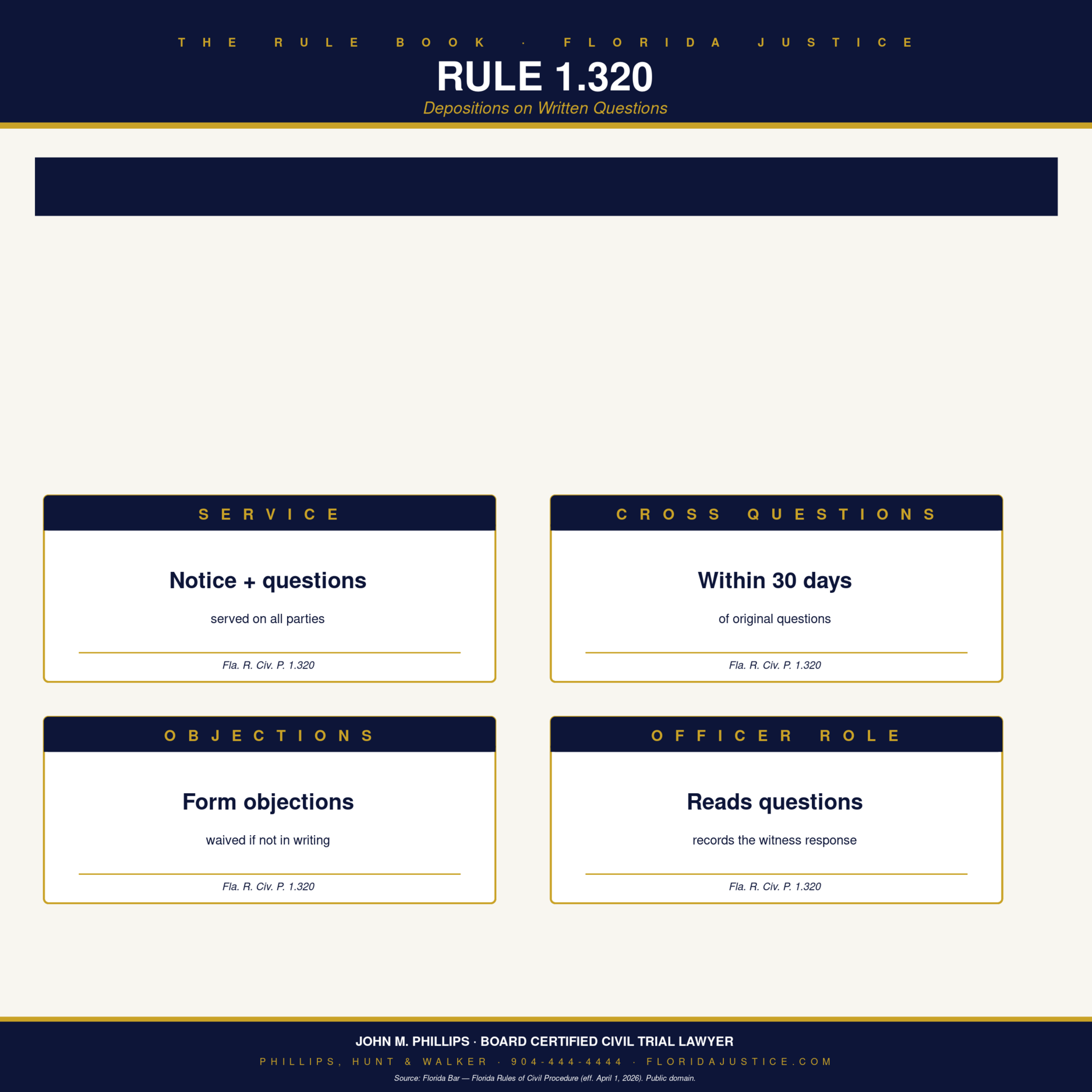


Florida Rule 1.320 governs depositions upon written questions — the cheaper, written-only alternative to oral depositions for discovery from witnesses you do not need to cross-examine live.
▶ Watch: Rule 1.320 — Depositions Upon Written Questions

Fla. R. Civ. P. 1.320 — Depositions Upon Written Questions
Last verified from official source: April 30, 2026 · Source: Florida Bar — Florida Rules of Civil Procedure (eff. April 1, 2026), p. 103
Rule Text (Verbatim)
The text below is mirrored verbatim from the Florida Bar’s official publication, with FRCP’s hierarchical indentation preserved. Public domain.
(a) Serving Questions; Notice. After commencement of the action any party may take the testimony of any person, including a party, by deposition upon written questions. The attendance of witnesses may be compelled by the use of subpoena as provided in rule 1.410. The deposition of a person confined in prison may be taken only by leave of court on such terms as the court prescribes. A party desiring to take a deposition upon written questions must serve them with a notice stating
(1) the name and address of the person who is to answer them, if known, and, if the name is not known, a general description sufficient to identify the person or the particular class or group to which that person belongs, and
(2) the name or descriptive title and address of the officer before whom the deposition is to be taken. A deposition upon written questions may be taken of a public or private corporation, a partnership or association, or a governmental agency in accordance with rule 1.310
(b)
(6). Within 30 days after the notice and written questions are served, a party may serve cross questions on all other parties. Within 10 days after being served with redirect questions, a party may serve recross questions on all other parties. Notwithstanding any contrary provision of rule 1.310
(c), objections to the form of written questions are waived unless served in writing on the party propounding them within the time allowed for serving the succeeding cross or other questions and within 10 days after service of the last questions authorized. The court may for cause shown enlarge or shorten the time.
(b) Officer to Take Responses and Prepare Record. A copy of the notice and copies of all questions served must be delivered by the party taking the depositions to the officer designated in the notice, who must proceed promptly to take the testimony of the witness in the manner provided by rules 1.310
(c),
(e), and
(f) in response to the questions and to prepare the deposition, attaching the copy of the notice and the questions received by the officer. The questions must not be filed separately from the deposition unless a party seeks to have the court consider the questions before the questions are submitted to the witness. Any deposition may be audiovisually recorded without leave of the court or stipulation of the parties, provided the deposition is taken in accordance with rule 1.310
(b)
(4). Committee Notes 1972 Amendment. Derived from Federal Rule of Civil Procedure 31 as amended in 1970. The name of interrogatories has been changed to questions to avoid confusion with interrogatories to parties under rule 1.340. Language changes resulting from the rearrangement of the discovery rules have been inserted and subdivision
(d) deleted.
Bar-Compliant Disclaimer
This page summarizes a Florida Rule of Civil Procedure for educational purposes. The rule text is mirrored from the Florida Bar’s official publication and is public domain. Any commentary on this page is the opinion of Phillips, Hunt & Walker and is general information only — not legal advice. Reading this page does not create an attorney-client relationship.
Infographic