



Fla. R. Civ. P. 1.442 — Proposals for Settlement
Last verified from official source: April 30, 2026 · Source: Florida Bar — Florida Rules of Civil Procedure (eff. April 1, 2026), p. 149
Rule Text (verbatim)
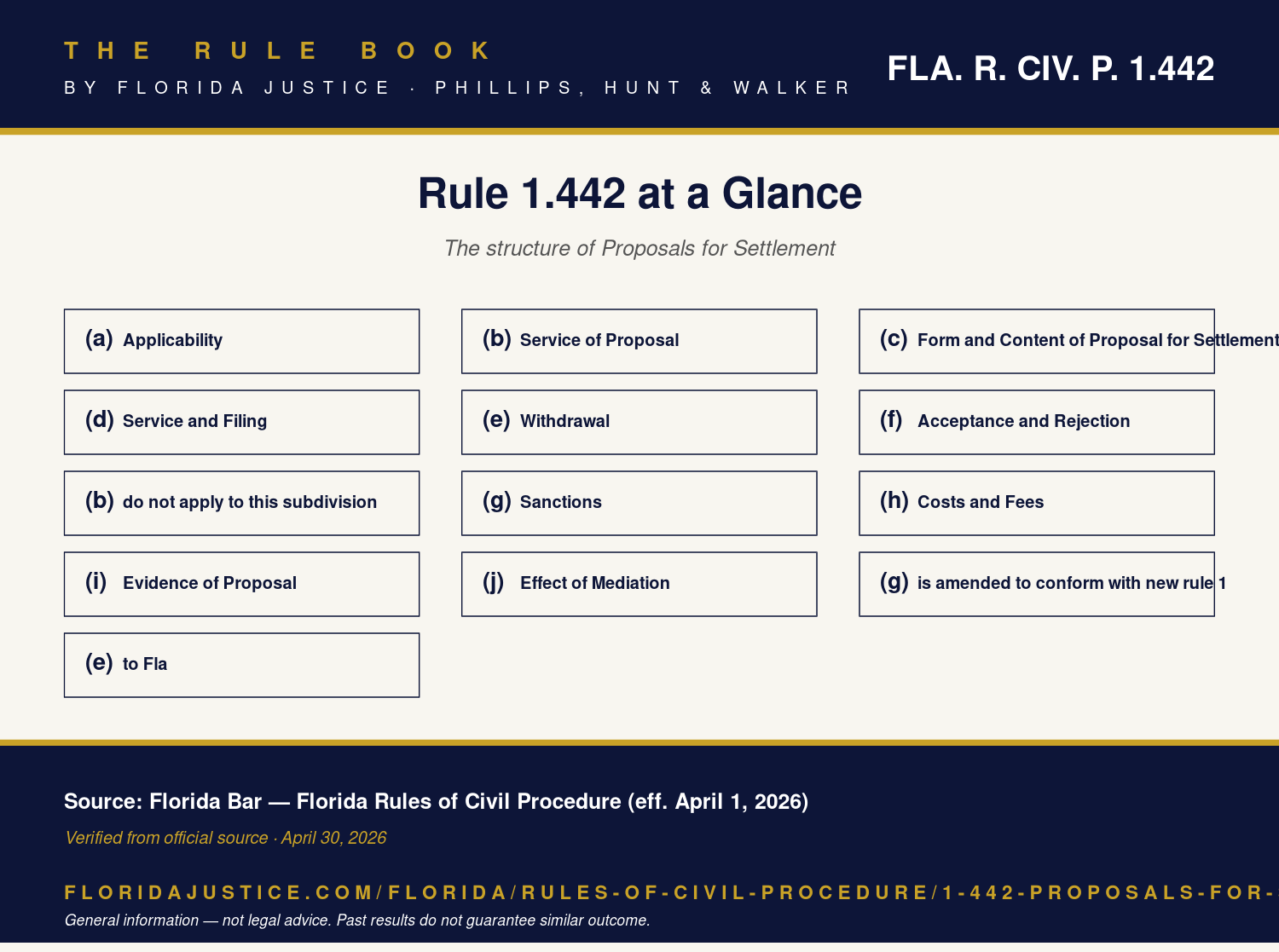
(a) Applicability. This rule applies to all proposals for settlement authorized by Florida law, regardless of the terms used to refer to such offers, demands, or proposals, and supersedes all other provisions of the rules and statutes that may be inconsistent with this rule.
(b) Service of Proposal. A proposal to a defendant may be served no earlier than 90 days after service of process on that defendant; a proposal to a plaintiff may be served no earlier than 90 days after the action has been commenced. No proposal may be served later than 45 days before the date set for trial or the first day of the docket on which the case is set for trial, whichever is earlier.
(c) Form and Content of Proposal for Settlement.
(1) A proposal must be in writing and must identify the applicable Florida law under which it is being made.
(2) A proposal must:
(A) name the party or parties making the proposal and the party or parties to whom the proposal is being made;
April 1, 2026 Florida Rules of Civil Procedure 149 (B) state that the proposal resolves all damages that would otherwise be awarded in a final judgment in the action in which the proposal is served, subject to subdivision (c)(2)(F);
(C) exclude nonmonetary terms, with the exceptions of a voluntary dismissal of all claims with prejudice and any other nonmonetary terms permitted by statute;
(D) state the total amount of the proposal;
(E) state with particularity the amount proposed to settle a claim for punitive damages, if any;
(F) state whether the proposal includes attorneys’ fees and whether attorneys’ fees are part of the legal claim; and
(G) include a certificate of service in the form required by Florida Rule of General Practice and Judicial Administration 2.516.
(3) A proposal may be made by or to any party or parties and by or to any combination of parties properly identified in the proposal. A joint proposal must state the amount and terms attributable to each party.
(4) Notwithstanding subdivision (c)(3), when a party is alleged to be solely vicariously, constructively, derivatively, or technically liable, whether by operation of law or by contract, a joint proposal made by or served on such a party need not state the apportionment or contribution as to that party. Acceptance by any party is without prejudice to rights of contribution or indemnity.
(d) Service and Filing. A proposal must be served on the party or parties to whom it is made but must not be filed unless necessary to enforce the provisions of this rule.
(e) Withdrawal. A proposal may be withdrawn in writing provided the written withdrawal is delivered before a written acceptance is delivered. Once withdrawn, a proposal is void.
April 1, 2026 Florida Rules of Civil Procedure 150 (f) Acceptance and Rejection.
(1) A proposal is deemed rejected unless accepted by delivery of a written notice of acceptance within 30 days after service of the proposal. The provisions of Florida Rule of General Practice and Judicial Administration 2.514(b) do not apply to this subdivision. Oral communications will not be considered an acceptance, rejection, or counteroffer under the provisions of this rule.
(2) In any case in which the existence of a class is alleged, the time for acceptance of a proposal for settlement is extended to 30 days after the date the order granting or denying certification is filed.
(g) Sanctions. Any party seeking sanctions under applicable Florida law, based on the failure of the proposal’s recipient to accept a proposal, must do so by serving a motion in accordance with rule 1.525.
(h) Costs and Fees.
(1) If a party is entitled to costs and fees under applicable Florida law, the court may, in its discretion, determine that a proposal was not made in good faith. In such case, the court may disallow an award of costs and attorneys’ fees.
(2) When determining the reasonableness of the amount of an award of attorneys’ fees under this subdivision, the court must consider, along with all other relevant criteria, the following factors:
(A) the then-apparent merit or lack of merit in the claim;
(B) the number and nature of proposals made by the parties;
(C) the closeness of questions of fact and law at issue;
April 1, 2026 Florida Rules of Civil Procedure 151 (D) whether the party making the proposal had unreasonably refused to furnish information necessary to evaluate the reasonableness of the proposal;
(E) whether the suit was in the nature of a test case presenting questions of far-reaching importance affecting nonparties; and
(F) the amount of the additional delay cost and expense that the party making the proposal reasonably would be expected to incur if the litigation were to be prolonged.
(i) Evidence of Proposal. Evidence of a proposal or acceptance of a proposal is admissible only in proceedings to enforce an accepted proposal or to determine the imposition of sanctions.
(j) Effect of Mediation. Mediation has no effect on the dates during which parties are permitted to make or accept a proposal for settlement under the terms of the rule.
Committee Notes
1996 Amendment. This rule was amended to reconcile, where possible, sections 44.102(6) (formerly 44.102(5)(b)), 45.061, 73.032, and 768.79, Florida Statutes, and the decisions of the Florida Supreme Court in Knealing v. Puleo, 675 So. 2d 593 (Fla. 1996), TGI Friday’s, Inc. v. Dvorak, 663 So. 2d 606 (Fla. 1995), and Timmons v. Combs, 608 So. 2d 1 (Fla. 1992). This rule replaces former rule 1.442, which was repealed by the Timmons decision, and supersedes those sections of the Florida Statutes and the prior decisions of the court, where reconciliation is impossible, in order to provide a workable structure for proposing settlements in civil actions. The provision which requires that a joint proposal state the amount and terms attributable to each party is in order to conform with Fabre v. Marin, 623 So. 2d 1182 (Fla. 1993).
2000 Amendment. Subdivision (f)(2) was added to establish the time for acceptance of proposals for settlement in class actions.
April 1, 2026 Florida Rules of Civil Procedure 152 “Filing” is defined in rule 1.080(e). Subdivision (g) is amended to conform with new rule 1.525.
2012 Amendment. Subdivision (c)(2)(G) is amended to reflect the relocation of the service rule from rule 1.080 to Fla. R. Jud. Admin. 2.516.
2013 Amendment. Subdivision (f)(1) was amended to reflect the relocation of the rule regarding additional time after service by mail or e-mail from rule 1.090(e) to Fla. R. Jud. Admin. 2.514(b).
2013 Amendment. Subdivision (c)(2)(B) is amended to clarify that a proposal for settlement must resolve all claims between the proponent and the party to whom the proposal is made except claims for attorneys’ fees, which may or may not be resolved in the proposal.
Plain-English Breakdown
Practitioner notes by John M. Phillips, Board Certified Civil Trial Lawyer — coming soon. Watch the video below for the plain-English breakdown.
Rule Text (Verbatim)
The text below is mirrored verbatim from the Florida Bar’s official publication. Public domain.
(a) Applicability. This rule applies to all proposals for settlement authorized by Florida law, regardless of the terms used to refer to such offers, demands, or proposals, and supersedes all other provisions of the rules and statutes that may be inconsistent with this rule. (b) Service of Proposal. A proposal to a defendant may be served no earlier than 90 days after service of process on that defendant; a proposal to a plaintiff may be served no earlier than 90 days after the action has been commenced. No proposal may be served later than 45 days before the date set for trial or the first day of the docket on which the case is set for trial, whichever is earlier. (c) Form and Content of Proposal for Settlement. (1) A proposal must be in writing and must identify the applicable Florida law under which it is being made. (2) A proposal must: (A) name the party or parties making the proposal and the party or parties to whom the proposal is being made;
(B) state that the proposal resolves all damages that would otherwise be awarded in a final judgment in the action in which the proposal is served, subject to subdivision (c)(2)(F); (C) exclude nonmonetary terms, with the exceptions of a voluntary dismissal of all claims with prejudice and any other nonmonetary terms permitted by statute; (D) state the total amount of the proposal; (E) state with particularity the amount proposed to settle a claim for punitive damages, if any; (F) state whether the proposal includes attorneys’ fees and whether attorneys’ fees are part of the legal claim; and (G) include a certificate of service in the form required by Florida Rule of General Practice and Judicial Administration 2.516. (3) A proposal may be made by or to any party or parties and by or to any combination of parties properly identified in the proposal. A joint proposal must state the amount and terms attributable to each party. (4) Notwithstanding subdivision (c)(3), when a party is alleged to be solely vicariously, constructively, derivatively, or technically liable, whether by operation of law or by contract, a joint proposal made by or served on such a party need not state the apportionment or contribution as to that party. Acceptance by any party is without prejudice to rights of contribution or indemnity. (d) Service and Filing. A proposal must be served on the party or parties to whom it is made but must not be filed unless necessary to enforce the provisions of this rule. (e) Withdrawal. A proposal may be withdrawn in writing provided the written withdrawal is delivered before a written acceptance is delivered. Once withdrawn, a proposal is void.
(f) Acceptance and Rejection. (1) A proposal is deemed rejected unless accepted by delivery of a written notice of acceptance within 30 days after service of the proposal. The provisions of Florida Rule of General Practice and Judicial Administration 2.514(b) do not apply to this subdivision. Oral communications will not be considered an acceptance, rejection, or counteroffer under the provisions of this rule. (2) In any case in which the existence of a class is alleged, the time for acceptance of a proposal for settlement is extended to 30 days after the date the order granting or denying certification is filed. (g) Sanctions. Any party seeking sanctions under applicable Florida law, based on the failure of the proposal’s recipient to accept a proposal, must do so by serving a motion in accordance with rule 1.525. (h) Costs and Fees. (1) If a party is entitled to costs and fees under applicable Florida law, the court may, in its discretion, determine that a proposal was not made in good faith. In such case, the court may disallow an award of costs and attorneys’ fees. (2) When determining the reasonableness of the amount of an award of attorneys’ fees under this subdivision, the court must consider, along with all other relevant criteria, the following factors: (A) the then-apparent merit or lack of merit in the claim; (B) the number and nature of proposals made by the parties; (C) the closeness of questions of fact and law at issue;
(D) whether the party making the proposal had unreasonably refused to furnish information necessary to evaluate the reasonableness of the proposal; (E) whether the suit was in the nature of a test case presenting questions of far-reaching importance affecting nonparties; and (F) the amount of the additional delay cost and expense that the party making the proposal reasonably would be expected to incur if the litigation were to be prolonged. (i) Evidence of Proposal. Evidence of a proposal or acceptance of a proposal is admissible only in proceedings to enforce an accepted proposal or to determine the imposition of sanctions. (j) Effect of Mediation. Mediation has no effect on the dates during which parties are permitted to make or accept a proposal for settlement under the terms of the rule.
Part of The Rule Book — full FRCP playlist. Plain-English breakdown by John M. Phillips, Board Certified Civil Trial Lawyer.
Committee Notes (verbatim)
1996 Amendment. This rule was amended to reconcile, where possible, sections 44.102(6) (formerly 44.102(5)(b)), 45.061, 73.032, and 768.79, Florida Statutes, and the decisions of the Florida Supreme Court in Knealing v. Puleo, 675 So. 2d 593 (Fla. 1996), TGI Friday’s, Inc. v. Dvorak, 663 So. 2d 606 (Fla. 1995), and Timmons v. Combs, 608 So. 2d 1 (Fla. 1992). This rule replaces former rule 1.442, which was repealed by the Timmons decision, and supersedes those sections of the Florida Statutes and the prior decisions of the court, where reconciliation is impossible, in order to provide a workable structure for proposing settlements in civil actions. The provision which requires that a joint proposal state the amount and terms attributable to each party is in order to conform with Fabre v. Marin, 623 So. 2d 1182 (Fla. 1993). 2000 Amendment. Subdivision (f)(2) was added to establish the time for acceptance of proposals for settlement in class actions.
“Filing” is defined in rule 1.080(e). Subdivision (g) is amended to conform with new rule 1.525. 2012 Amendment. Subdivision (c)(2)(G) is amended to reflect the relocation of the service rule from rule 1.080 to Fla. R. Jud. Admin. 2.516. 2013 Amendment. Subdivision (f)(1) was amended to reflect the relocation of the rule regarding additional time after service by mail or e-mail from rule 1.090(e) to Fla. R. Jud. Admin. 2.514(b). 2013 Amendment. Subdivision (c)(2)(B) is amended to clarify that a proposal for settlement must resolve all claims between the proponent and the party to whom the proposal is made except claims for attorneys’ fees, which may or may not be resolved in the proposal.