

Skip to Main Content

Fla. R. Civ. P. 1.370 — Requests for Admission

Educational reference. This page summarizes a Florida Rule of Civil Procedure for educational purposes. The rule text and Committee Notes are mirrored from the Florida Bar's official publication and are public domain. The plain-English summary is the opinion of Phillips, Hunt & Walker and is general information only — not legal advice. Reading this page does not create an attorney-client relationship. Past results do not guarantee a similar outcome in your case.

What this rule means in plain English

Florida Rule of Civil Procedure 1.370 — Requests for Admission — sets out the procedural requirements for this aspect of Florida civil practice. (a) Request for Admission. (1) A party may serve on any other party a written request for the admission of the truth of any matters within the scope of rule 1.280(c) set forth in the request that relate to statements or opinions of fact or of the application of law to fact, including the genuineness of any documents described in the request.

Rule Text (verbatim from the Florida Supreme Court)

(a) Request for Admission. (1) A party may serve on any other party a written request for the admission of the truth of any matters within the scope of rule 1.280(c) set forth in the request that relate to statements or opinions of fact or of the application of law to fact, including the genuineness of any documents described in the request.

(2) Requests and responses must be served on all parties. Copies of documents must be served with the request unless they have been or are otherwise furnished or made available for inspection and copying. (3) Without leave of court the request may be served on the plaintiff after commencement of the action and on any other party with or after service of the process and initial pleading on that party. (4) The request for admission must not exceed 30 requests, including all subparts, unless the court permits a larger number on motion and notice and for good cause, or the parties propounding and responding to the requests stipulate to a larger number. (5) Each matter of which an admission is requested must be separately set forth. (6) The matter is admitted unless the party to whom the request is directed serves on the party requesting the admission a written answer or objection addressed to the matter within 30 days after service of the request or such shorter or longer time as the court may allow but, unless the court shortens the time, a defendant is not required to serve answers or objections before the expiration of 45 days after service of the process and initial pleading on the defendant. (7) If objection is made, the reasons must be stated. (8) The answer must specifically deny the matter or set forth in detail the reasons why the answering party cannot truthfully admit or deny the matter. (9) A denial must fairly meet the substance of the requested admission, and when good faith requires that a party qualify an answer or deny only a part of the matter of which an admission is requested, the party must specify so much of it as is true and qualify or deny the remainder.

(10) An answering party may not give lack of information or knowledge as a reason for failure to admit or deny unless that party states that that party has made reasonable inquiry and that the information known or readily obtainable by that party is insufficient to enable that party to admit or deny. (11) A party who considers that a matter of which an admission has been requested presents a genuine issue for trial may not object to the request on that ground alone; the party may deny the matter or set forth reasons why the party cannot admit or deny it, subject to rule 1.380(c). (12) The party who has requested the admissions may move to determine the sufficiency of the answers or objections. (13) Unless the court determines that an objection is justified, it will order that an answer be served. (14) If the court determines that an answer does not comply with the requirements of this rule, it may order either that the matter is admitted or that an amended answer be served. (15) Instead of these orders the court may determine that final disposition of the request be made at a pretrial conference or at a designated time before trial. (16) The provisions of rule 1.380(a)(4) apply to the award of expenses incurred in relation to the motion. (b) Effect of Admission. (1) Any matter admitted under this rule is conclusively established unless the court on motion permits withdrawal or amendment of the admission. (2) Subject to rule 1.200 governing amendment of a pretrial order, the court may permit withdrawal or amendment when the presentation of the merits of the action will be subserved by it and the party who obtained the admission fails to satisfy the

court that withdrawal or amendment will prejudice that party in maintaining an action or defense on the merits. (3) Any admission made by a party under this rule is for the purpose of the pending action only and is not an admission for any other purpose nor may it be used against that party in any other proceeding.

Committee Notes (verbatim)

1972 Amendment. Derived from Federal Rule of Civil Procedure 36 as amended in 1970. The rule is changed to eliminate distinctions between questions of opinion, fact, and mixed questions. The time sequences are changed in accordance with the other discovery rules, and case law is incorporated by providing for amendment and withdrawal of the answers and for judicial scrutiny to determine the sufficiency of the answers. 2003 Amendment. The total number of requests for admission that may be served without leave of court is limited to 30, including all subparts.

The Rule Book — Florida Rules of Civil Procedure, by Florida Justice / Phillips, Hunt & Walker

The Rule Book → Florida → Civil Procedure → 1.370

Fla. R. Civ. P. 1.370 — Requests for Admission

Last verified from official source: April 30, 2026 · Source: Florida Bar — Florida Rules of Civil Procedure (eff. April 1, 2026), p. 121

Rule Text (verbatim)

(a) Request for Admission.

(1) A party may serve on any other party a written request for the admission of the truth of any matters within the scope of rule 1.280(c) set forth in the request that relate to statements or opinions of fact or of the application of law to fact, including the genuineness of any documents described in the request.

April 1, 2026 Florida Rules of Civil Procedure 121 (2) Requests and responses must be served on all parties. Copies of documents must be served with the request unless they have been or are otherwise furnished or made available for inspection and copying.

(3) Without leave of court the request may be served on the plaintiff after commencement of the action and on any other party with or after service of the process and initial pleading on that party.

(4) The request for admission must not exceed 30 requests, including all subparts, unless the court permits a larger number on motion and notice and for good cause, or the parties propounding and responding to the requests stipulate to a larger number.

(5) Each matter of which an admission is requested must be separately set forth.

(6) The matter is admitted unless the party to whom the request is directed serves on the party requesting the admission a written answer or objection addressed to the matter within 30 days after service of the request or such shorter or longer time as the court may allow but, unless the court shortens the time, a defendant is not required to serve answers or objections before the expiration of 45 days after service of the process and initial pleading on the defendant.

(7) If objection is made, the reasons must be stated.

(8) The answer must specifically deny the matter or set forth in detail the reasons why the answering party cannot truthfully admit or deny the matter.

(9) A denial must fairly meet the substance of the requested admission, and when good faith requires that a party qualify an answer or deny only a part of the matter of which an admission is requested, the party must specify so much of it as is true and qualify or deny the remainder.

April 1, 2026 Florida Rules of Civil Procedure 122 (10) An answering party may not give lack of information or knowledge as a reason for failure to admit or deny unless that party states that that party has made reasonable inquiry and that the information known or readily obtainable by that party is insufficient to enable that party to admit or deny.

(11) A party who considers that a matter of which an admission has been requested presents a genuine issue for trial may not object to the request on that ground alone; the party may deny the matter or set forth reasons why the party cannot admit or deny it, subject to rule 1.380(c).

(12) The party who has requested the admissions may move to determine the sufficiency of the answers or objections.

(13) Unless the court determines that an objection is justified, it will order that an answer be served.

(14) If the court determines that an answer does not comply with the requirements of this rule, it may order either that the matter is admitted or that an amended answer be served.

(15) Instead of these orders the court may determine that final disposition of the request be made at a pretrial conference or at a designated time before trial.

(16) The provisions of rule 1.380(a)(4) apply to the award of expenses incurred in relation to the motion.

(b) Effect of Admission.

(1) Any matter admitted under this rule is conclusively established unless the court on motion permits withdrawal or amendment of the admission.

(2) Subject to rule 1.200 governing amendment of a pretrial order, the court may permit withdrawal or amendment when the presentation of the merits of the action will be subserved by it and the party who obtained the admission fails to satisfy the

April 1, 2026 Florida Rules of Civil Procedure 123 court that withdrawal or amendment will prejudice that party in maintaining an action or defense on the merits.

(3) Any admission made by a party under this rule is for the purpose of the pending action only and is not an admission for any other purpose nor may it be used against that party in any other proceeding.

Committee Notes

1972 Amendment. Derived from Federal Rule of Civil Procedure 36 as amended in 1970. The rule is changed to eliminate distinctions between questions of opinion, fact, and mixed questions. The time sequences are changed in accordance with the other discovery rules, and case law is incorporated by providing for amendment and withdrawal of the answers and for judicial scrutiny to determine the sufficiency of the answers.

2003 Amendment. The total number of requests for admission that may be served without leave of court is limited to 30, including all subparts.

Plain-English Breakdown

Practitioner notes by John M. Phillips, Board Certified Civil Trial Lawyer — coming soon. Watch the video below for the plain-English breakdown.

Rule Text (Verbatim)

The text below is mirrored verbatim from the Florida Bar’s official publication. Public domain.

(a) Request for Admission. (1) A party may serve on any other party a written request for the admission of the truth of any matters within the scope of rule 1.280(c) set forth in the request that relate to statements or opinions of fact or of the application of law to fact, including the genuineness of any documents described in the request.

(2) Requests and responses must be served on all parties. Copies of documents must be served with the request unless they have been or are otherwise furnished or made available for inspection and copying. (3) Without leave of court the request may be served on the plaintiff after commencement of the action and on any other party with or after service of the process and initial pleading on that party. (4) The request for admission must not exceed 30 requests, including all subparts, unless the court permits a larger number on motion and notice and for good cause, or the parties propounding and responding to the requests stipulate to a larger number. (5) Each matter of which an admission is requested must be separately set forth. (6) The matter is admitted unless the party to whom the request is directed serves on the party requesting the admission a written answer or objection addressed to the matter within 30 days after service of the request or such shorter or longer time as the court may allow but, unless the court shortens the time, a defendant is not required to serve answers or objections before the expiration of 45 days after service of the process and initial pleading on the defendant. (7) If objection is made, the reasons must be stated. (8) The answer must specifically deny the matter or set forth in detail the reasons why the answering party cannot truthfully admit or deny the matter. (9) A denial must fairly meet the substance of the requested admission, and when good faith requires that a party qualify an answer or deny only a part of the matter of which an admission is requested, the party must specify so much of it as is true and qualify or deny the remainder.

(10) An answering party may not give lack of information or knowledge as a reason for failure to admit or deny unless that party states that that party has made reasonable inquiry and that the information known or readily obtainable by that party is insufficient to enable that party to admit or deny. (11) A party who considers that a matter of which an admission has been requested presents a genuine issue for trial may not object to the request on that ground alone; the party may deny the matter or set forth reasons why the party cannot admit or deny it, subject to rule 1.380(c). (12) The party who has requested the admissions may move to determine the sufficiency of the answers or objections. (13) Unless the court determines that an objection is justified, it will order that an answer be served. (14) If the court determines that an answer does not comply with the requirements of this rule, it may order either that the matter is admitted or that an amended answer be served. (15) Instead of these orders the court may determine that final disposition of the request be made at a pretrial conference or at a designated time before trial. (16) The provisions of rule 1.380(a)(4) apply to the award of expenses incurred in relation to the motion. (b) Effect of Admission. (1) Any matter admitted under this rule is conclusively established unless the court on motion permits withdrawal or amendment of the admission. (2) Subject to rule 1.200 governing amendment of a pretrial order, the court may permit withdrawal or amendment when the presentation of the merits of the action will be subserved by it and the party who obtained the admission fails to satisfy the

court that withdrawal or amendment will prejudice that party in maintaining an action or defense on the merits. (3) Any admission made by a party under this rule is for the purpose of the pending action only and is not an admission for any other purpose nor may it be used against that party in any other proceeding.

▶ Watch: Rule 1.370 — Requests for Admission

Part of The Rule Book — full FRCP playlist. Plain-English breakdown by John M. Phillips, Board Certified Civil Trial Lawyer.

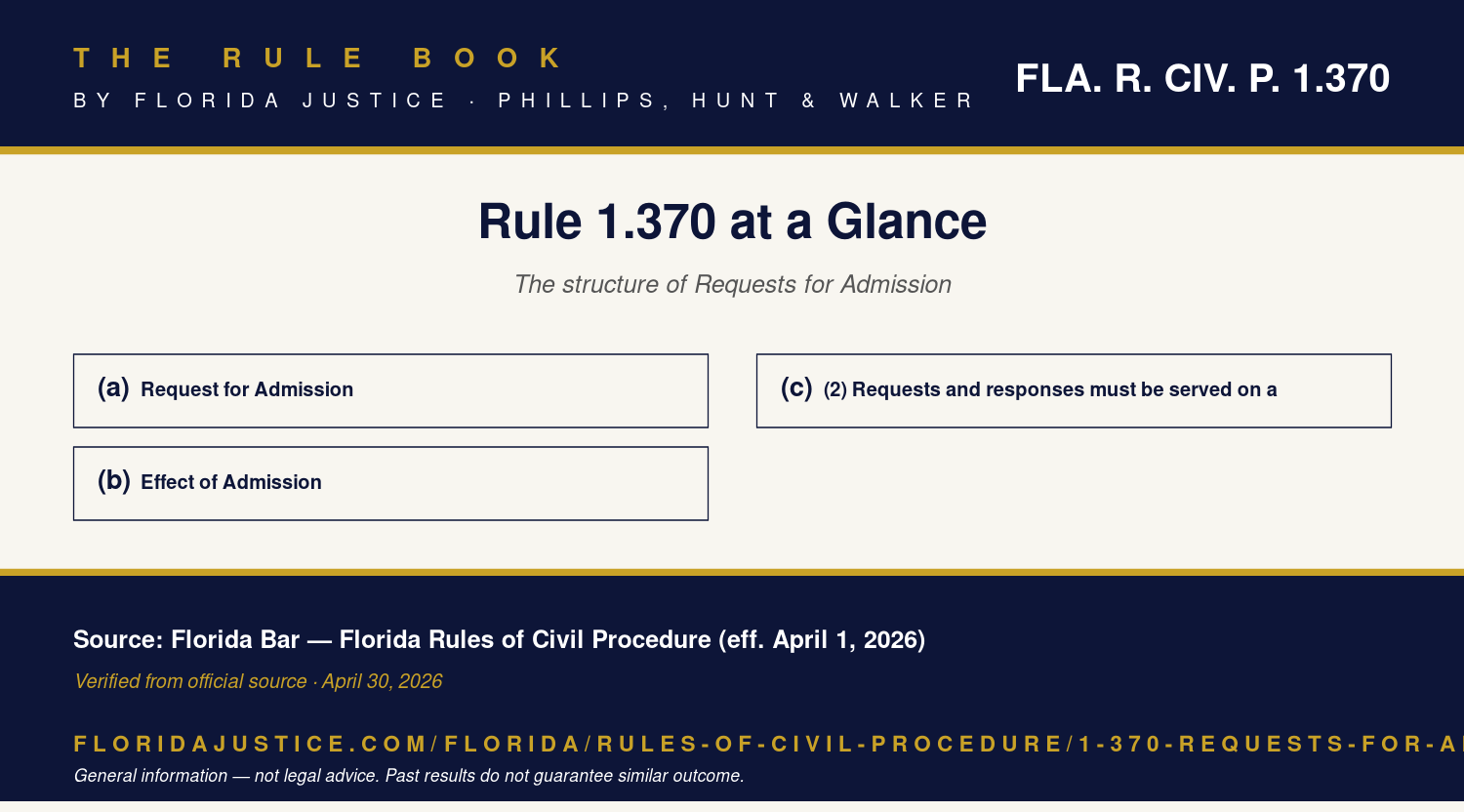
Infographic — Rule 1.370 at a Glance

Florida Rule 1.370 infographic

Committee Notes

View Committee Notes (legislative history)

1972 Amendment. Derived from Federal Rule of Civil Procedure 36 as amended in 1970. The rule is changed to eliminate distinctions between questions of opinion, fact, and mixed questions. The time sequences are changed in accordance with the other discovery rules, and case law is incorporated by providing for amendment and withdrawal of the answers and for judicial scrutiny to determine the sufficiency of the answers. 2003 Amendment. The total number of requests for admission that may be served without leave of court is limited to 30, including all subparts.

Lawyer-to-Lawyer Co-Counsel Referrals

If you’re a lawyer with a Florida case outside your normal practice — complex civil, catastrophic injury, federal court litigation, multi-state coordination — co-counsel referrals are a core part of what we do. You keep the client. We take the trial-side work. Fee split per Fla. Bar Rule 4-1.5 with full client consent.

Call John directly: (904) 444-4444
This page summarizes a Florida Rule of Civil Procedure for educational purposes. The rule text and Committee Notes are mirrored from the Florida Bar’s official publication and are public domain. The plain-English summary is the opinion of Phillips, Hunt & Walker and is general information only — not legal advice. Reading this page does not create an attorney-client relationship. Past results do not guarantee a similar outcome in your case.

X