(1) If a party dies and the claim is not thereby extinguished, the court may order substitution of the proper parties. The motion for substitution may be made by any party or by the successors or representatives of the deceased party and, together with the notice of hearing, shall be filed and served on all parties as provided in Florida Rule of General Practice and Judicial Administration 2.516 and upon persons not parties in the manner provided for the service of a summons. Unless the motion for substitution is made within 90 days after a statement noting the death is filed and served on all parties as provided in Rule of General Practice and Judicial Administration 2.516, the action shall be dismissed as to the deceased party.
(2) In the event of the death of one or more of the plaintiffs or of one or more of the defendants in an action in which the right sought to be enforced survives only to the surviving plaintiffs or only against the surviving defendants, the action shall not abate. A statement noting the death shall be filed and served on all parties as provided in Rule of General Practice and Judicial Administration 2.516 and the action shall proceed in favor of or against the surviving parties.
(b) Incompetency. If a party becomes incompetent, the court, upon motion filed and served as provided in subdivision (a) of this rule, may allow the action to be continued by or against that person’s representative.
(c) Transfer of Interest. In case of any transfer of interest, the action may be continued by or against the original party, unless the court upon motion directs the person to whom the interest is transferred to be substituted in the action or joined with the original party. Service of the motion shall be made as provided in subdivision (a) of this rule.
April 1, 2026 Florida Rules of Civil Procedure 75 (d) Public Officers; Death or Separation from Office
(1) When a public officer is a party to an action in an official capacity and during its pendency dies, resigns, or otherwise ceases to hold office, the action does not abate and the officer’s successor is automatically substituted as a party. Proceedings following the substitution shall be in the name of the substituted party, but any misnomer not affecting the substantial rights of the parties shall be disregarded. An order of substitution may be entered at any time, but the omission to enter such an order shall not affect the substitution.
(2) When a public officer sues or is sued in an official capacity, the officer may be described as a party by the official title rather than by name but the court may require the officer’s name to be added.
Plain-English Breakdown
Practitioner notes by John M. Phillips, Board Certified Civil Trial Lawyer — coming soon. Watch the video below for the plain-English breakdown.
Committee Notes
View Committee Notes (legislative history)
No Committee Notes for this rule version.
Lawyer-to-Lawyer Co-Counsel Referrals
If you’re a lawyer with a Florida case outside your normal practice — complex civil, catastrophic injury, federal court litigation, multi-state coordination — co-counsel referrals are a core part of what we do. You keep the client. We take the trial-side work. Fee split per Fla. Bar Rule 4-1.5 with full client consent.
Call John directly: (904) 444-4444
This page summarizes a Florida Rule of Civil Procedure for educational purposes. The rule text and Committee Notes are mirrored from the Florida Bar’s official publication and are public domain. The plain-English summary is the opinion of Phillips, Hunt & Walker and is general information only — not legal advice. Reading this page does not create an attorney-client relationship. Past results do not guarantee a similar outcome in your case.
(a) governs substitution when a party dies during litigation. The procedure runs on a clock: a motion for substitution of the proper party — typically the personal representative of the estate — must be made within 90 days after the death is suggested on the record by service of a statement of the fact. Failure to move within 90 days results in dismissal of the action as to the deceased party. The 90-day clock is procedural, not jurisdictional, but missing it requires a motion to enlarge under Rule 1.090 showing excusable neglect.
Suggestion of Death
The trigger for the 90-day clock is service of a “statement of the fact of death” on the parties and on the personal representative of the deceased party. Either side can serve the suggestion. Defense counsel sometimes serve it strategically when they suspect the plaintiff’s estate has not yet opened probate — the 90-day clock starts running and the absence of an opened estate creates a substitution problem.
Subsection (b) — Incapacity
(b) addresses substitution when a party becomes incompetent during the case. The court may allow substitution of the legal representative — typically a court-appointed guardian. Unlike death under (a), incapacity does not have a fixed 90-day clock; the court has discretion in setting the substitution timeline.
Subsection (c) — Transfer of Interest
(c) governs substitution when a party transfers the interest in the case mid-litigation. Common contexts: assignment of a contract claim to a third party; sale of a business and its pending claims; insurance subrogation. The court may allow substitution or may permit the original party to continue the case for the benefit of the transferee. Either path keeps the litigation moving.
Subsection (d) — Service on Substituted Party
(d) provides for service of the substitution motion on the proposed substituted party. Service must be effected on the personal representative, guardian, or transferee as appropriate. Failure to properly serve the proposed substituted party can render the substitution voidable.
Practical Approach
Calendar the 90-day clock the moment a suggestion of death is served. Open probate quickly if the deceased was the plaintiff. If defense counsel serves the suggestion before probate is open, document the steps taken to identify and serve the personal representative. Conclusory affidavits explaining delay do not satisfy excusable neglect under Rule 1.090; sworn detail of the chain of events does.
Cross-references: See Rule 1.090 (extending the 90-day window), Rule 1.210 (capacity to sue and be sued), and Rule 1.250 (adding or dropping parties).
▶ Watch: Rule 1.260 — Survivor; Substitution of Parties
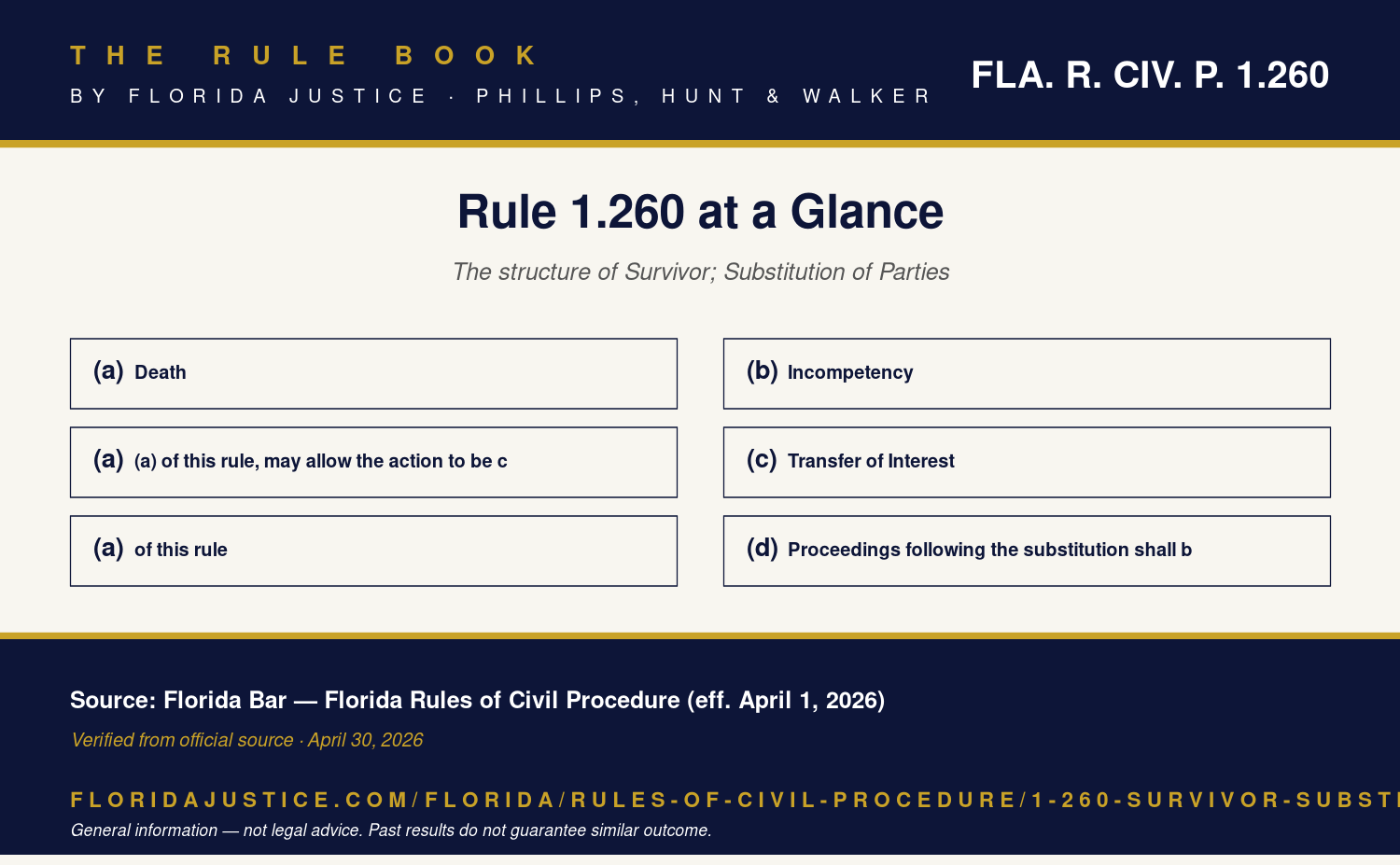
Infographic — Rule 1.260 at a Glance
Rule Text (verbatim from the Florida Supreme Court)
(a) Death. (1) If a party dies and the claim is not thereby extinguished, the court may order substitution of the proper parties. The motion for substitution may be made by any party or by the successors or representatives of the deceased party and, together with the notice of hearing, shall be filed and served on all parties as provided in Florida Rule of General Practice and Judicial Administration 2.516 and upon persons not parties in the manner provided for the service of a summons. Unless the motion for substitution is made within 90 days after a statement noting the death is filed and served on all parties as provided in Rule of General Practice and Judicial Administration 2.516, the action shall be dismissed as to the deceased party. (2) In the event of the death of one or more of the plaintiffs or of one or more of the defendants in an action in which the right sought to be enforced survives only to the surviving plaintiffs or only against the surviving defendants, the action shall not abate. A statement noting the death shall be filed and served on all parties as provided in Rule of General Practice and Judicial Administration 2.516 and the action shall proceed in favor of or against the surviving parties. (b) Incompetency. If a party becomes incompetent, the court, upon motion filed and served as provided in subdivision (a) of this rule, may allow the action to be continued by or against that person’s representative. (c) Transfer of Interest. In case of any transfer of interest, the action may be continued by or against the original party, unless the court upon motion directs the person to whom the interest is transferred to be substituted in the action or joined with the original party. Service of the motion shall be made as provided in subdivision (a) of this rule.
(d) Public Officers; Death or Separation from Office (1) When a public officer is a party to an action in an official capacity and during its pendency dies, resigns, or otherwise ceases to hold office, the action does not abate and the officer’s successor is automatically substituted as a party. Proceedings following the substitution shall be in the name of the substituted party, but any misnomer not affecting the substantial rights of the parties shall be disregarded. An order of substitution may be entered at any time, but the omission to enter such an order shall not affect the substitution. (2) When a public officer sues or is sued in an official capacity, the officer may be described as a party by the official title rather than by name but the court may require the officer’s name to be added.
Educational reference. This page summarizes a Florida Rule of Civil Procedure for educational purposes. The rule text and Committee Notes are mirrored from the Florida Bar's official publication and are public domain. The plain-English summary is the opinion of Phillips, Hunt & Walker and is general information only — not legal advice. Reading this page does not create an attorney-client relationship. Past results do not guarantee a similar outcome in your case.
What this rule means in plain English
Florida Rule of Civil Procedure 1.260 — Survivor; Substitution of Parties — sets out the procedural requirements for this aspect of Florida civil practice. (a) Death. (1) If a party dies and the claim is not thereby extinguished, the court may order substitution of the proper parties.
X
Manage Consent
To provide the best experiences, we use technologies like cookies to store and/or access device information. Consenting to these technologies will allow us to process data such as browsing behavior or unique IDs on this site. Not consenting or withdrawing consent, may adversely affect certain features and functions.
Functional
Always active
The technical storage or access is strictly necessary for the legitimate purpose of enabling the use of a specific service explicitly requested by the subscriber or user, or for the sole purpose of carrying out the transmission of a communication over an electronic communications network.
Preferences
The technical storage or access is necessary for the legitimate purpose of storing preferences that are not requested by the subscriber or user.
Statistics
The technical storage or access that is used exclusively for statistical purposes.The technical storage or access that is used exclusively for anonymous statistical purposes. Without a subpoena, voluntary compliance on the part of your Internet Service Provider, or additional records from a third party, information stored or retrieved for this purpose alone cannot usually be used to identify you.
Marketing
The technical storage or access is required to create user profiles to send advertising, or to track the user on a website or across several websites for similar marketing purposes.