



Fla. R. Civ. P. 1.220 — Class Actions
Last verified from official source: April 30, 2026 · Source: Florida Bar — Florida Rules of Civil Procedure (eff. April 1, 2026), p. 67
Rule Text (verbatim)
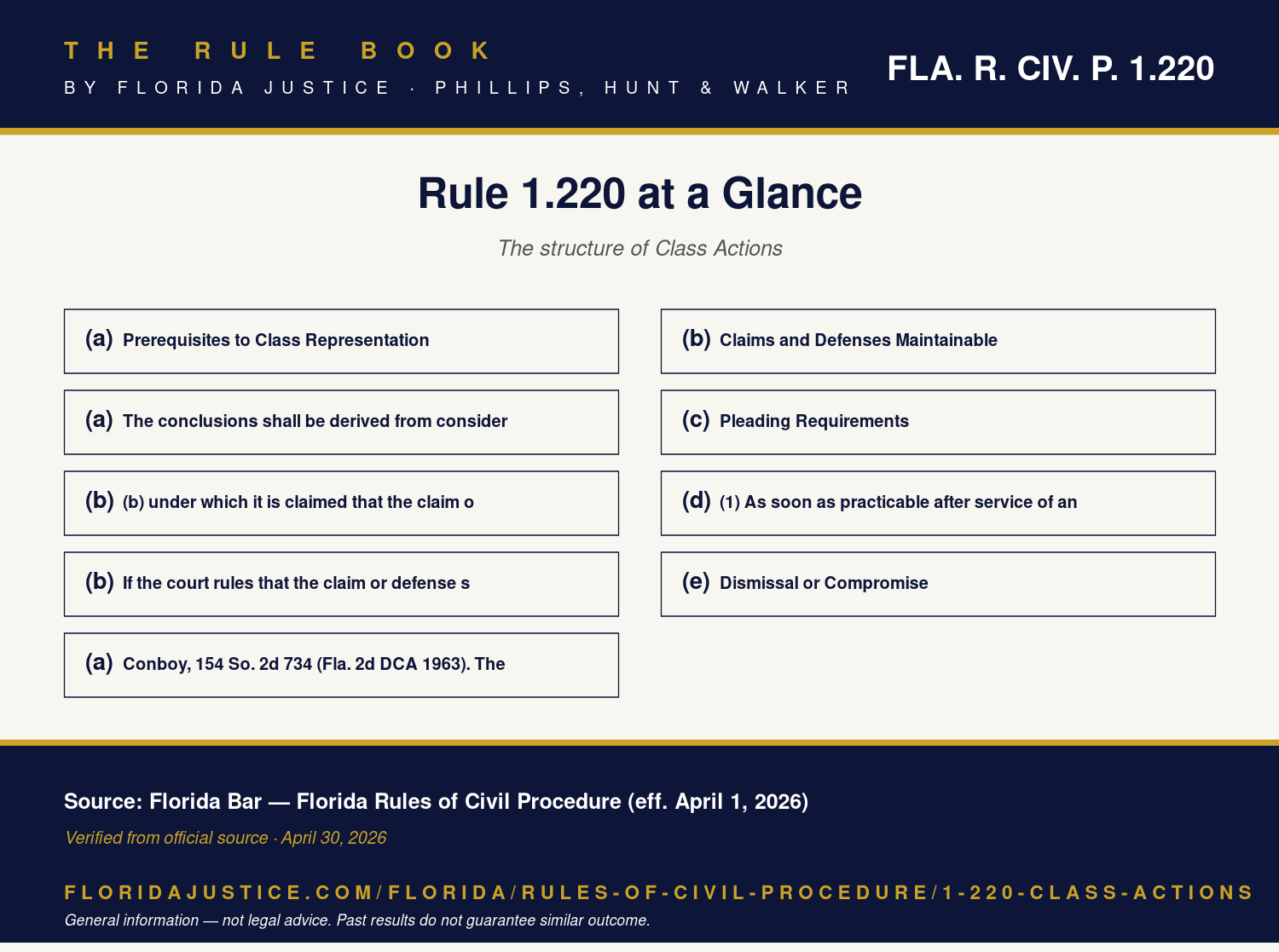
(a) Prerequisites to Class Representation. Before any claim or defense may be maintained on behalf of a class by one party or more suing or being sued as the representative of all the members of a class, the court shall first conclude that (1) the members of the class are so numerous that separate joinder of each member is impracticable, (2) the claim or defense of the representative party raises questions of law or fact common to the questions of law or fact raised by the claim or defense of each member of the class, (3) the claim or defense of the representative party is typical of the claim or defense of each member of the class, and (4) the representative party can fairly and adequately protect and represent the interests of each member of the class.
(b) Claims and Defenses Maintainable. A claim or defense may be maintained on behalf of a class if the court concludes that the prerequisites of subdivision (a) are satisfied, and that:
April 1, 2026 Florida Rules of Civil Procedure 67 (1) the prosecution of separate claims or defenses by or against individual members of the class would create a risk of either:
(A) inconsistent or varying adjudications concerning individual members of the class which would establish incompatible standards of conduct for the party opposing the class; or
(B) adjudications concerning individual members of the class which would, as a practical matter, be dispositive of the interests of other members of the class who are not parties to the adjudications, or substantially impair or impede the ability of other members of the class who are not parties to the adjudications to protect their interests; or
(2) the party opposing the class has acted or refused to act on grounds generally applicable to all the members of the class, thereby making final injunctive relief or declaratory relief concerning the class as a whole appropriate; or
(3) the claim or defense is not maintainable under either subdivision (b)(1) or (b)(2), but the questions of law or fact common to the claim or defense of the representative party and the claim or defense of each member of the class predominate over any question of law or fact affecting only individual members of the class, and class representation is superior to other available methods for the fair and efficient adjudication of the controversy. The conclusions shall be derived from consideration of all relevant facts and circumstances, including (A) the respective interests of each member of the class in individually controlling the prosecution of separate claims or defenses, (B) the nature and extent of any pending litigation to which any member of the class is a party and in which any question of law or fact controverted in the subject action is to be adjudicated, (C) the desirability or undesirability of concentrating the litigation in the forum where the subject action is instituted, and (D) the difficulties likely to be encountered in the management of the claim or defense on behalf of a class.
April 1, 2026 Florida Rules of Civil Procedure 68 (c) Pleading Requirements. Any pleading, counterclaim, or crossclaim alleging the existence of a class shall contain the following:
(1) Next to its caption the designation: “Class Representation.”
(2) Under a separate heading, designated as “Class Representation Allegations,” specific recitation of:
(A) the particular provision of subdivision (b) under which it is claimed that the claim or defense is maintainable on behalf of a class;
(B) the questions of law or fact that are common to the claim or defense of the representative party and the claim or defense of each member of the class;
(C) the particular facts and circumstances that show the claim or defense advanced by the representative party is typical of the claim or defense of each member of the class;
(D) (i) the approximate number of class members, (ii) a definition of the alleged class, and (iii) the particular facts and circumstances that show the representative party will fairly and adequately protect and represent the interests of each member of the class; and
(E) the particular facts and circumstances that support the conclusions required of the court in determining that the action may be maintained as a class action pursuant to the particular provision of subdivision (b) under which it is claimed that the claim or defense is maintainable on behalf of a class.
(d) Determination of Class Representation; Notice; Judgment: Claim or Defense Maintained Partly on Behalf of a Class.
(1) As soon as practicable after service of any pleading alleging the existence of a class under this rule and before service of
April 1, 2026 Florida Rules of Civil Procedure 69 an order for pretrial conference or a notice for trial, after hearing the court shall enter an order determining whether the claim or defense is maintainable on behalf of a class on the application of any party or on the court’s initiative. Irrespective of whether the court determines that the claim or defense is maintainable on behalf of a class, the order shall separately state the findings of fact and conclusions of law upon which the determination is based. In making the determination the court (A) may allow the claim or defense to be so maintained, and, if so, shall state under which subsection of subdivision (b) the claim or defense is to be maintained, (B) may disallow the class representation and strike the class representation allegations, or (C) may order postponement of the determination pending the completion of discovery concerning whether the claim or defense is maintainable on behalf of a class. If the court rules that the claim or defense shall be maintained on behalf of a class under subdivision (b)(3), the order shall also provide for the notice required by subdivision (d)(2). If the court rules that the claim or defense shall be maintained on behalf of a class under subdivision (b)(1) or subdivision (b)(2), the order shall also provide for the notice required by subdivision (d)(2), except when a showing is made that the notice is not required, the court may provide for another kind of notice to the class as is appropriate. When the court orders postponement of its determination, the court shall also establish a date, if possible, for further consideration and final disposition of the motion. An order under this subsection may be conditional and may be altered or amended before entry of a judgment on the merits of the action.
(2) As soon as is practicable after the court determines that a claim or defense is maintainable on behalf of a class, notice of the pendency of the claim or defense shall be given by the party asserting the existence of the class to all the members of the class. The notice shall be given to each member of the class who can be identified and located through reasonable effort and shall be given to the other members of the class in the manner determined by the court to be most practicable under the circumstances. Unless otherwise ordered by the court, the party asserting the existence of the class shall initially pay for the cost of giving notice. The notice shall inform each member of the class that (A) any member of the
April 1, 2026 Florida Rules of Civil Procedure 70 class who files a statement with the court by the date specified in the notice asking to be excluded shall be excluded from the class, (B) the judgment, whether favorable or not, will include all members who do not request exclusion, and (C) any member who does not request exclusion may make a separate appearance within the time specified in the notice.
(3) The judgment determining a claim or defense maintained on behalf of a class under subdivision (b)(1) or (b)(2), whether or not favorable to the class, shall include and describe those persons whom the court finds to be members of the class. The judgment determining a claim or defense maintained on behalf of a class under subdivision (b)(3), whether or not favorable to the class, shall include and identify those to whom the notice provided in subdivision (d)(2) was directed, who have not requested exclusion and whom the court finds to be members of the class.
(4) When appropriate, (A) a claim or defense may be brought or maintained on behalf of a class concerning particular issues, or (B) class representation may be divided into subclasses, and each subclass may be treated as a separate and distinct class and the provisions of this rule shall be applied accordingly.
(e) Dismissal or Compromise. After a claim or defense is determined to be maintainable on behalf of a class under subdivision (d), the claim or defense shall not be voluntarily withdrawn, dismissed, or compromised without approval of the court after notice and hearing. Notice of any proposed voluntary withdrawal, dismissal, or compromise shall be given to all members of the class as the court directs.
Committee Notes
1980 Amendment. The class action rule has been completely revised to bring it in line with modern practice. The rule is based on Federal Rule of Civil Procedure 23, but a number of changes have been made to eliminate problems in the federal rule through court decisions. Generally, the rule provides for the prerequisites to class representation, an early determination about whether the claim or defense is maintainable on behalf of a class, notice to all members
April 1, 2026 Florida Rules of Civil Procedure 71 of the class, provisions for the members of the class to exclude themselves, the form of judgment, and the procedure governing dismissal or compromise of a claim or defense maintained on behalf of a class. The prerequisites of subdivision (a) are changed from those in federal rule 23 only to the extent necessary to incorporate the criteria enunciated in Port Royal v. Conboy, 154 So. 2d 734 (Fla. 2d DCA 1963). The notice requirements have been made more explicit and stringent than those in the federal rule.
Plain-English Breakdown
Practitioner notes by John M. Phillips, Board Certified Civil Trial Lawyer — coming soon. Watch the video below for the plain-English breakdown.
Rule Text (Verbatim)
The text below is mirrored verbatim from the Florida Bar’s official publication. Public domain.
(a) Prerequisites to Class Representation. Before any claim or defense may be maintained on behalf of a class by one party or more suing or being sued as the representative of all the members of a class, the court shall first conclude that (1) the members of the class are so numerous that separate joinder of each member is impracticable, (2) the claim or defense of the representative party raises questions of law or fact common to the questions of law or fact raised by the claim or defense of each member of the class, (3) the claim or defense of the representative party is typical of the claim or defense of each member of the class, and (4) the representative party can fairly and adequately protect and represent the interests of each member of the class. (b) Claims and Defenses Maintainable. A claim or defense may be maintained on behalf of a class if the court concludes that the prerequisites of subdivision (a) are satisfied, and that:
(1) the prosecution of separate claims or defenses by or against individual members of the class would create a risk of either: (A) inconsistent or varying adjudications concerning individual members of the class which would establish incompatible standards of conduct for the party opposing the class; or (B) adjudications concerning individual members of the class which would, as a practical matter, be dispositive of the interests of other members of the class who are not parties to the adjudications, or substantially impair or impede the ability of other members of the class who are not parties to the adjudications to protect their interests; or (2) the party opposing the class has acted or refused to act on grounds generally applicable to all the members of the class, thereby making final injunctive relief or declaratory relief concerning the class as a whole appropriate; or (3) the claim or defense is not maintainable under either subdivision (b)(1) or (b)(2), but the questions of law or fact common to the claim or defense of the representative party and the claim or defense of each member of the class predominate over any question of law or fact affecting only individual members of the class, and class representation is superior to other available methods for the fair and efficient adjudication of the controversy. The conclusions shall be derived from consideration of all relevant facts and circumstances, including (A) the respective interests of each member of the class in individually controlling the prosecution of separate claims or defenses, (B) the nature and extent of any pending litigation to which any member of the class is a party and in which any question of law or fact controverted in the subject action is to be adjudicated, (C) the desirability or undesirability of concentrating the litigation in the forum where the subject action is instituted, and (D) the difficulties likely to be encountered in the management of the claim or defense on behalf of a class.
(c) Pleading Requirements. Any pleading, counterclaim, or crossclaim alleging the existence of a class shall contain the following: (1) Next to its caption the designation: “Class Representation.” (2) Under a separate heading, designated as “Class Representation Allegations,” specific recitation of: (A) the particular provision of subdivision (b) under which it is claimed that the claim or defense is maintainable on behalf of a class; (B) the questions of law or fact that are common to the claim or defense of the representative party and the claim or defense of each member of the class; (C) the particular facts and circumstances that show the claim or defense advanced by the representative party is typical of the claim or defense of each member of the class; (D) (i) the approximate number of class members, (ii) a definition of the alleged class, and (iii) the particular facts and circumstances that show the representative party will fairly and adequately protect and represent the interests of each member of the class; and (E) the particular facts and circumstances that support the conclusions required of the court in determining that the action may be maintained as a class action pursuant to the particular provision of subdivision (b) under which it is claimed that the claim or defense is maintainable on behalf of a class. (d) Determination of Class Representation; Notice; Judgment: Claim or Defense Maintained Partly on Behalf of a Class. (1) As soon as practicable after service of any pleading alleging the existence of a class under this rule and before service of
an order for pretrial conference or a notice for trial, after hearing the court shall enter an order determining whether the claim or defense is maintainable on behalf of a class on the application of any party or on the court’s initiative. Irrespective of whether the court determines that the claim or defense is maintainable on behalf of a class, the order shall separately state the findings of fact and conclusions of law upon which the determination is based. In making the determination the court (A) may allow the claim or defense to be so maintained, and, if so, shall state under which subsection of subdivision (b) the claim or defense is to be maintained, (B) may disallow the class representation and strike the class representation allegations, or (C) may order postponement of the determination pending the completion of discovery concerning whether the claim or defense is maintainable on behalf of a class. If the court rules that the claim or defense shall be maintained on behalf of a class under subdivision (b)(3), the order shall also provide for the notice required by subdivision (d)(2). If the court rules that the claim or defense shall be maintained on behalf of a class under subdivision (b)(1) or subdivision (b)(2), the order shall also provide for the notice required by subdivision (d)(2), except when a showing is made that the notice is not required, the court may provide for another kind of notice to the class as is appropriate. When the court orders postponement of its determination, the court shall also establish a date, if possible, for further consideration and final disposition of the motion. An order under this subsection may be conditional and may be altered or amended before entry of a judgment on the merits of the action. (2) As soon as is practicable after the court determines that a claim or defense is maintainable on behalf of a class, notice of the pendency of the claim or defense shall be given by the party asserting the existence of the class to all the members of the class. The notice shall be given to each member of the class who can be identified and located through reasonable effort and shall be given to the other members of the class in the manner determined by the court to be most practicable under the circumstances. Unless otherwise ordered by the court, the party asserting the existence of the class shall initially pay for the cost of giving notice. The notice shall inform each member of the class that (A) any member of the
class who files a statement with the court by the date specified in the notice asking to be excluded shall be excluded from the class, (B) the judgment, whether favorable or not, will include all members who do not request exclusion, and (C) any member who does not request exclusion may make a separate appearance within the time specified in the notice. (3) The judgment determining a claim or defense maintained on behalf of a class under subdivision (b)(1) or (b)(2), whether or not favorable to the class, shall include and describe those persons whom the court finds to be members of the class. The judgment determining a claim or defense maintained on behalf of a class under subdivision (b)(3), whether or not favorable to the class, shall include and identify those to whom the notice provided in subdivision (d)(2) was directed, who have not requested exclusion and whom the court finds to be members of the class. (4) When appropriate, (A) a claim or defense may be brought or maintained on behalf of a class concerning particular issues, or (B) class representation may be divided into subclasses, and each subclass may be treated as a separate and distinct class and the provisions of this rule shall be applied accordingly. (e) Dismissal or Compromise. After a claim or defense is determined to be maintainable on behalf of a class under subdivision (d), the claim or defense shall not be voluntarily withdrawn, dismissed, or compromised without approval of the court after notice and hearing. Notice of any proposed voluntary withdrawal, dismissal, or compromise shall be given to all members of the class as the court directs.
Part of The Rule Book — full FRCP playlist. Plain-English breakdown by John M. Phillips, Board Certified Civil Trial Lawyer.
Committee Notes (verbatim)
1980 Amendment. The class action rule has been completely revised to bring it in line with modern practice. The rule is based on Federal Rule of Civil Procedure 23, but a number of changes have been made to eliminate problems in the federal rule through court decisions. Generally, the rule provides for the prerequisites to class representation, an early determination about whether the claim or defense is maintainable on behalf of a class, notice to all members
of the class, provisions for the members of the class to exclude themselves, the form of judgment, and the procedure governing dismissal or compromise of a claim or defense maintained on behalf of a class. The prerequisites of subdivision (a) are changed from those in federal rule 23 only to the extent necessary to incorporate the criteria enunciated in Port Royal v. Conboy, 154 So. 2d 734 (Fla. 2d DCA 1963). The notice requirements have been made more explicit and stringent than those in the federal rule.