
Educational reference. This page summarizes a Florida Rule of Civil Procedure for educational purposes. The rule text and Committee Notes are mirrored from the Florida Bar's official publication and are public domain. The plain-English summary is the opinion of Phillips, Hunt & Walker and is general information only — not legal advice. Reading this page does not create an attorney-client relationship. Past results do not guarantee a similar outcome in your case.
What this rule means in plain English
Florida Rule of Civil Procedure 1.630 — Extraordinary Remedies — sets out the procedural requirements for this aspect of Florida civil practice. (a) Applicability. This rule applies to actions for the issuance of writs of mandamus, prohibition, quo warranto, and habeas corpus. (b) Initial Pleading. The initial pleading must be a complaint.
Rule Text (verbatim from the Florida Supreme Court)
(a) Applicability. This rule applies to actions for the issuance of writs of mandamus, prohibition, quo warranto, and habeas corpus. (b) Initial Pleading. The initial pleading must be a complaint. It must contain: (1) the facts on which the plaintiff relies for relief; (2) a request for the relief sought; and (3) if desired, argument in support of the complaint with citations of authority.
The caption must show the action filed in the name of the plaintiff in all cases and not on the relation of the state. When the complaint seeks a writ directed to a lower court or to a governmental or administrative agency, a copy of as much of the record as is necessary to support the plaintiff’s complaint must be attached. (c) Time. A complaint must be filed within the time provided by law. (d) Process. If the complaint shows a prima facie case for relief, the court must issue: (1) an order nisi in prohibition; (2) an alternative writ in mandamus that may incorporate the complaint by reference only; (3) a writ of quo warranto; or (4) a writ of habeas corpus. The writ must be served in the manner prescribed by law. (e) Response. Defendant must respond to the writ as provided in rule 1.140, but the answer in quo warranto must show better title to the office when the writ seeks an adjudication of the right to an office held by the defendant. Court Commentary 1984 Amendment. Rule 1.630 replaces rules and statutes used before 1980 when the present Florida Rules of Appellate Procedure were adopted. Experience has shown that rule 9.100 is not designed for use in trial court. The times for proceeding, the methods of proceeding, and the general nature of the procedure is appellate and presumes that the proceeding is basically an appellate proceeding. When the extraordinary remedies are sought in the trial court, these items do not usually exist and thus the rule is difficult to apply. The uniform procedure concept of rule 9.100
has been retained with changes making the procedure fit trial court procedure. The requirement of attaching a copy of the record in subdivision (b) may not be possible within the time allowed for the initial pleading because of the unavailability of the record. In that event the plaintiff should file a motion to extend the time to allow the preparation of the record and supply it when prepared. The filing of a motion to extend the time should be sufficient to extend it until the motion can be decided by the court.
Florida Rule 1.630 governs extraordinary remedies in Florida civil practice — the procedural mechanics for writs of certiorari, prohibition, mandamus, quo warranto, and habeas corpus.
▶ Watch: Rule 1.630 — Extraordinary Remedies

Fla. R. Civ. P. 1.630 — Extraordinary Remedies
Last verified from official source: April 30, 2026 · Source: Florida Bar — Florida Rules of Civil Procedure (eff. April 1, 2026), p. 187
Rule Text (verbatim)
(a) Applicability. This rule applies to actions for the issuance of writs of mandamus, prohibition, quo warranto, and habeas corpus.
(b) Initial Pleading. The initial pleading must be a complaint. It must contain:
(1) the facts on which the plaintiff relies for relief;
(2) a request for the relief sought; and
(3) if desired, argument in support of the complaint with citations of authority.
April 1, 2026 Florida Rules of Civil Procedure 187 The caption must show the action filed in the name of the plaintiff in all cases and not on the relation of the state. When the complaint seeks a writ directed to a lower court or to a governmental or administrative agency, a copy of as much of the record as is necessary to support the plaintiff’s complaint must be attached.
(c) Time. A complaint must be filed within the time provided by law.
(d) Process. If the complaint shows a prima facie case for relief, the court must issue:
(1) an order nisi in prohibition;
(2) an alternative writ in mandamus that may incorporate the complaint by reference only;
(3) a writ of quo warranto; or
(4) a writ of habeas corpus.
The writ must be served in the manner prescribed by law.
(e) Response. Defendant must respond to the writ as provided in rule 1.140, but the answer in quo warranto must show better title to the office when the writ seeks an adjudication of the right to an office held by the defendant.
Court Commentary
1984 Amendment. Rule 1.630 replaces rules and statutes used before 1980 when the present Florida Rules of Appellate Procedure were adopted. Experience has shown that rule 9.100 is not designed for use in trial court. The times for proceeding, the methods of proceeding, and the general nature of the procedure is appellate and presumes that the proceeding is basically an appellate proceeding. When the extraordinary remedies are sought in the trial court, these items do not usually exist and thus the rule is difficult to apply. The uniform procedure concept of rule 9.100
April 1, 2026 Florida Rules of Civil Procedure 188 has been retained with changes making the procedure fit trial court procedure. The requirement of attaching a copy of the record in subdivision (b) may not be possible within the time allowed for the initial pleading because of the unavailability of the record. In that event the plaintiff should file a motion to extend the time to allow the preparation of the record and supply it when prepared. The filing of a motion to extend the time should be sufficient to extend it until the motion can be decided by the court.
Committee Notes
2012 Amendment. Subdivision (d)(5) is amended to reflect the relocation of the service rule from rule 1.080 to Fla. R. Jud. Admin. 2.516.
2013 Amendment. Rule 1.630 has been amended to remove any reference to certiorari proceedings, which instead are governed by the Florida Rules of Appellate Procedure. The Florida Rules of Appellate Procedure apply when the circuit courts exercise their appellate jurisdiction.
Plain-English Breakdown
Practitioner notes by John M. Phillips, Board Certified Civil Trial Lawyer — coming soon. Watch the video at the top of this page for the plain-English breakdown.
Rule Text (Verbatim)
The text below is mirrored verbatim from the Florida Bar’s official publication. Public domain.
(a) Applicability. This rule applies to actions for the issuance of writs of mandamus, prohibition, quo warranto, and habeas corpus. (b) Initial Pleading. The initial pleading must be a complaint. It must contain: (1) the facts on which the plaintiff relies for relief; (2) a request for the relief sought; and (3) if desired, argument in support of the complaint with citations of authority.
The caption must show the action filed in the name of the plaintiff in all cases and not on the relation of the state. When the complaint seeks a writ directed to a lower court or to a governmental or administrative agency, a copy of as much of the record as is necessary to support the plaintiff’s complaint must be attached. (c) Time. A complaint must be filed within the time provided by law. (d) Process. If the complaint shows a prima facie case for relief, the court must issue: (1) an order nisi in prohibition; (2) an alternative writ in mandamus that may incorporate the complaint by reference only; (3) a writ of quo warranto; or (4) a writ of habeas corpus. The writ must be served in the manner prescribed by law. (e) Response. Defendant must respond to the writ as provided in rule 1.140, but the answer in quo warranto must show better title to the office when the writ seeks an adjudication of the right to an office held by the defendant. Court Commentary 1984 Amendment. Rule 1.630 replaces rules and statutes used before 1980 when the present Florida Rules of Appellate Procedure were adopted. Experience has shown that rule 9.100 is not designed for use in trial court. The times for proceeding, the methods of proceeding, and the general nature of the procedure is appellate and presumes that the proceeding is basically an appellate proceeding. When the extraordinary remedies are sought in the trial court, these items do not usually exist and thus the rule is difficult to apply. The uniform procedure concept of rule 9.100
has been retained with changes making the procedure fit trial court procedure. The requirement of attaching a copy of the record in subdivision (b) may not be possible within the time allowed for the initial pleading because of the unavailability of the record. In that event the plaintiff should file a motion to extend the time to allow the preparation of the record and supply it when prepared. The filing of a motion to extend the time should be sufficient to extend it until the motion can be decided by the court.
Committee Notes
View Committee Notes (legislative history)
2012 Amendment. Subdivision (d)(5) is amended to reflect the relocation of the service rule from rule 1.080 to Fla. R. Jud. Admin. 2.516. 2013 Amendment. Rule 1.630 has been amended to remove any reference to certiorari proceedings, which instead are governed by the Florida Rules of Appellate Procedure. The Florida Rules of Appellate Procedure apply when the circuit courts exercise their appellate jurisdiction.
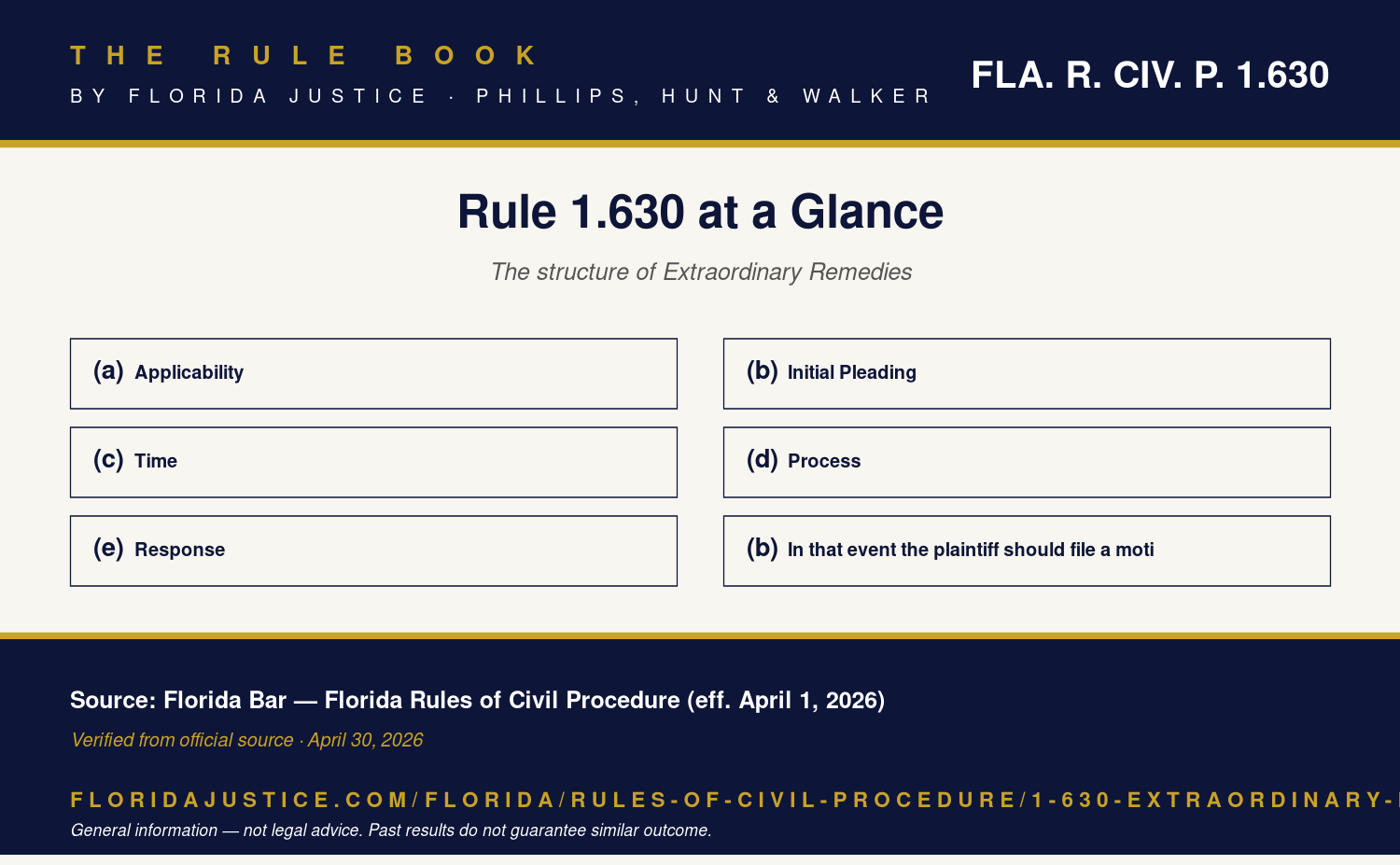
Infographic — Rule 1.630 at a Glance
Lawyer-to-Lawyer Co-Counsel Referrals
If you’re a lawyer with a Florida case outside your normal practice — complex civil, catastrophic injury, federal court litigation, multi-state coordination — co-counsel referrals are a core part of what we do. You keep the client. We take the trial-side work. Fee split per Fla. Bar Rule 4-1.5 with full client consent.
Call John directly: (904) 444-4444
This page summarizes a Florida Rule of Civil Procedure for educational purposes. The rule text and Committee Notes are mirrored from the Florida Bar’s official publication and are public domain. The plain-English summary is the opinion of Phillips, Hunt & Walker and is general information only — not legal advice. Reading this page does not create an attorney-client relationship. Past results do not guarantee a similar outcome in your case.
Committee Notes (verbatim)
2012 Amendment. Subdivision (d)(5) is amended to reflect the relocation of the service rule from rule 1.080 to Fla. R. Jud. Admin. 2.516. 2013 Amendment. Rule 1.630 has been amended to remove any reference to certiorari proceedings, which instead are governed by the Florida Rules of Appellate Procedure. The Florida Rules of Appellate Procedure apply when the circuit courts exercise their appellate jurisdiction.