



Fla. R. Civ. P. 1.210 — Parties
Last verified from official source: April 30, 2026 · Source: Florida Bar — Florida Rules of Civil Procedure (eff. April 1, 2026), p. 66
Rule Text (verbatim)
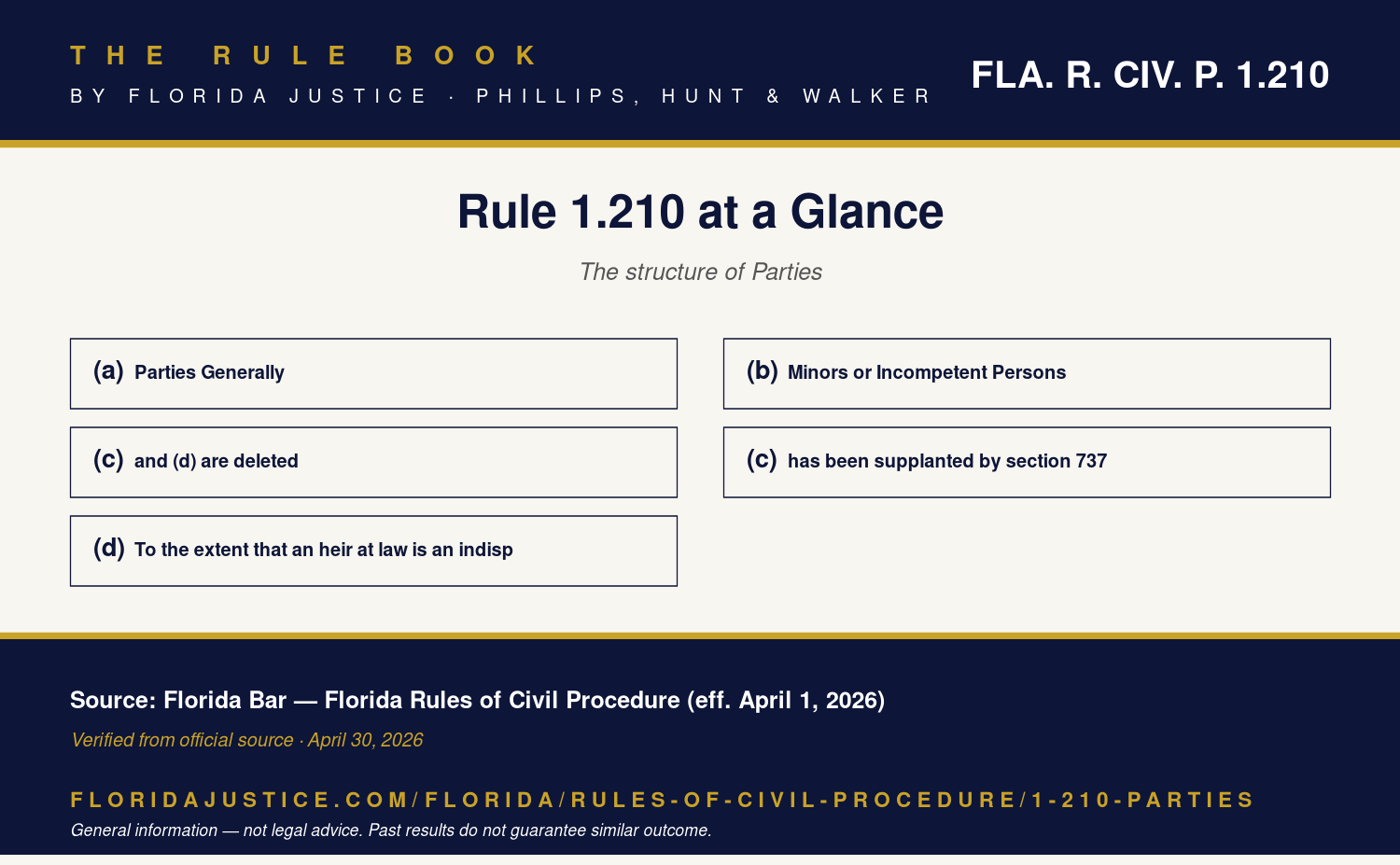
(a) Parties Generally. Every action may be prosecuted in the name of the real party in interest, but a personal representative, administrator, guardian, trustee of an express trust, a party with whom or in whose name a contract has been made for the benefit of another, or a party expressly authorized by statute may sue in that person’s own name without joining the party for whose benefit the action is brought. All persons having an interest in the subject of the action and in obtaining the relief demanded may join as plaintiffs and any person may be made a defendant who has or claims an interest adverse to the plaintiff. Any person may at any time be made a party if that person’s presence is necessary or proper to a complete determination of the cause. Persons having a united interest may be joined on the same side as plaintiffs or defendants, and anyone who refuses to join may for such reason be made a defendant.
(b) Minors or Incompetent Persons. When a minor or incompetent person has a representative, such as a guardian or other like fiduciary, the representative may sue or defend on behalf of the minor or incompetent person. A minor or incompetent person who does not have a duly appointed representative may sue by next friend or by a guardian ad litem. The court shall appoint a guardian ad litem for a minor or incompetent person not otherwise represented in an action or shall make such other order as it deems proper for the protection of the minor or incompetent person.
April 1, 2026 Florida Rules of Civil Procedure 66 Committee Notes
1980 Amendment. Subdivisions (c) and (d) are deleted. Both are obsolete. They were continued in effect earlier because the committee was uncertain about the need for them at the time. Subdivision (c) has been supplanted by section 737.402(2)(z), Florida Statutes (1979), that gives trustees the power to prosecute and defend actions, regardless of the conditions specified in the subdivision. The adoption of section 733.212, Florida Statutes (1979), eliminates the need for subdivision (d) because it provides an easier and less expensive method of eliminating the interests of an heir at law who is not a beneficiary under the will. To the extent that an heir at law is an indispensable party to a proceeding concerning a testamentary trust, due process requires notice and an opportunity to defend, so the rule would be unconstitutionally applied.
2003 Amendment. In subdivision (a), “an executor” is changed to “a personal representative” to conform to statutory language. See § 731.201(25), Fla. Stat. (2002).
Plain-English Breakdown
Practitioner notes by John M. Phillips, Board Certified Civil Trial Lawyer — coming soon. Watch the video below for the plain-English breakdown.
Committee Notes
View Committee Notes (legislative history)
1980 Amendment. Subdivisions (c) and (d) are deleted. Both are obsolete. They were continued in effect earlier because the committee was uncertain about the need for them at the time. Subdivision (c) has been supplanted by section 737.402(2)(z), Florida Statutes (1979), that gives trustees the power to prosecute and defend actions, regardless of the conditions specified in the subdivision. The adoption of section 733.212, Florida Statutes (1979), eliminates the need for subdivision (d) because it provides an easier and less expensive method of eliminating the interests of an heir at law who is not a beneficiary under the will. To the extent that an heir at law is an indispensable party to a proceeding concerning a testamentary trust, due process requires notice and an opportunity to defend, so the rule would be unconstitutionally applied. 2003 Amendment. In subdivision (a), “an executor” is changed to “a personal representative” to conform to statutory language. See § 731.201(25), Fla. Stat. (2002).
Lawyer-to-Lawyer Co-Counsel Referrals
If you’re a lawyer with a Florida case outside your normal practice — complex civil, catastrophic injury, federal court litigation, multi-state coordination — co-counsel referrals are a core part of what we do. You keep the client. We take the trial-side work. Fee split per Fla. Bar Rule 4-1.5 with full client consent.
Call John directly: (904) 444-4444
Committee Notes (verbatim)
1980 Amendment. Subdivisions (c) and (d) are deleted. Both are obsolete. They were continued in effect earlier because the committee was uncertain about the need for them at the time. Subdivision (c) has been supplanted by section 737.402(2)(z), Florida Statutes (1979), that gives trustees the power to prosecute and defend actions, regardless of the conditions specified in the subdivision. The adoption of section 733.212, Florida Statutes (1979), eliminates the need for subdivision (d) because it provides an easier and less expensive method of eliminating the interests of an heir at law who is not a beneficiary under the will. To the extent that an heir at law is an indispensable party to a proceeding concerning a testamentary trust, due process requires notice and an opportunity to defend, so the rule would be unconstitutionally applied. 2003 Amendment. In subdivision (a), “an executor” is changed to “a personal representative” to conform to statutory language. See § 731.201(25), Fla. Stat. (2002).