Fla. R. Civ. P. 1.453 — Jury Request to Review Testimony
Posted
by John Phillips |
Florida Rule 1.453 governs jury requests to review testimony or evidence — when jurors during deliberation can ask to re-hear testimony or re-examine an exhibit, and the procedure for delivering the requested material in open court.
▶ Watch: Rule 1.453 — Jury Request to Review Testimony
The Rule Book → Florida → Civil Procedure → 1.453
Fla. R. Civ. P. 1.453 — Jury Request to Review Testimony
(a) Request for Readback or Playback of Testimony. If, after retiring to consider their verdict, any juror requests a readback or playback of testimony, the jury may be conducted into the courtroom and the court may order the readback or playback of testimony. The testimony may be read or played back only after notice to counsel for the parties. Any readback or playback of testimony must be in open court in the presence of all parties. In its discretion, the court may respond in writing to a request for readback or playback of testimony without having the jury brought before the court, provided that the parties have received the
April 1, 2026 Florida Rules of Civil Procedure 155 opportunity to place objections on the record and both the request and response are made part of the record.
(b) Request for Transcripts. If any juror requests to have a transcript of trial testimony, the court must inform the jury that transcripts are not available but that they can request a readback or playback of testimony, which request may or may not be granted at the court’s discretion. If a juror makes only a general request for transcripts, as opposed to identifying any particular witness’s testimony that they wish to review, the court must also instruct the jury that, if they request a readback or playback, they must specify the particular trial testimony they wish to have read or played back. If, after being properly instructed in accordance with this subdivision, the jury requests a readback or playback of any trial testimony, the court must follow the procedures set forth in subdivision (a).
Plain-English Breakdown
Practitioner notes by John M. Phillips, Board Certified Civil Trial Lawyer — coming soon. Watch the video at the top of this page for the plain-English breakdown.
Committee Notes
View Committee Notes (legislative history)
No Committee Notes for this rule version.
Lawyer-to-Lawyer Co-Counsel Referrals
If you’re a lawyer with a Florida case outside your normal practice — complex civil, catastrophic injury, federal court litigation, multi-state coordination — co-counsel referrals are a core part of what we do. You keep the client. We take the trial-side work. Fee split per Fla. Bar Rule 4-1.5 with full client consent.
Call John directly: (904) 444-4444
This page summarizes a Florida Rule of Civil Procedure for educational purposes. The rule text and Committee Notes are mirrored from the Florida Bar’s official publication and are public domain. The plain-English summary is the opinion of Phillips, Hunt & Walker and is general information only — not legal advice. Reading this page does not create an attorney-client relationship. Past results do not guarantee a similar outcome in your case.
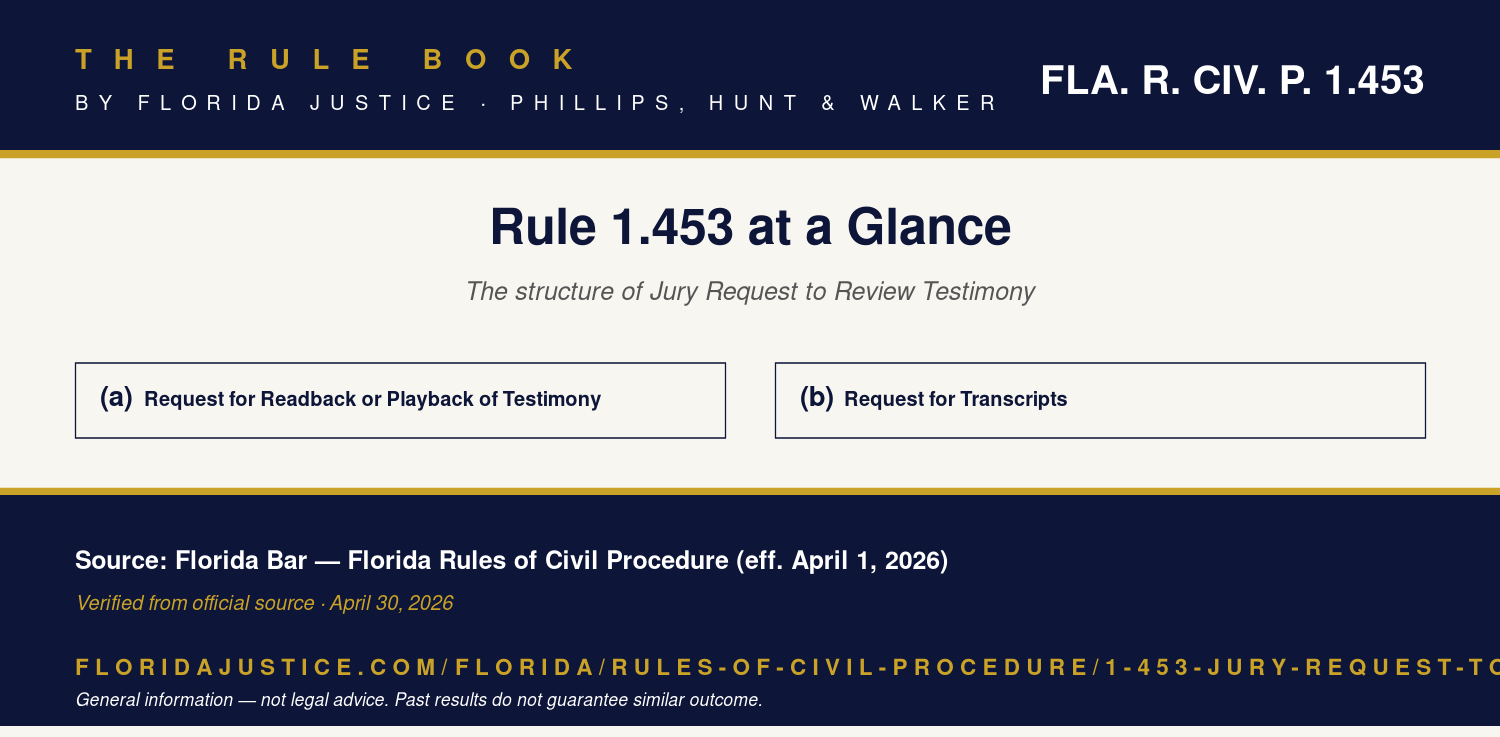
Infographic — Rule 1.453 at a Glance
Rule Text (verbatim from the Florida Supreme Court)
(a) Request for Readback or Playback of Testimony. If, after retiring to consider their verdict, any juror requests a readback or playback of testimony, the jury may be conducted into the courtroom and the court may order the readback or playback of testimony. The testimony may be read or played back only after notice to counsel for the parties. Any readback or playback of testimony must be in open court in the presence of all parties. In its discretion, the court may respond in writing to a request for readback or playback of testimony without having the jury brought before the court, provided that the parties have received the
opportunity to place objections on the record and both the request and response are made part of the record. (b) Request for Transcripts. If any juror requests to have a transcript of trial testimony, the court must inform the jury that transcripts are not available but that they can request a readback or playback of testimony, which request may or may not be granted at the court’s discretion. If a juror makes only a general request for transcripts, as opposed to identifying any particular witness’s testimony that they wish to review, the court must also instruct the jury that, if they request a readback or playback, they must specify the particular trial testimony they wish to have read or played back. If, after being properly instructed in accordance with this subdivision, the jury requests a readback or playback of any trial testimony, the court must follow the procedures set forth in subdivision (a).
Educational reference. This page summarizes a Florida Rule of Civil Procedure for educational purposes. The rule text and Committee Notes are mirrored from the Florida Bar's official publication and are public domain. The plain-English summary is the opinion of Phillips, Hunt & Walker and is general information only — not legal advice. Reading this page does not create an attorney-client relationship. Past results do not guarantee a similar outcome in your case.
What this rule means in plain English
Florida Rule of Civil Procedure 1.453 — Jury Request to Review Testimony — sets out the procedural requirements for this aspect of Florida civil practice. (a) Request for Readback or Playback of Testimony. If, after retiring to consider their verdict, any juror requests a readback or playback of testimony, the jury may be conducted into the courtroom and the court may order the readback or playback of testimony. The testimony may be read or played back only after notice to counsel for the parties.
X
Manage Consent
To provide the best experiences, we use technologies like cookies to store and/or access device information. Consenting to these technologies will allow us to process data such as browsing behavior or unique IDs on this site. Not consenting or withdrawing consent, may adversely affect certain features and functions.
Functional
Always active
The technical storage or access is strictly necessary for the legitimate purpose of enabling the use of a specific service explicitly requested by the subscriber or user, or for the sole purpose of carrying out the transmission of a communication over an electronic communications network.
Preferences
The technical storage or access is necessary for the legitimate purpose of storing preferences that are not requested by the subscriber or user.
Statistics
The technical storage or access that is used exclusively for statistical purposes.The technical storage or access that is used exclusively for anonymous statistical purposes. Without a subpoena, voluntary compliance on the part of your Internet Service Provider, or additional records from a third party, information stored or retrieved for this purpose alone cannot usually be used to identify you.
Marketing
The technical storage or access is required to create user profiles to send advertising, or to track the user on a website or across several websites for similar marketing purposes.