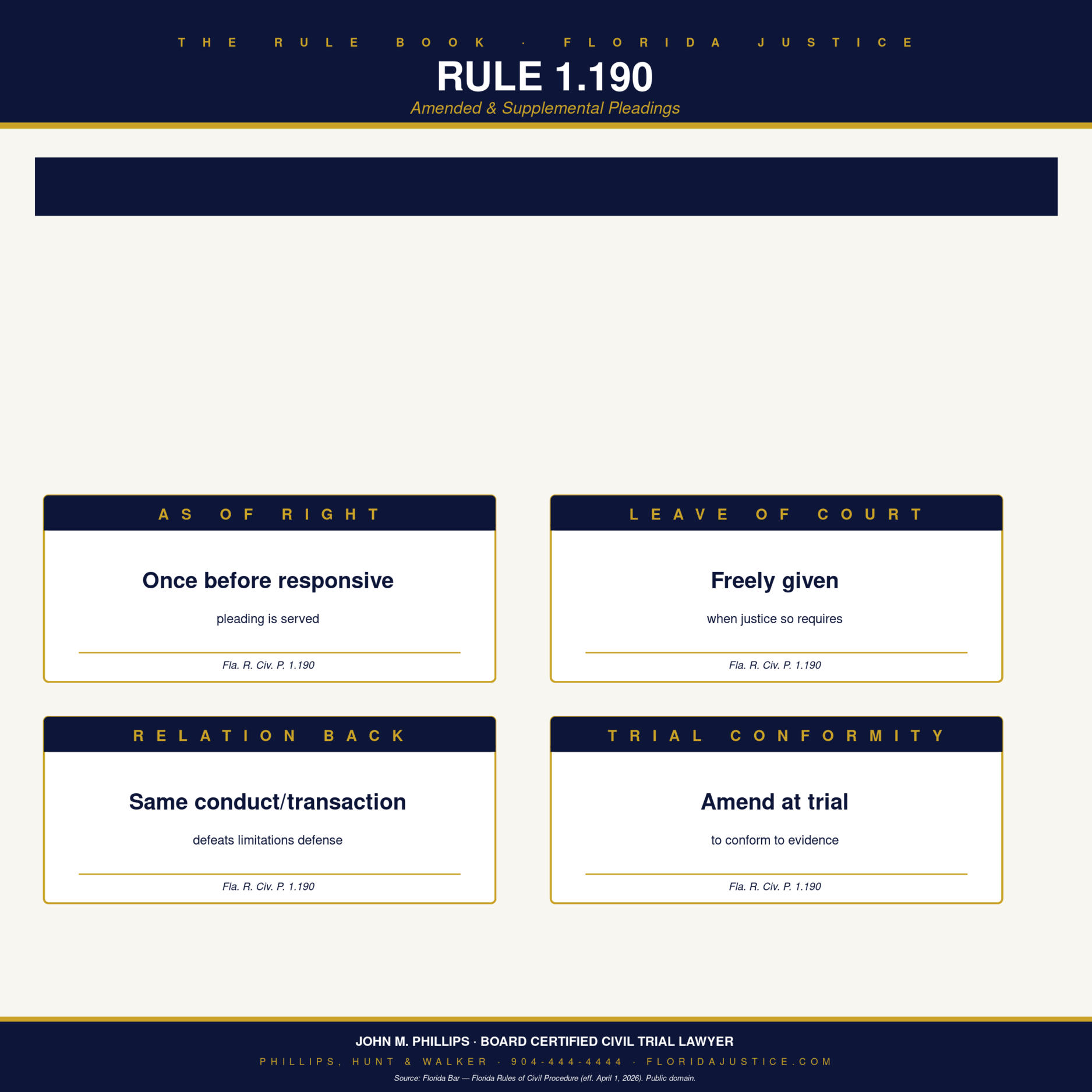



Fla. R. Civ. P. 1.190 — Amended And Supplemental Pleadings
Last verified from official source: April 30, 2026 · Source: Florida Bar — Florida Rules of Civil Procedure (eff. April 1, 2026), p. 47
Rule Text (Verbatim)
The text below is mirrored verbatim from the Florida Bar’s official publication, with FRCP’s hierarchical indentation preserved. Public domain.
(a) Amendments. A party may amend a pleading once as a matter of course at any time before a responsive pleading is served or, if the pleading is one to which no responsive pleading is permitted and the action has not been placed on the trial calendar, may so amend it at any time within 20 days after it is served. Otherwise a party may amend a pleading only by leave of court or by written consent of the adverse party. If a party files a motion to amend a pleading, the party shall attach the proposed amended pleading to the motion. Leave of court shall be given freely when justice so requires. A party shall plead in response to an amended pleading within 10 days after service of the amended pleading unless the court otherwise orders.
(b) Amendments to Conform with the Evidence. When issues not raised by the pleadings are tried by express or implied consent of the parties, they shall be treated in all respects as if they had been raised in the pleadings. Such amendment of the pleadings as may be necessary to cause them to conform to the evidence and to raise these issues may be made upon motion of any party at any time, even after judgment, but failure so to amend shall not affect the result of the trial of these issues. If the evidence is objected to at the trial on the ground that it is not within the issues made by the pleadings, the court may allow the pleadings to be amended to conform with the evidence and shall do so freely when the merits of the cause are more effectually presented thereby and the objecting party fails to satisfy the court that the admission of such evidence will prejudice the objecting party in maintaining an action or defense upon the merits.
(c) Relation Back of Amendments. When the claim or defense asserted in the amended pleading arose out of the conduct, transaction, or occurrence set forth or attempted to be set forth in the original pleading, the amendment shall relate back to the date of the original pleading.
(d) Supplemental Pleadings. Upon motion of a party the court may permit that party, upon reasonable notice and upon such terms as are just, to serve a supplemental pleading setting forth transactions or occurrences or events which have happened since the date of the pleading sought to be supplemented. If the court deems it advisable that the adverse party plead thereto, it shall so order, specifying the time therefor.
(e) Amendments Generally. At any time in furtherance of justice, upon such terms as may be just, the court may permit any process, proceeding, pleading, or record to be amended or material supplemental matter to be set forth in an amended or supplemental pleading. At every stage of the action the court must disregard any error or defect in the proceedings which does not affect the substantial rights of the parties.
(f) Claims for Punitive Damages. A motion for leave to amend a pleading to assert a claim for punitive damages shall make a reasonable showing, by evidence in the record or evidence to be proffered by the claimant, that provides a reasonable basis for recovery of such damages. The motion to amend can be filed separately and before the supporting evidence or proffer, but each shall be served on all parties at least 20 days before the hearing. Committee Notes 1980 Amendment. The last clause of subdivision
(a) is deleted to restore the decision in Scarfone v. Denby, 156 So. 2d 694 (Fla. 2d DCA 1963). The adoption of rule 1.500 requiring notice of an application for default after filing or serving of any paper eliminates the need for the clause. This will permit reinstatement of the procedure in federal practice and earlier Florida practice requiring a response to each amended pleading, thus simplifying the court file under the doctrine of Dee v. Southern Brewing Co., 146 Fla. 588, 1 So. 2d 562
(1941). 2003 Amendment. Subdivision
(a) is amended in accordance with Totura & Co., Inc. v. Williams, 754 So. 2d 671 (Fla. 2000). See the amendment to rule 1.070
(j). Subdivision
(f) is added to state the requirements for a party moving for leave of court to amend a pleading to assert a claim for punitive damages. See Beverly Health & Rehabilitation Services, Inc. v. Meeks, 778 So. 2d 322 (Fla. 2d DCA 2000).
Bar-Compliant Disclaimer
This page summarizes a Florida Rule of Civil Procedure for educational purposes. The rule text is mirrored from the Florida Bar’s official publication and is public domain. Any commentary on this page is the opinion of Phillips, Hunt & Walker and is general information only — not legal advice. Reading this page does not create an attorney-client relationship.
Subsection-by-Subsection Practitioner Notes — Rule 1.190
Subsection (a) — Free Amendment Window
(a) gives every party one free amendment as a matter of right before a responsive pleading is served (or, if no responsive pleading is permitted, within 20 days after service). This window is the most powerful tool in early-stage litigation. Use it. Plaintiffs add counts, fix pleading defects, or add parties. Defendants amend answers to add affirmative defenses they missed. After the free-amendment window closes, every change requires either the opposing party’s written consent or leave of court.
Leave of Court — “Freely Given When Justice So Requires”
(a) directs that leave to amend “shall be freely given when justice so requires.” Florida courts have applied this liberally. The factors that defeat leave are typically futility (the amendment would not survive a motion to dismiss anyway), undue prejudice to the opposing party (witnesses unavailable, discovery closed), and bad faith or dilatory motive. Mere lateness in the proceedings, by itself, is not enough — the opposing party must show specific prejudice.
Subsection (b) — Amendments to Conform to Evidence
(b) allows amendment of pleadings at trial or after trial to conform to the evidence actually presented. If issues are tried by express or implied consent of the parties, they are treated as if raised in the pleadings. The implied-consent path is the litigator’s tool when the case develops at trial in unexpected directions — but the claim or defense must have been actually litigated, not merely mentioned.
Subsection (c) — Relation Back — The Limitations Killer
(c) is the most important provision in this rule. An amendment that asserts a claim arising out of the same conduct, transaction, or occurrence as the original pleading relates back to the date of the original pleading for statute-of-limitations purposes. The amendment defeats limitations if (1) the operative facts are the same and (2) the opposing party had fair notice of the new theory from the original pleading. New parties added by amendment relate back only if the new party knew or should have known the action would have been brought against them but for a mistake concerning identity.
The Mistake-of-Identity Path
The “but for a mistake” path is narrow. It allows a plaintiff who sued the wrong defendant to substitute the right defendant after the limitations period expires — but only if the right defendant had notice of the lawsuit and knew or should have known they would have been sued but for the mistake. Sloppy lawyering — failure to investigate the right defendant — does not qualify as a mistake. True identity confusion (parent vs. subsidiary; named individual vs. corporate entity) does.
Subsection (d) — Supplemental Pleadings
(d) allows the court to permit a party to serve a supplemental pleading setting forth transactions, occurrences, or events that have happened since the date of the pleading. Supplemental pleadings are different from amendments — they add events that occurred after the original pleading, not events that existed at the time of pleading.
Cross-references: See Rule 1.110 (pleading requirements), Rule 1.140 (response to amended pleadings), and Rule 1.170 (compulsory counterclaims that may be added by amendment).
Infographic