



Fla. R. Civ. P. 1.280 — General Provisions Governing Discovery
Last verified from official source: April 30, 2026 · Source: Florida Bar — Florida Rules of Civil Procedure (eff. April 1, 2026), p. 76
Rule Text (Verbatim)
The text below is mirrored verbatim from the Florida Bar’s official publication, with FRCP’s hierarchical indentation preserved. Public domain.
(a) Initial Discovery Disclosure.
(1) In General. Except as exempted by subdivision (a)(2) or as ordered by the court, a party must, without awaiting a discovery request, provide to the other parties the following initial discovery disclosures unless privileged or protected from disclosure:
(A) the name and, if known, the address, telephone number, and e-mail address of each individual likely to have discoverable information—along with the subjects of that information—that the disclosing party may use to support its claims or defenses, unless the use would be solely for impeachment;
(B) a copy—or a description by category and location—of all documents, electronically stored information, and tangible things that the disclosing party has in its possession, custody, or control (or, if not in the disclosing party’s possession, custody, or control, a description by category and location of such information) and may use to support its claims or defenses, unless the use would be solely for impeachment;
(C) a computation for each category of damages claimed by the disclosing party and a copy of the documents or other evidentiary material, unless privileged or protected from disclosure, on which each computation is based, including materials bearing on the nature and extent of injuries suffered; provided that a party is not required to provide computations as to noneconomic damages, but the party must identify categories of damages claimed and provide supporting documents; and
(D) a copy of any insurance policy or agreement under which an insurance business may be liable to satisfy all or part of a possible judgment in the action or to indemnify or reimburse for payments made to satisfy the judgment.
(2) Proceedings Exempt from Initial Discovery Disclosure. Unless ordered by the court, actions and claims listed in rule 1.200(a) are exempt from initial discovery disclosure.
(3) Time for Initial Discovery Disclosures. A party must make the initial discovery disclosures required by this rule within 60 days after the service of the complaint or joinder, unless a different time is set by court order.
(4) Basis for Initial Discovery Disclosure; Unacceptable Excuses; Objections. A party must make its initial discovery disclosures based on the information then reasonably available to it. A party is not excused from making its initial discovery disclosures because it has not fully investigated the case or because it challenges the sufficiency of another party’s initial discovery disclosures or because another party has not made its initial discovery disclosures. A party who formally objects to providing certain information is not excused from making all other initial discovery disclosures required by this rule in a timely manner.
(b) Discovery Methods. Parties may obtain discovery by 1 or more of the following methods: depositions on oral examination or written questions; written interrogatories; production of documents or things or permission to enter on land or other property for inspection and other purposes; physical and mental examinations; and requests for admission. Unless the court orders otherwise and under subdivision (d), the frequency of use of these methods is not limited, except as provided in rules 1.200, 1.340, and 1.370.
(c) Scope of Discovery. Unless otherwise limited by court order, the scope of discovery is as follows:
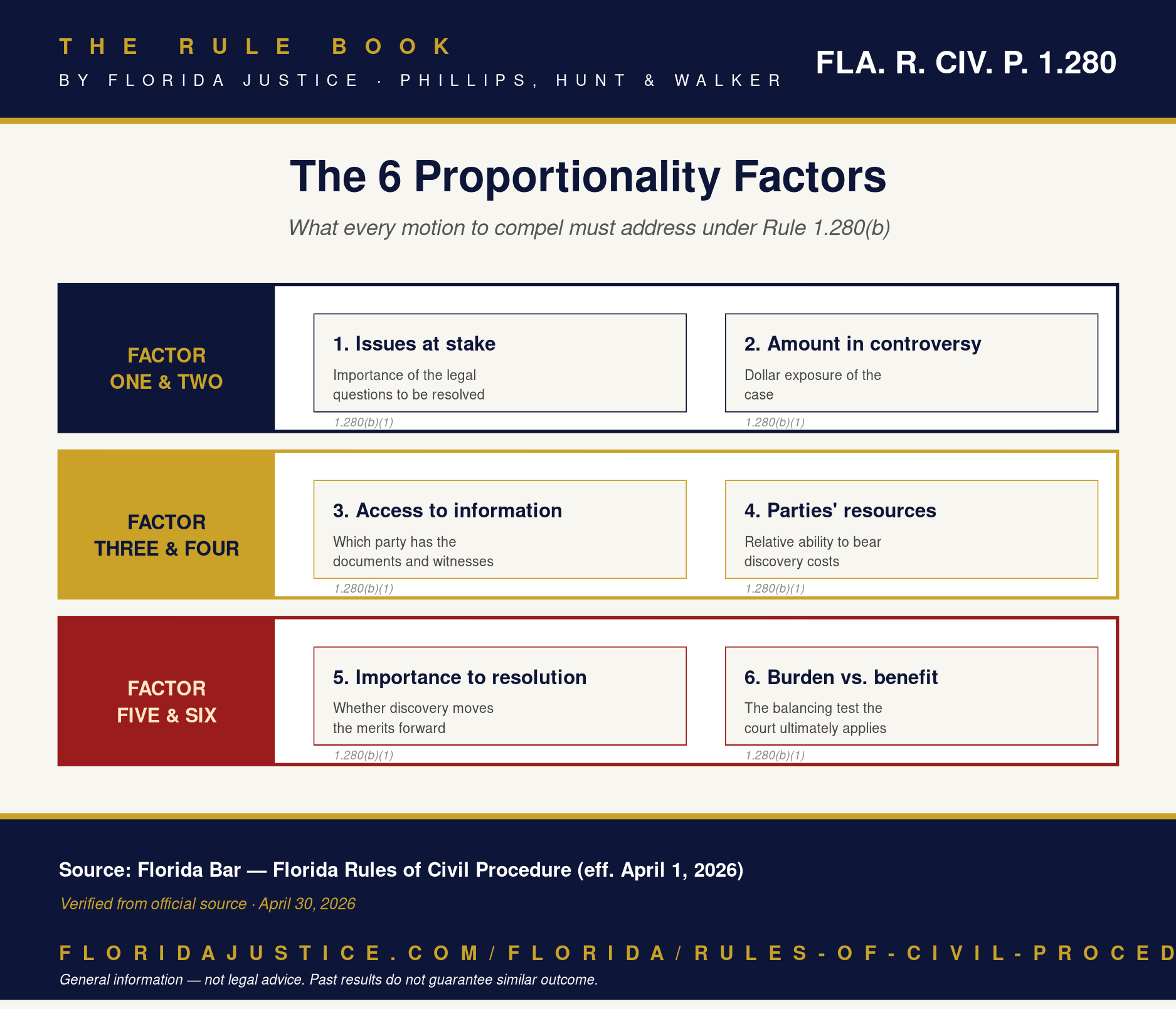
(1) In General. Parties may obtain discovery regarding any nonprivileged matter that is relevant to any party’s claim or defense and proportional to the needs of the case, considering the importance of the issues at stake in the action, the amount in controversy, the parties’ relative access to relevant information, the parties’ resources, the importance of the discovery in resolving the issues, and whether the burden or expense of the proposed discovery outweighs its likely benefit. Information within this scope of discovery need not be admissible in evidence to be discoverable.
(2) Indemnity Agreements. A party may obtain discovery of the existence and contents of any agreement under which any person may be liable to satisfy part or all of a judgment that may be entered in the action or to indemnify or to reimburse a party for payments made to satisfy the judgment. Information concerning the agreement is not admissible in evidence at trial by reason of disclosure.
(3) Electronically Stored Information. A party may obtain discovery of electronically stored information under these rules.
(4) Trial Preparation; Materials. Subject to the provisions of subdivision (c)(5), a party may obtain discovery of documents and tangible things otherwise discoverable under subdivision (c)(1) and prepared in anticipation of litigation or for trial by or for another party or by or for that party’s representative, including that party’s attorney, consultant, surety, indemnitor, insurer, or agent, only on a showing that the party seeking discovery has need of the materials in the preparation of the case and is unable without undue hardship to obtain the substantial equivalent of the materials by other means. In ordering discovery of the materials when the required showing has been made, the court must protect against disclosure of the mental impressions, conclusions, opinions, or legal theories of an attorney or other representative of a party concerning the litigation. Without the required showing a party may obtain a copy of a statement concerning the action or its subject matter previously made by that party. On request without the required showing a person not a party may obtain a copy of a statement concerning the action or its subject matter previously made by that person. If the request is refused, the person may move for an order to obtain a copy. The provisions of rule 1.380(a)(4) apply to the award of expenses incurred as a result of making the motion. For purposes of this paragraph, a statement previously made is a written statement signed or otherwise adopted or approved by the person making it, or a stenographic, mechanical, electrical, or other recording or transcription of it that is a substantially verbatim recital of an oral statement by the person making it and contemporaneously recorded.
(5) Trial Preparation; Experts. Discovery of facts known and opinions held by experts, otherwise discoverable under the provisions of subdivision (c)(1) and acquired or developed in anticipation of litigation or for trial, may be obtained only as follows:
(i) By interrogatories a party may require any other party to identify each person whom the other party expects to call as an expert witness at trial and to state the subject matter on which the expert is expected to testify, and to state the substance of the facts and opinions to which the expert is expected to testify and a summary of the grounds for each opinion.
(ii) Any person disclosed by interrogatories or otherwise as a person expected to be called as an expert witness at trial may be deposed in accordance with rule 1.390 without motion or order of court.
(iii) A party may obtain the following discovery regarding any person disclosed by interrogatories or otherwise as a person expected to be called as an expert witness at trial: 1. The scope of employment in the pending case and the compensation for such service. 2. The expert’s general litigation experience, including the percentage of work performed for plaintiffs and defendants. 3. The identity of other cases, within a reasonable time period, in which the expert has testified by deposition or at trial. 4. An approximation of the portion of the expert’s involvement as an expert witness, which may be based on the number of hours, percentage of hours, or percentage of earned income derived from serving as an expert witness; however, the expert will not be required to disclose the expert’s earnings as an expert witness or income derived from other services. An expert may be required to produce financial and business records only under the most unusual or compelling circumstances and may not be compelled to compile or produce nonexistent documents. On motion, the court may order further discovery by other means, subject to such restrictions as to scope and other provisions under subdivision (c)(5)(C) concerning fees and expenses as the court may deem appropriate.
(B) A party may discover facts known or opinions held by an expert who has been retained or specially employed by another party in anticipation of litigation or preparation for trial and who is not expected to be called as a witness at trial, only as provided in rule 1.360(b) or upon a showing of exceptional circumstances under which it is impracticable for the party seeking discovery to obtain facts or opinions on the same subject by other means.
(C) Unless manifest injustice would result, the court will require that the party seeking discovery pay the expert a reasonable fee for time spent in responding to discovery under subdivisions (c)(5)(A) and (c)(5)(B); and concerning discovery from an expert obtained under subdivision (c)(5)(A) the court may require, and concerning discovery obtained under subdivision (c)(5)(B) will require, the party seeking discovery to pay the other party a fair part of the fees and expenses reasonably incurred by the latter party in obtaining facts and opinions from the expert.
(D) As used in these rules an expert witness is defined in rule 1.390(a).
(6) Claims of Privilege or Protection of Trial Preparation Materials. When a party withholds information otherwise discoverable under these rules by claiming that it is privileged or subject to protection as trial preparation material, the party must make the claim expressly and must describe the nature of the documents, communications, or things not produced or disclosed in a manner that, without revealing information itself privileged or protected, will enable other parties to assess the applicability of the privilege or protection.
(d) Protective Orders. On motion by a party or by the person from whom discovery is sought, and for good cause shown, the court in which the action is pending may make any order to protect a party or person from annoyance, embarrassment, oppression, or undue burden or expense that justice requires, including 1 or more of the following:
(1) that the discovery not be had;
(2) that the discovery may be had only on specified terms and conditions, including a designation of the time or place or the allocation of expenses;
(3) that the discovery may be had only by a method of discovery other than that selected by the party seeking discovery;
(4) that certain matters not be inquired into, or that the scope of the discovery be limited to certain matters;
(5) that discovery be conducted with no one present except persons designated by the court;
(6) that a deposition after being sealed be opened only by order of the court;
(7) that a trade secret or other confidential research, development, or commercial information not be disclosed or be disclosed only in a designated way; and
(8) that the parties simultaneously file specified documents or information enclosed in sealed envelopes to be opened as directed by the court. If the motion for a protective order is denied in whole or in part, the court may, on such terms and conditions as are just, order that any party or person provide or permit discovery. The provisions of rule 1.380(a)(4) apply to the award of expenses incurred in relation to the motion.
(e) Limitations on Discovery of Electronically Stored Information.
(1) A person may object to discovery of electronically stored information from sources that the person identifies as not reasonably accessible because of burden or cost. On motion to compel discovery or for a protective order, the person from whom discovery is sought must show that the information sought or the format requested is not reasonably accessible because of undue burden or cost. If that showing is made, the court may nonetheless order the discovery from such sources or in such formats if the requesting party shows good cause. The court may specify conditions of the discovery, including ordering that some or all of the expenses incurred by the person from whom discovery is sought be paid by the party seeking the discovery.
(2) In determining any motion involving discovery of electronically stored information, the court must limit the frequency or extent of discovery otherwise allowed by these rules if it determines that:
(A) the discovery sought is unreasonably cumulative or duplicative, or can be obtained from another source or in another manner that is more convenient, less burdensome, or less expensive; or
(B) the burden or expense of the discovery outweighs its likely benefit, considering the needs of the case, the amount in controversy, the parties’ resources, the importance of the issues at stake in the action, and the importance of the discovery in resolving the issues.
(f) Timing and Sequence of Discovery.
(1) Timing. A party may not seek discovery from any source before that party’s initial disclosures are served on the other party, except when authorized by stipulation or by court order.
(2) Sequence. Except as provided in subdivision (c)(5), or unless the parties stipulate or the court orders otherwise, methods of discovery may be used in any sequence, and the fact that a party is conducting discovery, whether by deposition or otherwise, must not delay any other party’s discovery.
(g) Supplementing of Responses. A party who has made a disclosure under this rule or who has responded to an interrogatory, a request for production, or a request for admission must supplement or correct its disclosure or response:
(1) in a timely manner if the party learns that in some material respect the disclosure or response is incomplete or incorrect, and if the additional or corrective information has not otherwise been made known to the other parties during the discovery process or in writing; or
(2) as ordered by the court.
(h) Court Filing of Documents and Discovery. Information obtained during discovery may not be filed with the court until such time as it is filed for good cause. The requirement of good cause is satisfied only when the filing of the information is allowed or required by another applicable rule of procedure or by court order. All filings of discovery documents must comply with Florida Rule of General Practice and Judicial Administration 2.425. The court has the authority to impose sanctions for violation of this rule.
(i) Apex Doctrine. A current or former high-level government or corporate officer may seek an order preventing the officer from being subject to a deposition. The motion, whether by a party or by the person of whom the deposition is sought, must be accompanied by an affidavit or declaration of the officer explaining that the officer lacks unique, personal knowledge of the issues being litigated. If the officer meets this burden of production, the court shall issue an order preventing the deposition, unless the party seeking the deposition demonstrates that it has exhausted other discovery, that such discovery is inadequate, and that the officer has unique, personal knowledge of discoverable information. The court may vacate or modify the order if, after additional discovery, the party seeking the deposition can meet its burden of persuasion under this rule. The burden to persuade the court that the officer is high-level for purposes of this rule lies with the person or party opposing the deposition.
(j) Form of Responses to Written Discovery Requests. When responding to requests for production served under rule 1.310(b)(5), written deposition questions served under rule 1.320, interrogatories served under rule 1.340, requests for production or inspection served under rule 1.350, requests for production of documents or things without deposition served under rule 1.351, requests for admissions served under rule 1.370, or requests for the production of documentary evidence served under rule 1.410(c), the responding party must state each deposition question, interrogatory, or discovery request in full as numbered, followed by the answer, objection, or other response.
(k) Signing Disclosures and Discovery Requests; Responses; and Objections. Every initial discovery disclosure under subdivision
(a) of this rule and every discovery request, response, or objection made by a party represented by an attorney must be signed by at least 1 attorney of record and must include the attorney’s address, e-mail address, and telephone number. A self-represented litigant must sign the request, response, or objection and must include the self-represented litigant’s address, e-mail address, and telephone number. By signing, an attorney or self-represented litigant certifies that to the best of the person’s knowledge, information, and belief formed after a reasonable inquiry:
(1) with respect to a disclosure, it is complete and correct as of the time it is made; and
(2) with respect to a discovery request, response, or objection, it is:
(A) consistent with these rules and warranted by existing law or a good faith argument for the extension, modification, or reversal of existing law;
(B) not interposed for any improper purpose, such as to harass or to cause unnecessary delay or needless increase in the cost of litigation; and
(C) not unreasonable or unduly burdensome or expensive, given the needs of the case, the discovery already had in the case, the amount in controversy, and the importance of the issues at stake in the litigation. No party has a duty to act on an unsigned disclosure, request, response, or objection until it is signed. If a certification violates this rule without substantial justification, the court, on motion or on its own, must impose an appropriate sanction on the signer, the party on whose behalf the signer was acting, or both. The sanction may include an order to pay the reasonable expenses, including attorney’s fees, caused by the violation.
Committee Notes
View Committee Notes (legislative history)
1972 Amendment. The rule is derived from Federal Rule of Civil Procedure 26 as amended in 1970. Subdivisions (a), (b)(2), and (b)(3) are new. Subdivision (c) contains material from former rule 1.310(b). Subdivisions (d) and (e) are new, but the latter is similar to former rule 1.340(d). Significant changes are made in discovery from experts. The general rearrangement of the discovery rule is more logical and is the result of 35 years of experience under the federal rules. 1988 Amendment. Subdivision (b)(2) has been added to enable discovery of the existence and contents of indemnity agreements and is the result of the enactment of sections 627.7262 and 627.7264, Florida Statutes, proscribing the joinder of insurers but providing for disclosure. This rule is derived from Federal Rule of Civil Procedure 26(b)(2). Subdivisions (b)(2) and (b)(3) have been redesignated as (b)(3) and (b)(4) respectively. The purpose of the amendment to subdivision (b)(3)(A) (renumbered (b)(4)(A)) is to allow, without leave of court, the depositions of experts who have been disclosed as expected to be used at trial. The purpose of subdivision (b)(4)(D) is to define the term “expert” as used in these rules. 1996 Amendment. The amendments to subdivision (b)(4)(A) are derived from the Supreme Court’s decision in Elkins v. Syken, 672 So. 2d 517 (Fla. 1996). They are intended to avoid annoyance, embarrassment, and undue expense while still permitting the adverse party to obtain relevant information regarding the potential bias or interest of the expert witness.
Subdivision (b)(5) is added and is derived from Federal Rule of Civil Procedure 26(b)(5) (1993). 2011 Amendment. Subdivision (f) is added to ensure that information obtained during discovery is not filed with the court unless there is good cause for the documents to be filed, and that information obtained during discovery that includes certain private information shall not be filed with the court unless the private information is redacted as required by Florida Rule of Judicial Administration 2.425. 2012 Amendment. Subdivisions (b)(3) and (d) are added to address discovery of electronically stored information. The parties should consider conferring with one another at the earliest practical opportunity to discuss the reasonable scope of preservation and production of electronically stored information. These issues may also be addressed by means of a rule 1.200 or rule 1.201 case management conference. Under the good cause test in subdivision (d)(1), the court should balance the costs and burden of the requested discovery, including the potential for disruption of operations or corruption of the electronic devices or systems from which discovery is sought, against the relevance of the information and the requesting party’s need for that information. Under the proportionality and reasonableness factors set out in subdivision (d)(2), the court must limit the frequency or extent of discovery if it determines that the discovery sought is excessive in relation to the factors listed. In evaluating the good cause or proportionality tests, the court may find its task complicated if the parties know little about what information the sources at issue contain, whether the information sought is relevant, or how valuable it may be to the litigation. If appropriate, the court may direct the parties to develop the record further by engaging in focused discovery, including sampling of the sources, to learn more about what electronically stored information may be contained in those sources, what costs and burdens are involved in retrieving, reviewing, and producing the information, and how valuable the information sought may be to the litigation in
light of the availability of information from other sources or methods of discovery, and in light of the parties’ resources and the issues at stake in the litigation. Court Commentary 2000 Amendment. Allstate Insurance Co. v. Boecher, 733 So. 2d 993, 999 (Fla. 1999), clarifies that subdivision (b)(4)(A)(iii) is not intended “to place a blanket bar on discovery from parties about information they have in their possession about an expert, including the party’s financial relationship with the expert.” 2024 Amendment. The scope of discovery in subdivision (c)(1) is amended to adopt almost all the text of Federal Rule of Civil Procedure 26(b)(1) and is to be construed and applied in accordance with the federal proportionality standard.
Plain-English Summary
Florida Rule of Civil Procedure 1.280 is the foundation rule for all civil discovery. It defines what discovery is available, what’s privileged, what’s protected as work product, when supplemental responses are required, and how parties can obtain protective orders.
The 2024 amendments brought Florida discovery closer to the federal model. The rule now includes proportionality language drawn from Federal Rule 26(b)(1) — discovery must be proportional to the needs of the case considering the importance of the issues, amount in controversy, parties’ resources, importance of the discovery in resolving the issues, and whether the burden outweighs the likely benefit.
Subsection (b) defines the scope: any nonprivileged matter relevant to any party’s claim or defense and proportional to the needs of the case. Subsection (c) governs protective orders. Subsection (d) covers electronically stored information (ESI), including format of production, inaccessibility, and cost-shifting. Subsection (e) imposes initial disclosure duties.
Rule 1.280 is the rule every Florida civil practitioner needs to read at the start of every case. Its scope language drives motion practice, its work-product clauses drive privilege fights, and its proportionality factors drive every motion to compel.
Watch: Rule 1.280 Explained
Practitioner Notes — From the Trial Lawyers at Florida Justice
Read the rule before every discovery dispute. 1.280 is the rule judges quote when ruling on motions to compel and motions for protective order. Before drafting either, re-read the proportionality factors in 1.280(b)(1) and the protective-order grounds in 1.280(c). Every objection should be tied to specific language in the rule.
Proportionality is the new fight. The 2024 amendment imported the federal proportionality test. Boilerplate “overly burdensome” objections without tie-back to the proportionality factors get overruled. When you object on burden grounds, specifically address (i) importance of the issues at stake, (ii) amount in controversy, (iii) parties’ relative access to information, (iv) parties’ resources, (v) importance of the discovery to resolving the issues, and (vi) whether burden outweighs benefit.
Work product vs. attorney-client are different fights. 1.280(b)(4) protects work product — materials prepared in anticipation of litigation. Attorney-client privilege is separate. When opposing counsel demands documents, log them under the correct theory or you risk waiver. Opinion work product (mental impressions, theories) gets near-absolute protection; fact work product can be obtained on a showing of substantial need.
ESI rules are technical. 1.280(d) sets the format for ESI production, addresses inaccessible sources, and authorizes cost-shifting when production is unreasonably burdensome. If the case involves email, databases, or large file collections, raise format and cost-shifting at the early case-management conference, not after production has started.
Initial disclosures — don’t sleep on the deadline. 1.280(e) imposes initial disclosure obligations. Mark the deadline on intake. Failure to disclose limits what you can use later under the rule’s exclusion provisions. Treat 1.280(e) compliance with the same urgency as a deposition deadline.
Supplementation is ongoing. Under 1.280(f), parties have a continuing duty to supplement responses when prior answers become incomplete or incorrect. This applies to expert disclosures, witness lists, and document productions. Build supplementation reminders into your case-management calendar.
Related Rules in The Rule Book
- Rule 1.310 — Depositions on Oral Examination (the workhorse discovery tool)
- Rule 1.340 — Interrogatories to Parties (limits and serving rules)
- Rule 1.350 — Production of Documents (document production mechanics)
- Rule 1.380 — Failure to Make Discovery; Sanctions (consequences for noncompliance)
Lawyer-to-Lawyer Co-Counsel Referrals
If you’re a lawyer with a Florida case outside your normal practice — complex civil, catastrophic injury, federal court litigation, multi-state coordination — co-counsel referrals are a core part of what we do. You keep the client. We take the trial-side work. Fee split per Fla. Bar Rule 4-1.5 with full client consent.
Call John directly: (904) 444-4444
This page summarizes a Florida Rule of Civil Procedure for educational purposes. The rule text and Committee Notes are mirrored from the Florida Bar’s official publication and are public domain. The plain-English summary, practitioner notes, and video commentary are the opinion of Phillips, Hunt & Walker and are general information only — not legal advice. Reading this page does not create an attorney-client relationship. Past results do not guarantee a similar outcome in your case.
Subsection-by-Subsection Practitioner Notes — Rule 1.280
Subsection (a) — Methods of Discovery
(a) lists the discovery methods available in Florida civil practice: oral depositions, depositions by written questions, interrogatories, requests for production, examinations of persons, and requests for admission. The list is closed — discovery outside these methods (informal interviews of opposing parties’ employees, ex parte communications with represented parties) is not “discovery” within the rule and may violate other ethical or procedural rules.
Subsection (b) — Scope and Limits (The 2024 Proportionality Amendment)
(b) is the single most-litigated provision in Florida discovery practice after the 2024 amendment. Florida adopted the federal proportionality factors: importance of the issues at stake, amount in controversy, parties’ relative access to information, parties’ resources, importance of the discovery in resolving the issues, and whether the burden or expense outweighs the likely benefit. The change shifts the burden in motion-to-compel practice. The proponent of discovery used to win simply by showing relevance; now they have to address proportionality on the face of the request. Defenders gain a real argument: “yes, this is relevant, but it is not proportional to the needs of this case.”
Subsection (c) — Protective Orders
(c) authorizes protective orders to prevent annoyance, embarrassment, oppression, or undue burden. The court has broad discretion in crafting the order — limit the scope, designate a different time or place, designate the persons who may be present, require sealing, or require trade-secret-style filing under seal. The party seeking protection bears the burden of showing good cause.
Subsection (e) — Work Product
(e) codifies Florida’s work-product doctrine. Materials prepared in anticipation of litigation by a party or its representative are protected. Fact work product is discoverable only on a substantial-need showing. Opinion work product (mental impressions, conclusions, opinions, legal theories) is given near-absolute protection. Treat every internal memo, witness-interview note, and litigation-strategy document as opinion work product unless you affirmatively want to put it in evidence.
Subsection (f) — Expert Discovery
(f) governs discovery of experts. Testifying experts are subject to deposition and to disclosure of opinions, the basis for those opinions, qualifications, and compensation. Consulting experts who are not expected to testify are generally protected from discovery except on a showing of exceptional circumstances. The line between “consulting” and “testifying” hardens on disclosure — once an expert is disclosed as a trial witness, prior consulting work for that case becomes discoverable.
Subsection (g) — Supplementation
(g) imposes an ongoing duty to supplement discovery responses when the responding party learns the response was incorrect when made or is no longer correct. Failure to supplement can trigger sanctions under Rule 1.380, including witness or evidence preclusion at trial.
Cross-references: See Rule 1.310 (oral depositions), Rule 1.340 (interrogatory limits), Rule 1.350 (document production), and Rule 1.380 (sanctions).
Infographic
Rule Text (verbatim from the Florida Supreme Court)
(a) Initial Discovery Disclosure. (1) In General. Except as exempted by subdivision (a)(2) or as ordered by the court, a party must, without awaiting a discovery request, provide to the other parties the following initial discovery disclosures unless privileged or protected from disclosure:
(A) the name and, if known, the address, telephone number, and e-mail address of each individual likely to have discoverable information—along with the subjects of that information—that the disclosing party may use to support its claims or defenses, unless the use would be solely for impeachment; (B) a copy—or a description by category and location—of all documents, electronically stored information, and tangible things that the disclosing party has in its possession, custody, or control (or, if not in the disclosing party’s possession, custody, or control, a description by category and location of such information) and may use to support its claims or defenses, unless the use would be solely for impeachment; (C) a computation for each category of damages claimed by the disclosing party and a copy of the documents or other evidentiary material, unless privileged or protected from disclosure, on which each computation is based, including materials bearing on the nature and extent of injuries suffered; provided that a party is not required to provide computations as to noneconomic damages, but the party must identify categories of damages claimed and provide supporting documents; and (D) a copy of any insurance policy or agreement under which an insurance business may be liable to satisfy all or part of a possible judgment in the action or to indemnify or reimburse for payments made to satisfy the judgment. (2) Proceedings Exempt from Initial Discovery Disclosure. Unless ordered by the court, actions and claims listed in rule 1.200(a) are exempt from initial discovery disclosure. (3) Time for Initial Discovery Disclosures. A party must make the initial discovery disclosures required by this rule within 60 days after the service of the complaint or joinder, unless a different time is set by court order. (4) Basis for Initial Discovery Disclosure; Unacceptable Excuses; Objections. A party must make its initial discovery
disclosures based on the information then reasonably available to it. A party is not excused from making its initial discovery disclosures because it has not fully investigated the case or because it challenges the sufficiency of another party’s initial discovery disclosures or because another party has not made its initial discovery disclosures. A party who formally objects to providing certain information is not excused from making all other initial discovery disclosures required by this rule in a timely manner. (b) Discovery Methods. Parties may obtain discovery by 1 or more of the following methods: depositions on oral examination or written questions; written interrogatories; production of documents or things or permission to enter on land or other property for inspection and other purposes; physical and mental examinations; and requests for admission. Unless the court orders otherwise and under subdivision (d), the frequency of use of these methods is not limited, except as provided in rules 1.200, 1.340, and 1.370. (c) Scope of Discovery. Unless otherwise limited by court order, the scope of discovery is as follows: (1) In General. Parties may obtain discovery regarding any nonprivileged matter that is relevant to any party’s claim or defense and proportional to the needs of the case, considering the importance of the issues at stake in the action, the amount in controversy, the parties’ relative access to relevant information, the parties’ resources, the importance of the discovery in resolving the issues, and whether the burden or expense of the proposed discovery outweighs its likely benefit. Information within this scope of discovery need not be admissible in evidence to be discoverable. (2) Indemnity Agreements. A party may obtain discovery of the existence and contents of any agreement under which any person may be liable to satisfy part or all of a judgment that may be entered in the action or to indemnify or to reimburse a party for payments made to satisfy the judgment. Information concerning the agreement is not admissible in evidence at trial by reason of disclosure.
(3) Electronically Stored Information. A party may obtain discovery of electronically stored information under these rules. (4) Trial Preparation; Materials. Subject to the provisions of subdivision (c)(5), a party may obtain discovery of documents and tangible things otherwise discoverable under subdivision (c)(1) and prepared in anticipation of litigation or for trial by or for another party or by or for that party’s representative, including that party’s attorney, consultant, surety, indemnitor, insurer, or agent, only on a showing that the party seeking discovery has need of the materials in the preparation of the case and is unable without undue hardship to obtain the substantial equivalent of the materials by other means. In ordering discovery of the materials when the required showing has been made, the court must protect against disclosure of the mental impressions, conclusions, opinions, or legal theories of an attorney or other representative of a party concerning the litigation. Without the required showing a party may obtain a copy of a statement concerning the action or its subject matter previously made by that party. On request without the required showing a person not a party may obtain a copy of a statement concerning the action or its subject matter previously made by that person. If the request is refused, the person may move for an order to obtain a copy. The provisions of rule 1.380(a)(4) apply to the award of expenses incurred as a result of making the motion. For purposes of this paragraph, a statement previously made is a written statement signed or otherwise adopted or approved by the person making it, or a stenographic, mechanical, electrical, or other recording or transcription of it that is a substantially verbatim recital of an oral statement by the person making it and contemporaneously recorded. (5) Trial Preparation; Experts. Discovery of facts known and opinions held by experts, otherwise discoverable under the provisions of subdivision (c)(1) and acquired or developed in anticipation of litigation or for trial, may be obtained only as follows:
(A) (i) By interrogatories a party may require any other party to identify each person whom the other party expects to call as an expert witness at trial and to state the subject matter on which the expert is expected to testify, and to state the substance of the facts and opinions to which the expert is expected to testify and a summary of the grounds for each opinion. (ii) Any person disclosed by interrogatories or otherwise as a person expected to be called as an expert witness at trial may be deposed in accordance with rule 1.390 without motion or order of court. (iii) A party may obtain the following discovery regarding any person disclosed by interrogatories or otherwise as a person expected to be called as an expert witness at trial: 1. The scope of employment in the pending case and the compensation for such service. 2. The expert’s general litigation experience, including the percentage of work performed for plaintiffs and defendants. 3. The identity of other cases, within a reasonable time period, in which the expert has testified by deposition or at trial. 4. An approximation of the portion of the expert’s involvement as an expert witness, which may be based on the number of hours, percentage of hours, or percentage of earned income derived from serving as an expert witness; however, the expert will not be required to disclose the expert’s earnings as an expert witness or income derived from other services. An expert may be required to produce financial and business records only under the most unusual or compelling circumstances and may not be compelled to compile or produce nonexistent documents. On motion, the court may order further discovery by other means, subject to such restrictions as to scope and other
provisions under subdivision (c)(5)(C) concerning fees and expenses as the court may deem appropriate. (B) A party may discover facts known or opinions held by an expert who has been retained or specially employed by another party in anticipation of litigation or preparation for trial and who is not expected to be called as a witness at trial, only as provided in rule 1.360(b) or upon a showing of exceptional circumstances under which it is impracticable for the party seeking discovery to obtain facts or opinions on the same subject by other means. (C) Unless manifest injustice would result, the court will require that the party seeking discovery pay the expert a reasonable fee for time spent in responding to discovery under subdivisions (c)(5)(A) and (c)(5)(B); and concerning discovery from an expert obtained under subdivision (c)(5)(A) the court may require, and concerning discovery obtained under subdivision (c)(5)(B) will require, the party seeking discovery to pay the other party a fair part of the fees and expenses reasonably incurred by the latter party in obtaining facts and opinions from the expert. (D) As used in these rules an expert witness is defined in rule 1.390(a). (6) Claims of Privilege or Protection of Trial Preparation Materials. When a party withholds information otherwise discoverable under these rules by claiming that it is privileged or subject to protection as trial preparation material, the party must make the claim expressly and must describe the nature of the documents, communications, or things not produced or disclosed in a manner that, without revealing information itself privileged or protected, will enable other parties to assess the applicability of the privilege or protection. (d) Protective Orders. On motion by a party or by the person from whom discovery is sought, and for good cause shown, the court in which the action is pending may make any order to protect a party or person from annoyance, embarrassment,
oppression, or undue burden or expense that justice requires, including 1 or more of the following: (1) that the discovery not be had; (2) that the discovery may be had only on specified terms and conditions, including a designation of the time or place or the allocation of expenses; (3) that the discovery may be had only by a method of discovery other than that selected by the party seeking discovery; (4) that certain matters not be inquired into, or that the scope of the discovery be limited to certain matters; (5) that discovery be conducted with no one present except persons designated by the court; (6) that a deposition after being sealed be opened only by order of the court; (7) that a trade secret or other confidential research, development, or commercial information not be disclosed or be disclosed only in a designated way; and (8) that the parties simultaneously file specified documents or information enclosed in sealed envelopes to be opened as directed by the court. If the motion for a protective order is denied in whole or in part, the court may, on such terms and conditions as are just, order that any party or person provide or permit discovery. The provisions of rule 1.380(a)(4) apply to the award of expenses incurred in relation to the motion. (e) Limitations on Discovery of Electronically Stored Information. (1) A person may object to discovery of electronically stored information from sources that the person identifies as not reasonably accessible because of burden or cost. On motion to
compel discovery or for a protective order, the person from whom discovery is sought must show that the information sought or the format requested is not reasonably accessible because of undue burden or cost. If that showing is made, the court may nonetheless order the discovery from such sources or in such formats if the requesting party shows good cause. The court may specify conditions of the discovery, including ordering that some or all of the expenses incurred by the person from whom discovery is sought be paid by the party seeking the discovery. (2) In determining any motion involving discovery of electronically stored information, the court must limit the frequency or extent of discovery otherwise allowed by these rules if it determines that: (A) the discovery sought is unreasonably cumulative or duplicative, or can be obtained from another source or in another manner that is more convenient, less burdensome, or less expensive; or (B) the burden or expense of the discovery outweighs its likely benefit, considering the needs of the case, the amount in controversy, the parties’ resources, the importance of the issues at stake in the action, and the importance of the discovery in resolving the issues. (f) Timing and Sequence of Discovery. (1) Timing. A party may not seek discovery from any source before that party’s initial disclosures are served on the other party, except when authorized by stipulation or by court order. (2) Sequence. Except as provided in subdivision (c)(5), or unless the parties stipulate or the court orders otherwise, methods of discovery may be used in any sequence, and the fact that a party is conducting discovery, whether by deposition or otherwise, must not delay any other party’s discovery. (g) Supplementing of Responses. A party who has made a disclosure under this rule or who has responded to an
interrogatory, a request for production, or a request for admission must supplement or correct its disclosure or response: (1) in a timely manner if the party learns that in some material respect the disclosure or response is incomplete or incorrect, and if the additional or corrective information has not otherwise been made known to the other parties during the discovery process or in writing; or (2) as ordered by the court. (h) Court Filing of Documents and Discovery. Information obtained during discovery may not be filed with the court until such time as it is filed for good cause. The requirement of good cause is satisfied only when the filing of the information is allowed or required by another applicable rule of procedure or by court order. All filings of discovery documents must comply with Florida Rule of General Practice and Judicial Administration 2.425. The court has the authority to impose sanctions for violation of this rule. (i) Apex Doctrine. A current or former high-level government or corporate officer may seek an order preventing the officer from being subject to a deposition. The motion, whether by a party or by the person of whom the deposition is sought, must be accompanied by an affidavit or declaration of the officer explaining that the officer lacks unique, personal knowledge of the issues being litigated. If the officer meets this burden of production, the court shall issue an order preventing the deposition, unless the party seeking the deposition demonstrates that it has exhausted other discovery, that such discovery is inadequate, and that the officer has unique, personal knowledge of discoverable information. The court may vacate or modify the order if, after additional discovery, the party seeking the deposition can meet its burden of persuasion under this rule. The burden to persuade the court that the officer is high-level for purposes of this rule lies with the person or party opposing the deposition. (j) Form of Responses to Written Discovery Requests. When responding to requests for production served under rule 1.310(b)(5), written deposition questions served under rule 1.320,
interrogatories served under rule 1.340, requests for production or inspection served under rule 1.350, requests for production of documents or things without deposition served under rule 1.351, requests for admissions served under rule 1.370, or requests for the production of documentary evidence served under rule 1.410(c), the responding party must state each deposition question, interrogatory, or discovery request in full as numbered, followed by the answer, objection, or other response. (k) Signing Disclosures and Discovery Requests; Responses; and Objections. Every initial discovery disclosure under subdivision (a) of this rule and every discovery request, response, or objection made by a party represented by an attorney must be signed by at least 1 attorney of record and must include the attorney’s address, e-mail address, and telephone number. A self-represented litigant must sign the request, response, or objection and must include the self-represented litigant’s address, e-mail address, and telephone number. By signing, an attorney or self-represented litigant certifies that to the best of the person’s knowledge, information, and belief formed after a reasonable inquiry: (1) with respect to a disclosure, it is complete and correct as of the time it is made; and (2) with respect to a discovery request, response, or objection, it is: (A) consistent with these rules and warranted by existing law or a good faith argument for the extension, modification, or reversal of existing law; (B) not interposed for any improper purpose, such as to harass or to cause unnecessary delay or needless increase in the cost of litigation; and (C) not unreasonable or unduly burdensome or expensive, given the needs of the case, the discovery already had in the case, the amount in controversy, and the importance of the issues at stake in the litigation.
No party has a duty to act on an unsigned disclosure, request, response, or objection until it is signed. If a certification violates this rule without substantial justification, the court, on motion or on its own, must impose an appropriate sanction on the signer, the party on whose behalf the signer was acting, or both. The sanction may include an order to pay the reasonable expenses, including attorney’s fees, caused by the violation.
Educational reference. This page summarizes a Florida Rule of Civil Procedure for educational purposes. The rule text and Committee Notes are mirrored from the Florida Bar's official publication and are public domain. The plain-English summary, practitioner notes, and video commentary are the opinion of Phillips, Hunt & Walker and are general information only — not legal advice. Reading this page does not create an attorney-client relationship. Past results do not guarantee a similar outcome in your case.
What this rule means in plain English
Florida Rule of Civil Procedure 1.280 is the foundation rule for all civil discovery. It defines what discovery is available, what’s privileged, what’s protected as work product, when supplemental responses are required, and how parties can obtain protective orders.
The 2024 amendments brought Florida discovery closer to the federal model. The rule now includes proportionality language drawn from Federal Rule 26(b)(1) — discovery must be proportional to the needs of the case considering the importance of the issues, amount in controversy, parties’ resources, importance of the discovery in resolving the issues, and whether the burden outweighs the likely benefit.
Subsection (b) defines the scope: any nonprivileged matter relevant to any party’s claim or defense and proportional to the needs of the case. Subsection (c) governs protective orders. Subsection (d) covers electronically stored information (ESI), including format of production, inaccessibility, and cost-shifting. Subsection (e) imposes initial disclosure duties.
Rule 1.280 is the rule every Florida civil practitioner needs to read at the start of every case. Its scope language drives motion practice, its work-product clauses drive privilege fights, and its proportionality factors drive every motion to compel.
Practitioner notes
Read the rule before every discovery dispute. 1.280 is the rule judges quote when ruling on motions to compel and motions for protective order. Before drafting either, re-read the proportionality factors in 1.280(b)(1) and the protective-order grounds in 1.280(c). Every objection should be tied to specific language in the rule.
Proportionality is the new fight. The 2024 amendment imported the federal proportionality test. Boilerplate “overly burdensome” objections without tie-back to the proportionality factors get overruled. When you object on burden grounds, specifically address (i) importance of the issues at stake, (ii) amount in controversy, (iii) parties’ relative access to information, (iv) parties’ resources, (v) importance of the discovery to resolving the issues, and (vi) whether burden outweighs benefit.
Work product vs. attorney-client are different fights. 1.280(b)(4) protects work product — materials prepared in anticipation of litigation. Attorney-client privilege is separate. When opposing counsel demands documents, log them under the correct theory or you risk waiver. Opinion work product (mental impressions, theories) gets near-absolute protection; fact work product can be obtained on a showing of substantial need.
ESI rules are technical. 1.280(d) sets the format for ESI production, addresses inaccessible sources, and authorizes cost-shifting when production is unreasonably burdensome. If the case involves email, databases, or large file collections, raise format and cost-shifting at the early case-management conference, not after production has started.
Initial disclosures — don’t sleep on the deadline. 1.280(e) imposes initial disclosure obligations. Mark the deadline on intake. Failure to disclose limits what you can use later under the rule’s exclusion provisions. Treat 1.280(e) compliance with the same urgency as a deposition deadline.
Supplementation is ongoing. Under 1.280(f), parties have a continuing duty to supplement responses when prior answers become incomplete or incorrect. This applies to expert disclosures, witness lists, and document productions. Build supplementation reminders into your case-management calendar.
Committee Notes (verbatim)
1972 Amendment. The rule is derived from Federal Rule of Civil Procedure 26 as amended in 1970. Subdivisions (a), (b)(2), and (b)(3) are new. Subdivision (c) contains material from former rule 1.310(b). Subdivisions (d) and (e) are new, but the latter is similar to former rule 1.340(d). Significant changes are made in discovery from experts. The general rearrangement of the discovery rule is more logical and is the result of 35 years of experience under the federal rules. 1988 Amendment. Subdivision (b)(2) has been added to enable discovery of the existence and contents of indemnity agreements and is the result of the enactment of sections 627.7262 and 627.7264, Florida Statutes, proscribing the joinder of insurers but providing for disclosure. This rule is derived from Federal Rule of Civil Procedure 26(b)(2). Subdivisions (b)(2) and (b)(3) have been redesignated as (b)(3) and (b)(4) respectively. The purpose of the amendment to subdivision (b)(3)(A) (renumbered (b)(4)(A)) is to allow, without leave of court, the depositions of experts who have been disclosed as expected to be used at trial. The purpose of subdivision (b)(4)(D) is to define the term “expert” as used in these rules. 1996 Amendment. The amendments to subdivision (b)(4)(A) are derived from the Supreme Court’s decision in Elkins v. Syken, 672 So. 2d 517 (Fla. 1996). They are intended to avoid annoyance, embarrassment, and undue expense while still permitting the adverse party to obtain relevant information regarding the potential bias or interest of the expert witness.
Subdivision (b)(5) is added and is derived from Federal Rule of Civil Procedure 26(b)(5) (1993). 2011 Amendment. Subdivision (f) is added to ensure that information obtained during discovery is not filed with the court unless there is good cause for the documents to be filed, and that information obtained during discovery that includes certain private information shall not be filed with the court unless the private information is redacted as required by Florida Rule of Judicial Administration 2.425. 2012 Amendment. Subdivisions (b)(3) and (d) are added to address discovery of electronically stored information. The parties should consider conferring with one another at the earliest practical opportunity to discuss the reasonable scope of preservation and production of electronically stored information. These issues may also be addressed by means of a rule 1.200 or rule 1.201 case management conference. Under the good cause test in subdivision (d)(1), the court should balance the costs and burden of the requested discovery, including the potential for disruption of operations or corruption of the electronic devices or systems from which discovery is sought, against the relevance of the information and the requesting party’s need for that information. Under the proportionality and reasonableness factors set out in subdivision (d)(2), the court must limit the frequency or extent of discovery if it determines that the discovery sought is excessive in relation to the factors listed. In evaluating the good cause or proportionality tests, the court may find its task complicated if the parties know little about what information the sources at issue contain, whether the information sought is relevant, or how valuable it may be to the litigation. If appropriate, the court may direct the parties to develop the record further by engaging in focused discovery, including sampling of the sources, to learn more about what electronically stored information may be contained in those sources, what costs and burdens are involved in retrieving, reviewing, and producing the information, and how valuable the information sought may be to the litigation in
light of the availability of information from other sources or methods of discovery, and in light of the parties’ resources and the issues at stake in the litigation. Court Commentary 2000 Amendment. Allstate Insurance Co. v. Boecher, 733 So. 2d 993, 999 (Fla. 1999), clarifies that subdivision (b)(4)(A)(iii) is not intended “to place a blanket bar on discovery from parties about information they have in their possession about an expert, including the party’s financial relationship with the expert.” 2024 Amendment. The scope of discovery in subdivision (c)(1) is amended to adopt almost all the text of Federal Rule of Civil Procedure 26(b)(1) and is to be construed and applied in accordance with the federal proportionality standard.