



Fla. R. Civ. P. 1.510 — Summary Judgment
Last verified from official source: April 30, 2026 · Source: Florida Bar — Florida Rules of Civil Procedure (eff. April 1, 2026), p. 169
Rule Text (Verbatim)
The text below is mirrored verbatim from the Florida Bar’s official publication, with FRCP’s hierarchical indentation preserved. Public domain.
(a) Motion for Summary Judgment or Partial Summary Judgment. A party may move for summary judgment, identifying each claim or defense—or the part of each claim or defense—on which summary judgment is sought. The court shall grant summary judgment if the movant shows that there is no genuine dispute as to any material fact and the movant is entitled to judgment as a matter of law. The court shall state on the record the reasons for granting or denying the motion. The summary judgment standard provided for in this rule shall be construed and applied in accordance with the federal summary judgment standard.
(b) Time to File a Motion. A party may move for summary judgment at any time after the expiration of 20 days from the commencement of the action or after service of a motion for summary judgment by the adverse party. The movant must file and serve the motion for summary judgment consistent with any court- ordered deadlines.
(c) Procedures.
(1) Supporting Factual Positions. A party asserting that a fact cannot be or is genuinely disputed must support the assertion by:
(A) citing to particular parts of materials in the record, including depositions, documents, electronically stored information, affidavits or declarations, stipulations (including those made for purposes of the motion only), admissions, interrogatory answers, or other materials; or
(B) showing that the materials cited do not establish the absence or presence of a genuine dispute, or that an adverse party cannot produce admissible evidence to support the fact.
(2) Objection That a Fact Is Not Supported by Admissible Evidence. A party may object that the material cited to support or dispute a fact cannot be presented in a form that would be admissible in evidence.
(3) Materials Not Cited. The court need consider only the cited materials, but it may consider other materials in the record.
(4) Affidavits or Declarations. An affidavit or declaration used to support or oppose a motion must be made on personal knowledge, set out facts that would be admissible in evidence, and show that the affiant or declarant is competent to testify on the matters stated.
(5) Timing for Supporting Factual Positions. At the time of filing a motion for summary judgment, the movant must also serve the movant’s supporting factual position as provided in subdivision
(1) above. No later than 40 days after service of the motion for summary judgment, the nonmovant must serve a response that includes the nonmovant’s supporting factual position as provided in subdivision
(1) above.
(6) Timing for Hearing. Any hearing on a motion for summary judgment must be set for a date at least 10 days after the deadline for serving a response, unless the parties stipulate or the court orders otherwise.
(d) When Facts Are Unavailable to the Nonmovant. If a nonmovant shows by affidavit or declaration that, for specified reasons, it cannot present facts essential to justify its opposition, the court may:
(1) defer considering the motion or deny it;
(2) allow time to obtain affidavits or declarations or to take discovery; or
(3) issue any other appropriate order.
(e) Failing to Properly Support or Address a Fact. If a party fails to properly support an assertion of fact or fails to properly address another party’s assertion of fact as required by rule 1.510(c), the court may:
(1) give an opportunity to properly support or address the fact;
(2) consider the fact undisputed for purposes of the motion;
(3) grant summary judgment if the motion and supporting materials—including the facts considered undisputed— show that the movant is entitled to it; or
(4) issue any other appropriate order.
(f) Judgment Independent of the Motion. After giving notice and a reasonable time to respond, the court may:
(1) grant summary judgment for a nonmovant;
(2) grant the motion on grounds not raised by a party; or
(3) consider summary judgment on its own after identifying for the parties material facts that may not be genuinely in dispute.
(g) Failing to Grant All the Requested Relief. If the court does not grant all the relief requested by the motion, it may enter an order stating any material fact—including an item of damages or other relief—that is not genuinely in dispute and treating the fact as established in the case.
(h) Affidavit or Declaration Submitted in Bad Faith. If satisfied that an affidavit or declaration under this rule is submitted in bad faith or solely for delay, the court—after notice and a reasonable time to respond—may order the submitting party to pay the other party the reasonable expenses, including attorney’s fees, it incurred as a result. An offending party or attorney may also be held in contempt or subjected to other appropriate sanctions. Court Notes 2021 Amendment. The rule is amended to adopt almost all the text of Federal Rule of Civil Procedure 56. The “federal summary judgment standard” refers to the principles announced in Celotex Corp. v. Catrett, 477 U.S. 317 (1986), Anderson v. Liberty Lobby, Inc., 477 U.S. 242 (1986), and Matsushita Electric Industrial Co. v. Zenith Radio Corp., 475 U.S. 574 (1986), and more generally to case law interpreting Federal Rule of Civil Procedure 56.
Committee Notes
View Committee Notes (legislative history)
1976 Amendment. Subdivision (c) has been amended to require a movant to state with particularity the grounds and legal authority which the movant will rely upon in seeking summary judgment. This amendment will eliminate surprise and bring the summary judgment rule into conformity with the identical provision in rule 1.140(b) with respect to motions to dismiss. 1992 Amendment. The amendment to subdivision (c) will require timely service of opposing affidavits, whether by mail or by delivery, prior to the day of the hearing on a motion for summary judgment. 2005 Amendment. Subdivision (c) has been amended to ensure that the moving party and the adverse party are each given advance notice of and, where appropriate, copies of the evidentiary
material on which the other party relies in connection with a summary judgment motion. 2012 Amendment. Subdivision (c) is amended to reflect the relocation of the service rule from rule 1.080 to Fla. R. Jud. Admin. 2.516.
Plain-English Summary
Florida Rule of Civil Procedure 1.510 was rewritten by the Florida Supreme Court effective May 1, 2021, to align Florida summary judgment practice with the federal standard. The change is among the most consequential procedural amendments in modern Florida practice.
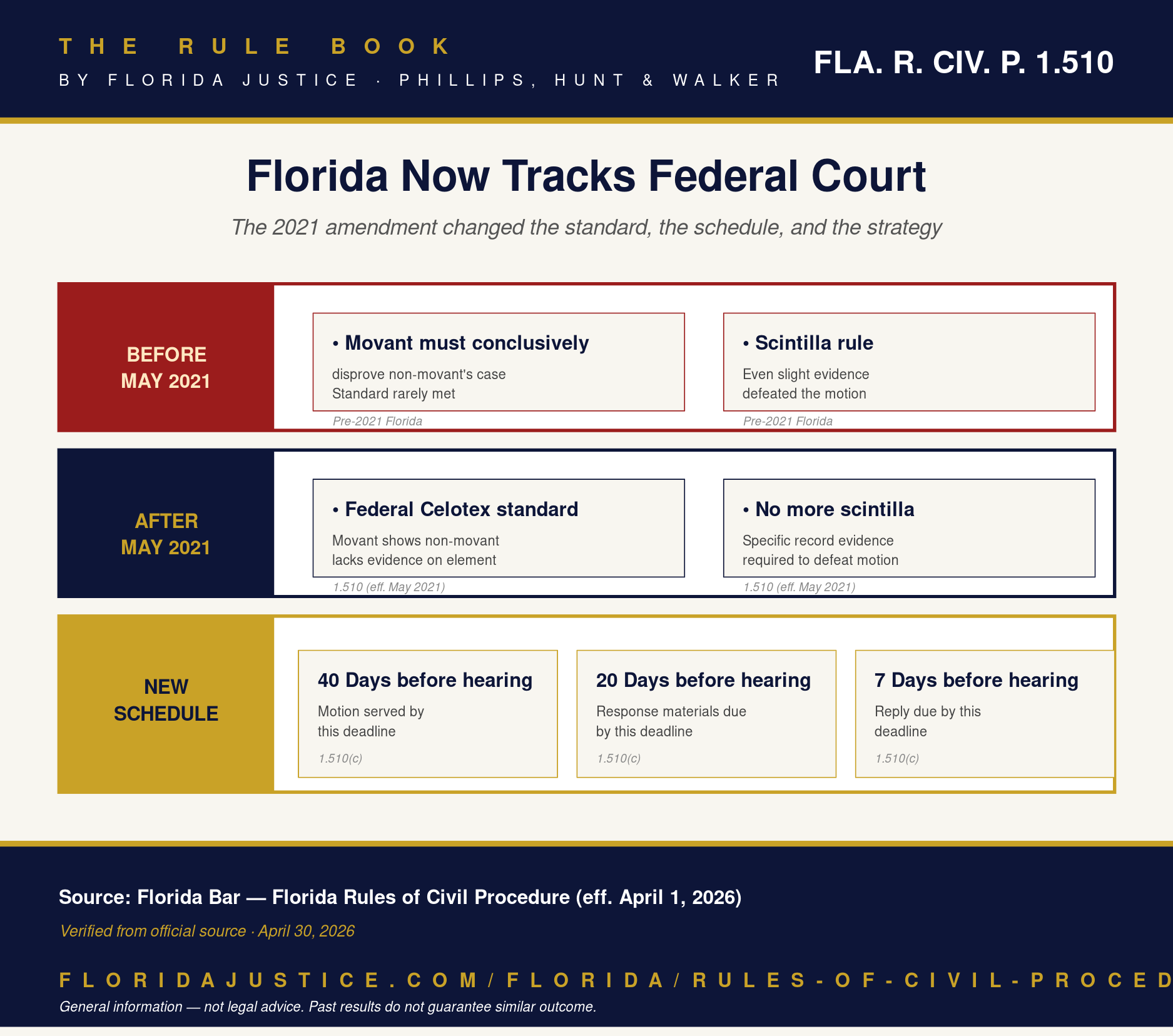
Pre-2021, Florida required the moving party to conclusively disprove the non-movant’s case — a standard so favorable to non-movants that summary judgment was rarely granted. The 2021 amendment scrapped that. Under the current rule, the moving party can prevail by showing the non-moving party lacks evidence sufficient to establish an essential element of its claim. The non-movant must come forward with concrete evidence — not allegations — to defeat the motion.
Subsection (c) sets the schedule: the motion must be served at least 40 days before hearing. Response materials are due 20 days before the hearing. The reply is due 7 days before the hearing. These deadlines are strict and drive case-management calendars.
The rule applies the federal Celotex standard. The court views evidence in the light most favorable to the non-movant but is not required to credit a “scintilla” of evidence. More cases now resolve at summary judgment than under the prior rule. Trial defense and plaintiff strategy both shifted in 2021 — and five years later, practitioners who haven’t internalized the change are at a disadvantage.
Practitioner Notes — From the Trial Lawyers at Florida Justice
The standard changed in 2021. Internalize it. Pre-2021 case law applying the old “conclusively disprove” standard is now obsolete on the substantive standard. Cite federal Celotex-line authority and the 2021 amendment commentary, not pre-2021 Florida case law that articulated the prior standard. Misciting the standard is a common reason summary judgment motions fail.
40 / 20 / 7 — the new schedule is strict. 1.510(c) sets a 40-day-before-hearing deadline for the motion, 20-day deadline for response materials, and 7-day deadline for reply. Trial courts enforce these deadlines. Motions filed less than 40 days out are commonly continued or denied without prejudice. Calendar these dates from the hearing date backward.
Frame the absence of evidence, not the existence of contrary evidence. Under the new standard, a movant who shows the non-movant lacks evidence on an essential element wins. The motion does not need to disprove the case — it just needs to highlight the evidentiary gap. Draft the motion accordingly: identify the essential element, state the absence of evidence supporting it, and require the non-movant to produce specific evidence.
Discovery must be sufficient before the motion. A premature motion — filed before discovery has been adequate — invites a 1.510(d) request to defer. The court can defer ruling pending discovery. Make sure the discovery record is sufficient before filing. Conversely, when responding to a premature motion, immediately invoke 1.510(d) and identify specific discovery needed.
Specific facts beat allegations. The non-movant cannot rest on pleadings or allegations. The response must cite specific record evidence — deposition pages, affidavit paragraphs, document Bates numbers. Generic statements (“there is a genuine issue of material fact”) do not defeat the motion. Treat the response like trial — every assertion must have a record citation.
Partial summary judgment is the right tool more often than full. 1.510(a) authorizes summary judgment on individual claims, defenses, or issues. Many cases that don’t justify full summary judgment have specific issues that can be resolved as a matter of law. Identify those issues and move surgically — narrowing the trial issues changes settlement leverage.
Related Rules in The Rule Book
- Rule 1.140 — Defenses (Motion to Dismiss) (earlier-stage challenge to the pleadings)
- Rule 1.380 — Failure to Make Discovery; Sanctions (discovery as foundation for the motion)
- Rule 1.420 — Dismissal of Actions (alternative case-disposition route)
- Rule 1.530 — Motions for New Trial and Rehearing (post-judgment relief if SJ entered)
Lawyer-to-Lawyer Co-Counsel Referrals
If you’re a lawyer with a Florida case outside your normal practice — complex civil, catastrophic injury, federal court litigation, multi-state coordination — co-counsel referrals are a core part of what we do. You keep the client. We take the trial-side work. Fee split per Fla. Bar Rule 4-1.5 with full client consent.
Call John directly: (904) 444-4444
This page summarizes a Florida Rule of Civil Procedure for educational purposes. The rule text and Committee Notes are mirrored from the Florida Bar’s official publication and are public domain. The plain-English summary, practitioner notes, and video commentary are the opinion of Phillips, Hunt & Walker and are general information only — not legal advice. Reading this page does not create an attorney-client relationship. Past results do not guarantee a similar outcome in your case.
The 2021 Federal-Standard Amendment — What Changed
Effective May 1, 2021, the Florida Supreme Court rewrote Rule 1.510 to align Florida summary judgment practice with the federal standard articulated in the Celotex Corp. v. Catrett, Anderson v. Liberty Lobby, and Matsushita Electric Industrial Co. v. Zenith Radio Corp. trilogy. The change is substantive, not cosmetic.
Gone: The “Slightest Doubt” Standard
For decades, Florida courts denied summary judgment if the record showed even the slightest doubt about a material fact. The non-movant could survive by raising any plausible factual dispute, however thin. That standard is gone. Florida now applies the federal “no genuine dispute of material fact” test, which permits summary judgment when the non-movant cannot produce evidence sufficient for a reasonable jury to find in their favor.
Subsection (a) — Standard
(a) now requires summary judgment when the movant shows there is no genuine dispute as to any material fact and the movant is entitled to judgment as a matter of law. The trial court must state the reasons on the record — a written or oral statement of the basis for granting or denying the motion. This requirement was added with the 2021 amendment to facilitate appellate review.
Subsection (c) — Time and Procedure
(c) sets the timing. The motion and supporting documents must be served at least 40 days before the hearing. The non-movant must respond at least 20 days before the hearing. These windows are critical — late-filed evidence can be disregarded. Calendar the hearing date backward to set the filing deadlines.
The Movant’s Initial Burden
Under Celotex, the movant on a fact for which the movant bears the burden of proof at trial must produce affirmative evidence. The movant on a fact for which the non-movant bears the burden of proof can satisfy the initial burden by pointing out the absence of evidence on an essential element. The non-movant must then come forward with admissible evidence creating a genuine dispute. Florida courts now follow this allocation.
The Non-Movant’s Burden — No More “Inferences” Argument
Under the old “slightest doubt” rule, non-movants could often defeat motions by asking the court to draw inferences in their favor. The 2021 amendment requires the non-movant to identify specific facts in the record that would permit a reasonable jury to find for them. Generalized arguments about the strength of the non-movant’s case at trial are not enough.
Practical Impact
Defense counsel who previously avoided 1.510 motions because of the harsh non-movant-friendly standard now have a real tool. Plaintiff’s counsel who relied on “we’ll show this at trial” must now build the trial record into the summary judgment opposition.
Cross-references: See Rule 1.140 (motion to dismiss vs. summary judgment), Rule 1.280 (discovery support for summary judgment record), and Rule 1.480 (directed verdict standard, related to summary judgment).
Infographic
Rule Text (verbatim from the Florida Supreme Court)
(a) Motion for Summary Judgment or Partial Summary Judgment. A party may move for summary judgment, identifying each claim or defense—or the part of each claim or defense—on which summary judgment is sought. The court shall grant summary judgment if the movant shows that there is no genuine dispute as to any material fact and the movant is entitled to judgment as a matter of law. The court shall state on the record the reasons for granting or denying the motion. The summary judgment standard provided for in this rule shall be construed and applied in accordance with the federal summary judgment standard. (b) Time to File a Motion. A party may move for summary judgment at any time after the expiration of 20 days from the commencement of the action or after service of a motion for summary judgment by the adverse party. The movant must file and serve the motion for summary judgment consistent with any court- ordered deadlines. (c) Procedures. (1) Supporting Factual Positions. A party asserting that a fact cannot be or is genuinely disputed must support the assertion by: (A) citing to particular parts of materials in the record, including depositions, documents, electronically stored
information, affidavits or declarations, stipulations (including those made for purposes of the motion only), admissions, interrogatory answers, or other materials; or (B) showing that the materials cited do not establish the absence or presence of a genuine dispute, or that an adverse party cannot produce admissible evidence to support the fact. (2) Objection That a Fact Is Not Supported by Admissible Evidence. A party may object that the material cited to support or dispute a fact cannot be presented in a form that would be admissible in evidence. (3) Materials Not Cited. The court need consider only the cited materials, but it may consider other materials in the record. (4) Affidavits or Declarations. An affidavit or declaration used to support or oppose a motion must be made on personal knowledge, set out facts that would be admissible in evidence, and show that the affiant or declarant is competent to testify on the matters stated. (5) Timing for Supporting Factual Positions. At the time of filing a motion for summary judgment, the movant must also serve the movant’s supporting factual position as provided in subdivision (1) above. No later than 40 days after service of the motion for summary judgment, the nonmovant must serve a response that includes the nonmovant’s supporting factual position as provided in subdivision (1) above. (6) Timing for Hearing. Any hearing on a motion for summary judgment must be set for a date at least 10 days after the deadline for serving a response, unless the parties stipulate or the court orders otherwise. (d) When Facts Are Unavailable to the Nonmovant. If a nonmovant shows by affidavit or declaration that, for specified
reasons, it cannot present facts essential to justify its opposition, the court may: (1) defer considering the motion or deny it; (2) allow time to obtain affidavits or declarations or to take discovery; or (3) issue any other appropriate order. (e) Failing to Properly Support or Address a Fact. If a party fails to properly support an assertion of fact or fails to properly address another party’s assertion of fact as required by rule 1.510(c), the court may: (1) give an opportunity to properly support or address the fact; (2) consider the fact undisputed for purposes of the motion; (3) grant summary judgment if the motion and supporting materials—including the facts considered undisputed— show that the movant is entitled to it; or (4) issue any other appropriate order. (f) Judgment Independent of the Motion. After giving notice and a reasonable time to respond, the court may: (1) grant summary judgment for a nonmovant; (2) grant the motion on grounds not raised by a party; or (3) consider summary judgment on its own after identifying for the parties material facts that may not be genuinely in dispute. (g) Failing to Grant All the Requested Relief. If the court does not grant all the relief requested by the motion, it may enter
an order stating any material fact—including an item of damages or other relief—that is not genuinely in dispute and treating the fact as established in the case. (h) Affidavit or Declaration Submitted in Bad Faith. If satisfied that an affidavit or declaration under this rule is submitted in bad faith or solely for delay, the court—after notice and a reasonable time to respond—may order the submitting party to pay the other party the reasonable expenses, including attorney’s fees, it incurred as a result. An offending party or attorney may also be held in contempt or subjected to other appropriate sanctions. Court Notes 2021 Amendment. The rule is amended to adopt almost all the text of Federal Rule of Civil Procedure 56. The “federal summary judgment standard” refers to the principles announced in Celotex Corp. v. Catrett, 477 U.S. 317 (1986), Anderson v. Liberty Lobby, Inc., 477 U.S. 242 (1986), and Matsushita Electric Industrial Co. v. Zenith Radio Corp., 475 U.S. 574 (1986), and more generally to case law interpreting Federal Rule of Civil Procedure 56.
Educational reference. This page summarizes a Florida Rule of Civil Procedure for educational purposes. The rule text and Committee Notes are mirrored from the Florida Bar's official publication and are public domain. The plain-English summary, practitioner notes, and video commentary are the opinion of Phillips, Hunt & Walker and are general information only — not legal advice. Reading this page does not create an attorney-client relationship. Past results do not guarantee a similar outcome in your case.
What this rule means in plain English
Florida Rule of Civil Procedure 1.510 was rewritten by the Florida Supreme Court effective May 1, 2021, to align Florida summary judgment practice with the federal standard. The change is among the most consequential procedural amendments in modern Florida practice.
Pre-2021, Florida required the moving party to conclusively disprove the non-movant’s case — a standard so favorable to non-movants that summary judgment was rarely granted. The 2021 amendment scrapped that. Under the current rule, the moving party can prevail by showing the non-moving party lacks evidence sufficient to establish an essential element of its claim. The non-movant must come forward with concrete evidence — not allegations — to defeat the motion.
Subsection (c) sets the schedule: the motion must be served at least 40 days before hearing. Response materials are due 20 days before the hearing. The reply is due 7 days before the hearing. These deadlines are strict and drive case-management calendars.
The rule applies the federal Celotex standard. The court views evidence in the light most favorable to the non-movant but is not required to credit a “scintilla” of evidence. More cases now resolve at summary judgment than under the prior rule. Trial defense and plaintiff strategy both shifted in 2021 — and five years later, practitioners who haven’t internalized the change are at a disadvantage.
Practitioner notes
The standard changed in 2021. Internalize it. Pre-2021 case law applying the old “conclusively disprove” standard is now obsolete on the substantive standard. Cite federal Celotex-line authority and the 2021 amendment commentary, not pre-2021 Florida case law that articulated the prior standard. Misciting the standard is a common reason summary judgment motions fail.
40 / 20 / 7 — the new schedule is strict. 1.510(c) sets a 40-day-before-hearing deadline for the motion, 20-day deadline for response materials, and 7-day deadline for reply. Trial courts enforce these deadlines. Motions filed less than 40 days out are commonly continued or denied without prejudice. Calendar these dates from the hearing date backward.
Frame the absence of evidence, not the existence of contrary evidence. Under the new standard, a movant who shows the non-movant lacks evidence on an essential element wins. The motion does not need to disprove the case — it just needs to highlight the evidentiary gap. Draft the motion accordingly: identify the essential element, state the absence of evidence supporting it, and require the non-movant to produce specific evidence.
Discovery must be sufficient before the motion. A premature motion — filed before discovery has been adequate — invites a 1.510(d) request to defer. The court can defer ruling pending discovery. Make sure the discovery record is sufficient before filing. Conversely, when responding to a premature motion, immediately invoke 1.510(d) and identify specific discovery needed.
Specific facts beat allegations. The non-movant cannot rest on pleadings or allegations. The response must cite specific record evidence — deposition pages, affidavit paragraphs, document Bates numbers. Generic statements (“there is a genuine issue of material fact”) do not defeat the motion. Treat the response like trial — every assertion must have a record citation.
Partial summary judgment is the right tool more often than full. 1.510(a) authorizes summary judgment on individual claims, defenses, or issues. Many cases that don’t justify full summary judgment have specific issues that can be resolved as a matter of law. Identify those issues and move surgically — narrowing the trial issues changes settlement leverage.
Committee Notes (verbatim)
1976 Amendment. Subdivision (c) has been amended to require a movant to state with particularity the grounds and legal authority which the movant will rely upon in seeking summary judgment. This amendment will eliminate surprise and bring the summary judgment rule into conformity with the identical provision in rule 1.140(b) with respect to motions to dismiss. 1992 Amendment. The amendment to subdivision (c) will require timely service of opposing affidavits, whether by mail or by delivery, prior to the day of the hearing on a motion for summary judgment. 2005 Amendment. Subdivision (c) has been amended to ensure that the moving party and the adverse party are each given advance notice of and, where appropriate, copies of the evidentiary
material on which the other party relies in connection with a summary judgment motion. 2012 Amendment. Subdivision (c) is amended to reflect the relocation of the service rule from rule 1.080 to Fla. R. Jud. Admin. 2.516.