

Skip to Main Content

Fla. R. Civ. P. 1.115 — Pleading Mortgage Foreclosures

The Rule Book — Florida Rules of Civil Procedure, by Florida Justice / Phillips, Hunt & Walker


The Rule Book → Florida → Civil Procedure → 1.115

Fla. R. Civ. P. 1.115 — Pleading Mortgage Foreclosures

Last verified from official source: April 30, 2026 · Source: Florida Bar — Florida Rules of Civil Procedure (eff. April 1, 2026), p. 35

Rule Text (verbatim)

(a) Claim for Relief. A claim for relief that seeks to foreclose a mortgage or other lien which secures a promissory note on residential real property, including individual units of condominiums and cooperatives designed principally for occupation by one to four families, must: (1) contain affirmative allegations expressly made by the claimant at the time the proceeding is commenced that the claimant is the holder of the original note secured by the mortgage; or (2) allege with specificity the factual basis by which the claimant is a person entitled to enforce the note under section 673.3011, Florida Statutes.

(b) Delegated Claim for Relief. If a claimant has been delegated the authority to institute a mortgage foreclosure action on behalf of the person entitled to enforce the note, the claim for relief shall describe the authority of the claimant and identify with specificity the document that grants the claimant the authority to act on behalf of the person entitled to enforce the note. The term

April 1, 2026 Florida Rules of Civil Procedure 35 “original note” or “original promissory note” means the signed or executed promissory note rather than a copy of it. The term includes any renewal, replacement, consolidation, or amended and restated note or instrument given in renewal, replacement, or substitution for a previous promissory note. The term also includes a transferrable record, as defined by the Uniform Electronic Transaction Act in section 668.50(16), Florida Statutes.

(c) Possession of Original Promissory Note. If the claimant is in possession of the original promissory note, the claimant must file under penalty of perjury a certification contemporaneously with the filing of the claim for relief for foreclosure that the claimant is in possession of the original promissory note. The certification must set forth the location of the note, the name and title of the individual giving the certification, the name of the person who personally verified such possession, and the time and date on which the possession was verified. Correct copies of the note and all allonges to the note must be attached to the certification. The original note and the allonges must be filed with the court before the entry of any judgment of foreclosure or judgment on the note.

(d) Lost, Destroyed, or Stolen Instrument. If the claimant seeks to enforce a lost, destroyed, or stolen instrument, an affidavit executed under penalty of perjury must be attached to the claim for relief. The affidavit must: (1) detail a clear chain of all endorsements, transfers, or assignments of the promissory note that is the subject of the action; (2) set forth facts showing that the claimant is entitled to enforce a lost, destroyed, or stolen instrument pursuant to section 673.3091, Florida Statutes; and (3) include as exhibits to the affidavit such copies of the note and the allonges to the note, audit reports showing receipt of the original note, or other evidence of the acquisition, ownership, and possession of the note as may be available to the claimant. Adequate protection as required and identified under sections 673.3091(2) and 702.11(1), Florida Statutes, shall be provided before the entry of final judgment.

(e) Verification. When filing an action for foreclosure on a mortgage for residential real property the claim for relief shall be

April 1, 2026 Florida Rules of Civil Procedure 36 verified by the claimant seeking to foreclose the mortgage. When verification of a document is required, the document filed shall include an oath, affirmation, or the following statement:

“Under penalties of perjury, I declare that I have read the foregoing, and the facts alleged therein are true and correct to the best of my knowledge and belief.”

Plain-English Breakdown

Practitioner notes by John M. Phillips, Board Certified Civil Trial Lawyer — coming soon. Watch the video below for the plain-English breakdown.

Rule Text (Verbatim)

The text below is mirrored verbatim from the Florida Bar’s official publication. Public domain.

(a) Claim for Relief. A claim for relief that seeks to foreclose a mortgage or other lien which secures a promissory note on residential real property, including individual units of condominiums and cooperatives designed principally for occupation by one to four families, must: (1) contain affirmative allegations expressly made by the claimant at the time the proceeding is commenced that the claimant is the holder of the original note secured by the mortgage; or (2) allege with specificity the factual basis by which the claimant is a person entitled to enforce the note under section 673.3011, Florida Statutes. (b) Delegated Claim for Relief. If a claimant has been delegated the authority to institute a mortgage foreclosure action on behalf of the person entitled to enforce the note, the claim for relief shall describe the authority of the claimant and identify with specificity the document that grants the claimant the authority to act on behalf of the person entitled to enforce the note. The term

“original note” or “original promissory note” means the signed or executed promissory note rather than a copy of it. The term includes any renewal, replacement, consolidation, or amended and restated note or instrument given in renewal, replacement, or substitution for a previous promissory note. The term also includes a transferrable record, as defined by the Uniform Electronic Transaction Act in section 668.50(16), Florida Statutes. (c) Possession of Original Promissory Note. If the claimant is in possession of the original promissory note, the claimant must file under penalty of perjury a certification contemporaneously with the filing of the claim for relief for foreclosure that the claimant is in possession of the original promissory note. The certification must set forth the location of the note, the name and title of the individual giving the certification, the name of the person who personally verified such possession, and the time and date on which the possession was verified. Correct copies of the note and all allonges to the note must be attached to the certification. The original note and the allonges must be filed with the court before the entry of any judgment of foreclosure or judgment on the note. (d) Lost, Destroyed, or Stolen Instrument. If the claimant seeks to enforce a lost, destroyed, or stolen instrument, an affidavit executed under penalty of perjury must be attached to the claim for relief. The affidavit must: (1) detail a clear chain of all endorsements, transfers, or assignments of the promissory note that is the subject of the action; (2) set forth facts showing that the claimant is entitled to enforce a lost, destroyed, or stolen instrument pursuant to section 673.3091, Florida Statutes; and (3) include as exhibits to the affidavit such copies of the note and the allonges to the note, audit reports showing receipt of the original note, or other evidence of the acquisition, ownership, and possession of the note as may be available to the claimant. Adequate protection as required and identified under sections 673.3091(2) and 702.11(1), Florida Statutes, shall be provided before the entry of final judgment. (e) Verification. When filing an action for foreclosure on a mortgage for residential real property the claim for relief shall be

verified by the claimant seeking to foreclose the mortgage. When verification of a document is required, the document filed shall include an oath, affirmation, or the following statement: “Under penalties of perjury, I declare that I have read the foregoing, and the facts alleged therein are true and correct to the best of my knowledge and belief.”

▶ Watch: Rule 1.115 — Pleading Mortgage Foreclosures

Part of The Rule Book — full FRCP playlist. Plain-English breakdown by John M. Phillips, Board Certified Civil Trial Lawyer.

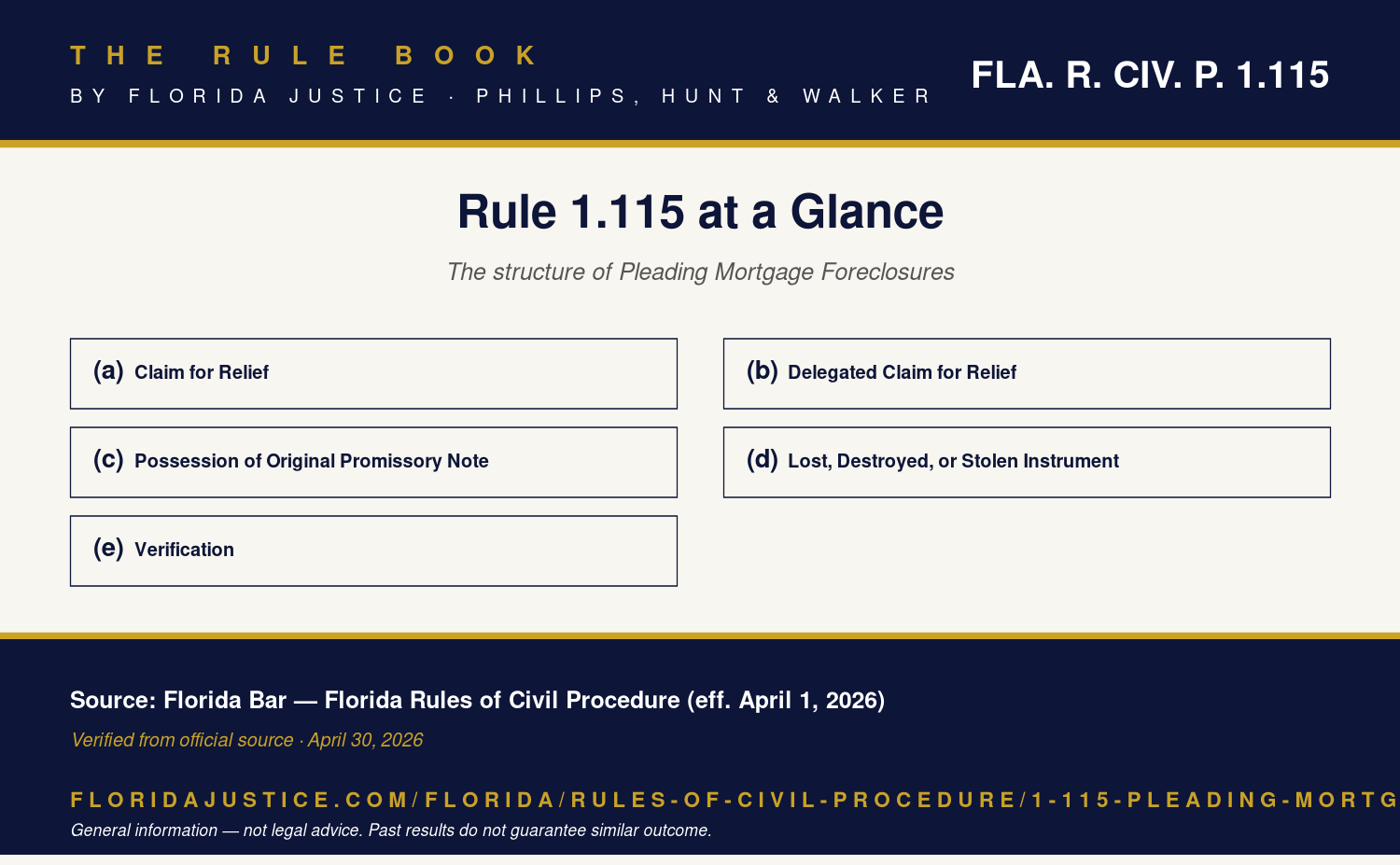
Infographic — Rule 1.115 at a Glance

Florida Rule 1.115 infographic

Committee Notes

View Committee Notes (legislative history)

No Committee Notes for this rule version.

Lawyer-to-Lawyer Co-Counsel Referrals

If you’re a lawyer with a Florida case outside your normal practice — complex civil, catastrophic injury, federal court litigation, multi-state coordination — co-counsel referrals are a core part of what we do. You keep the client. We take the trial-side work. Fee split per Fla. Bar Rule 4-1.5 with full client consent.

Call John directly: (904) 444-4444
This page summarizes a Florida Rule of Civil Procedure for educational purposes. The rule text and Committee Notes are mirrored from the Florida Bar’s official publication and are public domain. The plain-English summary is the opinion of Phillips, Hunt & Walker and is general information only — not legal advice. Reading this page does not create an attorney-client relationship. Past results do not guarantee a similar outcome in your case.

Rule Text (verbatim from the Florida Supreme Court)

(a) Claim for Relief. A claim for relief that seeks to foreclose a mortgage or other lien which secures a promissory note on residential real property, including individual units of condominiums and cooperatives designed principally for occupation by one to four families, must: (1) contain affirmative allegations expressly made by the claimant at the time the proceeding is commenced that the claimant is the holder of the original note secured by the mortgage; or (2) allege with specificity the factual basis by which the claimant is a person entitled to enforce the note under section 673.3011, Florida Statutes. (b) Delegated Claim for Relief. If a claimant has been delegated the authority to institute a mortgage foreclosure action on behalf of the person entitled to enforce the note, the claim for relief shall describe the authority of the claimant and identify with specificity the document that grants the claimant the authority to act on behalf of the person entitled to enforce the note. The term

“original note” or “original promissory note” means the signed or executed promissory note rather than a copy of it. The term includes any renewal, replacement, consolidation, or amended and restated note or instrument given in renewal, replacement, or substitution for a previous promissory note. The term also includes a transferrable record, as defined by the Uniform Electronic Transaction Act in section 668.50(16), Florida Statutes. (c) Possession of Original Promissory Note. If the claimant is in possession of the original promissory note, the claimant must file under penalty of perjury a certification contemporaneously with the filing of the claim for relief for foreclosure that the claimant is in possession of the original promissory note. The certification must set forth the location of the note, the name and title of the individual giving the certification, the name of the person who personally verified such possession, and the time and date on which the possession was verified. Correct copies of the note and all allonges to the note must be attached to the certification. The original note and the allonges must be filed with the court before the entry of any judgment of foreclosure or judgment on the note. (d) Lost, Destroyed, or Stolen Instrument. If the claimant seeks to enforce a lost, destroyed, or stolen instrument, an affidavit executed under penalty of perjury must be attached to the claim for relief. The affidavit must: (1) detail a clear chain of all endorsements, transfers, or assignments of the promissory note that is the subject of the action; (2) set forth facts showing that the claimant is entitled to enforce a lost, destroyed, or stolen instrument pursuant to section 673.3091, Florida Statutes; and (3) include as exhibits to the affidavit such copies of the note and the allonges to the note, audit reports showing receipt of the original note, or other evidence of the acquisition, ownership, and possession of the note as may be available to the claimant. Adequate protection as required and identified under sections 673.3091(2) and 702.11(1), Florida Statutes, shall be provided before the entry of final judgment. (e) Verification. When filing an action for foreclosure on a mortgage for residential real property the claim for relief shall be

verified by the claimant seeking to foreclose the mortgage. When verification of a document is required, the document filed shall include an oath, affirmation, or the following statement: “Under penalties of perjury, I declare that I have read the foregoing, and the facts alleged therein are true and correct to the best of my knowledge and belief.”

Educational reference. This page summarizes a Florida Rule of Civil Procedure for educational purposes. The rule text and Committee Notes are mirrored from the Florida Bar's official publication and are public domain. The plain-English summary is the opinion of Phillips, Hunt & Walker and is general information only — not legal advice. Reading this page does not create an attorney-client relationship. Past results do not guarantee a similar outcome in your case.

What this rule means in plain English

Florida Rule of Civil Procedure 1.115 — Pleading Mortgage Foreclosures — sets out the procedural requirements for this aspect of Florida civil practice. (a) Claim for Relief. A claim for relief that seeks to foreclose a mortgage or other lien which secures a promissory note on residential real property, including individual units of condominiums and cooperatives designed principally for occupation by one to four families, must: (1) contain affirmati…

X