(a) Effect. A party who moves for a directed verdict at the close of the evidence offered by the adverse party may offer evidence in the event the motion is denied without having reserved the right to do so and to the same extent as if the motion had not been made. The denial of a motion for a directed verdict shall not operate to discharge the jury. A motion for a directed verdict shall state the specific grounds therefor. The order directing a verdict is effective without any assent of the jury.
(b) Reservation of Decision on Motion. When a motion for a directed verdict is denied or for any reason is not granted, the court is deemed to have submitted the action to the jury subject to a later determination of the legal questions raised by the motion. Within 15 days after the return of a verdict, a party who has timely moved for a directed verdict may serve a motion to set aside the verdict and any judgment entered thereon and to enter judgment in accordance with the motion for a directed verdict. If a verdict was not returned, a party who has timely moved for a directed verdict may serve a motion for judgment in accordance with the motion for a directed verdict within 15 days after discharge of the jury.
(c) Joined with Motion for New Trial. A motion for a new trial may be joined with this motion or a new trial may be requested in the alternative. If a verdict was returned, the court may allow the judgment to stand or may reopen the judgment and either order a new trial or direct the entry of judgment as if the requested verdict had been directed. If no verdict was returned, the court may direct the entry of judgment as if the requested verdict had been directed or may order a new trial.
Committee Notes
1996 Amendment. Subdivision (b) is amended to clarify that the time limitations in this rule are based on service.
April 1, 2026 Florida Rules of Civil Procedure 160 2010 Amendment. Subdivision (b) is amended to conform to 2006 changes to Federal Rule of Civil Procedure 50(b) eliminating the requirement for renewing at the close of all the evidence a motion for directed verdict already made at the close of an adverse party’s evidence.
2013 Amendment. Subdivision (b) is amended to change the time for service of a motion from 10 to 15 days after the specified event.
Plain-English Breakdown
Practitioner notes by John M. Phillips, Board Certified Civil Trial Lawyer — coming soon. Watch the video below for the plain-English breakdown.
Committee Notes
View Committee Notes (legislative history)
1996 Amendment. Subdivision (b) is amended to clarify that the time limitations in this rule are based on service.
2010 Amendment. Subdivision (b) is amended to conform to 2006 changes to Federal Rule of Civil Procedure 50(b) eliminating the requirement for renewing at the close of all the evidence a motion for directed verdict already made at the close of an adverse party’s evidence. 2013 Amendment. Subdivision (b) is amended to change the time for service of a motion from 10 to 15 days after the specified event.
Lawyer-to-Lawyer Co-Counsel Referrals
If you’re a lawyer with a Florida case outside your normal practice — complex civil, catastrophic injury, federal court litigation, multi-state coordination — co-counsel referrals are a core part of what we do. You keep the client. We take the trial-side work. Fee split per Fla. Bar Rule 4-1.5 with full client consent.
Call John directly: (904) 444-4444
This page summarizes a Florida Rule of Civil Procedure for educational purposes. The rule text and Committee Notes are mirrored from the Florida Bar’s official publication and are public domain. The plain-English summary is the opinion of Phillips, Hunt & Walker and is general information only — not legal advice. Reading this page does not create an attorney-client relationship. Past results do not guarantee a similar outcome in your case.
(a) authorizes a motion for directed verdict at the close of evidence offered by the opposing party. In practice, this means two natural moments: at the close of the plaintiff’s case-in-chief, and at the close of all the evidence. The motion is also available at the close of the defendant’s case if the defendant has the burden on a counterclaim or affirmative issue. Filing too early — before the opposing party has rested — is procedurally premature.
The Standard
The court grants a directed verdict only when there is no evidence on which a reasonable jury could find for the non-movant. The court views the evidence in the light most favorable to the non-movant and resolves all reasonable inferences in the non-movant’s favor. The court does not weigh credibility — that is the jury’s function. The motion succeeds only when the non-movant has failed to put on enough evidence to allow a reasonable jury to find in their favor on each essential element.
Preservation — Why Failure to Move Costs the Appeal
Florida appellate courts have repeatedly held that failure to move for directed verdict at the close of the plaintiff’s case can waive the sufficiency-of-evidence challenge on appeal. Defense counsel who do not preserve the motion lose the strongest appellate argument they have on a verdict that was thinly supported. The motion is procedural insurance — even when defense counsel believes the motion will be denied, the act of moving preserves the issue for review.
Subsection (b) — Renewed Motion / JNOV
(b) allows the directed-verdict motion to be renewed within 15 days after the return of the verdict. This is the JNOV — judgment notwithstanding the verdict. The standard is the same as the directed-verdict standard: no evidence on which a reasonable jury could have found for the non-movant. The 15-day window is jurisdictional, like the Rule 1.530 motion-for-new-trial deadline.
Subsection (c) — Conditional Rulings on New Trial
(c) directs the court ruling on a JNOV motion to also rule conditionally on any pending motion for new trial. This avoids appellate ping-pong. If the appellate court reverses the JNOV, the trial court’s conditional new-trial ruling stands without remand for new ruling.
Practical Approach
Move at the close of the plaintiff’s case even when the motion will be denied. State the elements on which the plaintiff has failed to put on evidence with specificity. Renew at the close of all evidence. Renew again as a JNOV within 15 days of judgment. Each step preserves the issue and creates the appellate record. Skipping any step risks waiver of the strongest sufficiency challenge.
Cross-references: See Rule 1.530 (15-day deadline shared with JNOV), Rule 1.510 (pre-trial standard, related but distinct), and Rule 1.470 (jury instructions and preservation).
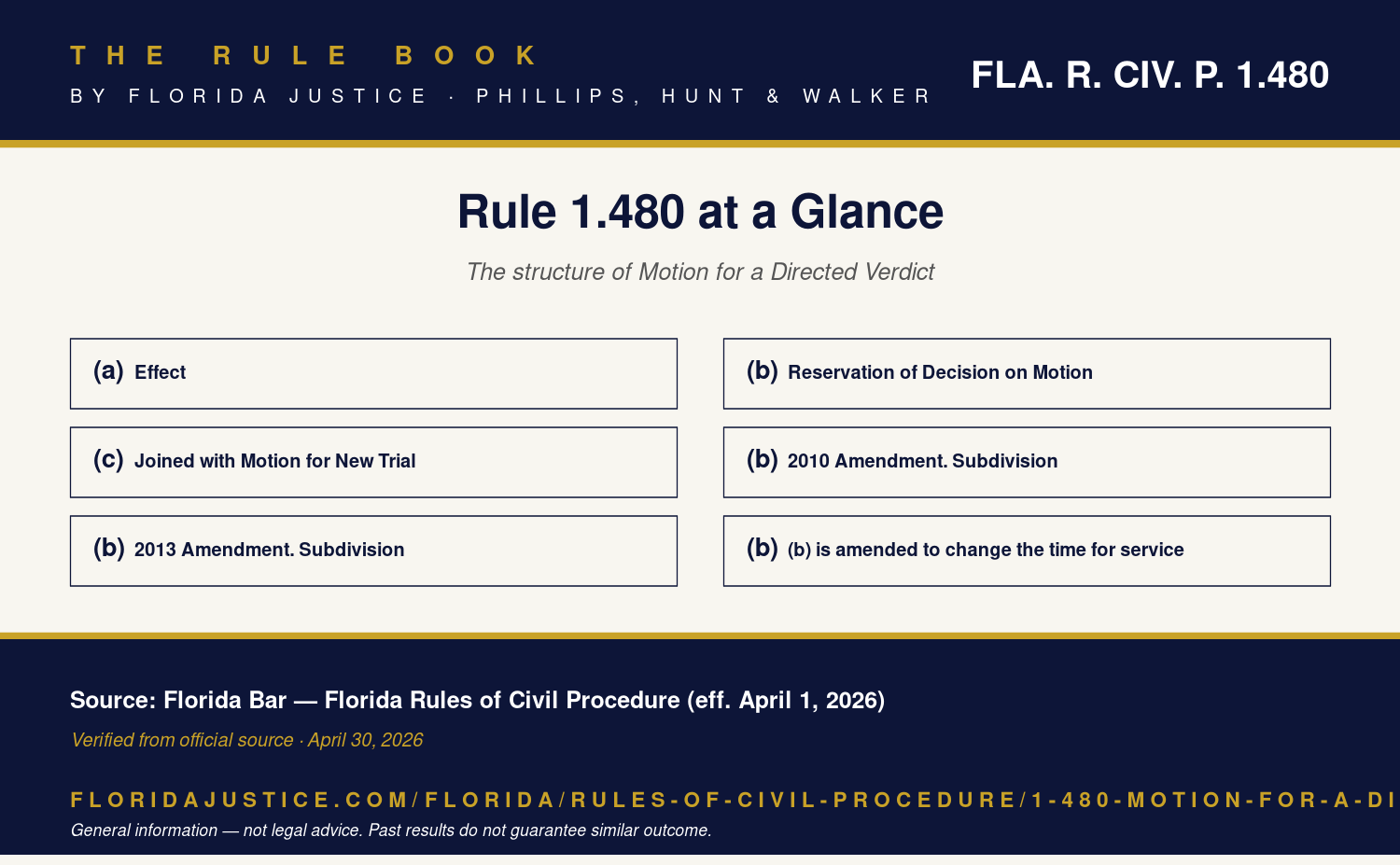
Infographic — Rule 1.480 at a Glance
Rule Text (verbatim from the Florida Supreme Court)
(a) Effect. A party who moves for a directed verdict at the close of the evidence offered by the adverse party may offer evidence in the event the motion is denied without having reserved the right to do so and to the same extent as if the motion had not been made. The denial of a motion for a directed verdict shall not operate to discharge the jury. A motion for a directed verdict shall state the specific grounds therefor. The order directing a verdict is effective without any assent of the jury. (b) Reservation of Decision on Motion. When a motion for a directed verdict is denied or for any reason is not granted, the court is deemed to have submitted the action to the jury subject to a later determination of the legal questions raised by the motion. Within 15 days after the return of a verdict, a party who has timely moved for a directed verdict may serve a motion to set aside the verdict and any judgment entered thereon and to enter judgment in accordance with the motion for a directed verdict. If a verdict was not returned, a party who has timely moved for a directed verdict may serve a motion for judgment in accordance with the motion for a directed verdict within 15 days after discharge of the jury. (c) Joined with Motion for New Trial. A motion for a new trial may be joined with this motion or a new trial may be requested in the alternative. If a verdict was returned, the court may allow the judgment to stand or may reopen the judgment and either order a new trial or direct the entry of judgment as if the requested verdict had been directed. If no verdict was returned, the court may direct the entry of judgment as if the requested verdict had been directed or may order a new trial.
Educational reference. This page summarizes a Florida Rule of Civil Procedure for educational purposes. The rule text and Committee Notes are mirrored from the Florida Bar's official publication and are public domain. The plain-English summary is the opinion of Phillips, Hunt & Walker and is general information only — not legal advice. Reading this page does not create an attorney-client relationship. Past results do not guarantee a similar outcome in your case.
What this rule means in plain English
Florida Rule of Civil Procedure 1.480 — Motion for a Directed Verdict — sets out the procedural requirements for this aspect of Florida civil practice. (a) Effect. A party who moves for a directed verdict at the close of the evidence offered by the adverse party may offer evidence in the event the motion is denied without having reserved the right to do so and to the same extent as if the motion had not been made.
Committee Notes (verbatim)
1996 Amendment. Subdivision (b) is amended to clarify that the time limitations in this rule are based on service.
2010 Amendment. Subdivision (b) is amended to conform to 2006 changes to Federal Rule of Civil Procedure 50(b) eliminating the requirement for renewing at the close of all the evidence a motion for directed verdict already made at the close of an adverse party’s evidence. 2013 Amendment. Subdivision (b) is amended to change the time for service of a motion from 10 to 15 days after the specified event.
X
Manage Consent
To provide the best experiences, we use technologies like cookies to store and/or access device information. Consenting to these technologies will allow us to process data such as browsing behavior or unique IDs on this site. Not consenting or withdrawing consent, may adversely affect certain features and functions.
Functional
Always active
The technical storage or access is strictly necessary for the legitimate purpose of enabling the use of a specific service explicitly requested by the subscriber or user, or for the sole purpose of carrying out the transmission of a communication over an electronic communications network.
Preferences
The technical storage or access is necessary for the legitimate purpose of storing preferences that are not requested by the subscriber or user.
Statistics
The technical storage or access that is used exclusively for statistical purposes.The technical storage or access that is used exclusively for anonymous statistical purposes. Without a subpoena, voluntary compliance on the part of your Internet Service Provider, or additional records from a third party, information stored or retrieved for this purpose alone cannot usually be used to identify you.
Marketing
The technical storage or access is required to create user profiles to send advertising, or to track the user on a website or across several websites for similar marketing purposes.




Committee Notes (verbatim)
1996 Amendment. Subdivision (b) is amended to clarify that the time limitations in this rule are based on service.
2010 Amendment. Subdivision (b) is amended to conform to 2006 changes to Federal Rule of Civil Procedure 50(b) eliminating the requirement for renewing at the close of all the evidence a motion for directed verdict already made at the close of an adverse party’s evidence. 2013 Amendment. Subdivision (b) is amended to change the time for service of a motion from 10 to 15 days after the specified event.