


Fla. R. Civ. P. 1.380 — Failure to Make Discovery; Sanctions
Last verified from official source: April 30, 2026 · Source: Florida Bar — Florida Rules of Civil Procedure (eff. April 1, 2026), p. 124
Rule Text (Verbatim)
The text below is mirrored verbatim from the Florida Bar’s official publication, with FRCP’s hierarchical indentation preserved. Public domain.
(a) Motion for Order Compelling Discovery. On reasonable notice to other parties and all persons affected, a party may apply for an order compelling discovery as follows:
(1) Appropriate Court. An application for an order to a party may be made to the court in which the action is pending or in accordance with rule 1.310(d). An application for an order to a deponent who is not a party must be made to the circuit court where the deposition is being taken.
(2) Motion.
(A) If a party fails to make a disclosure required by rule 1.280(a), any other party may move to compel disclosure and for appropriate sanctions.
(B) The discovering party may move for an order compelling an answer if:
(i) a deponent fails to answer a question propounded or submitted under rule 1.310 or 1.320; or
(ii) a party fails to answer an interrogatory submitted under rule 1.340.
(C) The discovering party may move for an order compelling a designation if a corporation or other entity fails to make a designation under rule 1.310(b)(6) or 1.320(a).
(D) The discovering party may move for an order compelling an inspection if a party in response to a request for inspection submitted under rule 1.350 fails to respond that inspection will be permitted as requested or fails to permit inspection as requested.
(E) The discovering party may move for an order compelling an examination if a party:
(i) in response to a request for examination of a person submitted under rule 1.360(a) objects to the examination;
(ii) fails to respond that the examination will be permitted as requested;
(iii) fails to submit to examination; or
(iv) fails to produce a person in that party’s custody or legal control for examination
(F) A discovering party may move for an order compelling a response if a party fails to produce documents and things under rule 1.350(b).
(G) When taking a deposition on oral examination, the proponent of the question may complete or adjourn the examination before applying for an order.
(H) If the court denies the motion in whole or in part, it may make the protective order as it would have been empowered to make on a motion made under rule 1.280(d).
(3) Evasive or Incomplete Answer. For purposes of this subdivision an evasive or incomplete answer is treated as a failure to answer.
(4) Award of Expenses of Motion.
(A) If the motion is granted and after opportunity for hearing, the court must require the party or deponent whose conduct necessitated the motion, or the party or counsel advising the conduct, to pay to the moving party the reasonable expenses incurred in obtaining the order that may include attorneys’ fees, unless the court finds that the opposition to the motion was substantially justified or that other circumstances make an award of expenses unjust.
(B) If the motion is denied and after opportunity for hearing, the court must require the moving party to pay to the party or deponent who opposed the motion the reasonable expenses incurred in opposing the motion that may include attorneys’ fees, unless the court finds that the making of the motion was substantially justified or that other circumstances make an award of expenses unjust.
(C) If the motion is granted in part and denied in part, the court may apportion the reasonable expenses incurred as a result of making the motion among the parties and persons.
(b) Failure to Comply with Order.
(1) If, after being ordered to do so by the court, a deponent fails to be sworn or to answer a question or produce documents, the failure may be considered a contempt of the court.
(2) If a party or an officer, director, or managing agent of a party or a person designated under rule 1.310(b)(6) or 1.320(a) to testify on behalf of a party fails to obey an order to provide or permit discovery, including an order made under subdivision
(a) of this rule or rule 1.360, the court in which the action is pending may make any of the following orders:
(A) An order that the matters regarding which the questions were asked or any other designated facts will be taken to be established for the purposes of the action in accordance with the claim of the party obtaining the order.
(B) An order refusing to allow the disobedient party to support or oppose designated claims or defenses, or prohibiting that party from introducing designated matters in evidence.
(C) An order striking out pleadings or parts of them or staying further proceedings until the order is obeyed, or dismissing the action or proceeding or any part of it, or rendering a judgment by default against the disobedient party.
(D) Instead of any of the foregoing orders or in addition to them, an order treating as a contempt of court the failure to obey any orders except an order to submit to an examination made under rule 1.360(a)(1)(B) or subdivision (a)(2) of this rule.
(E) When a party has failed to comply with an order under rule 1.360(a)(1)(B) requiring that party to produce another for examination, the orders listed in subdivisions (b)(2)(A), (b)(2)(B), (b)(2)(C), and (b)(2)(D) of this rule, unless the party failing to comply shows the inability to produce the person for examination.
(3) Instead of any of the foregoing orders or in addition to them, the court must require the party failing to obey the order to pay the reasonable expenses caused by the failure, which may include attorneys’ fees, unless the court finds that the failure was substantially justified or that other circumstances make an award of expenses unjust.
(c) Expenses on Failure to Admit. If a party fails to admit the genuineness of any document or the truth of any matter as requested under rule 1.370 and if the party requesting the admissions thereafter proves the genuineness of the document or the truth of the matter, the requesting party may file a motion for an order requiring the other party to pay the requesting party the reasonable expenses incurred in making that proof, which may include attorneys’ fees. The court must issue the order at the time a party requesting the admissions proves the genuineness of the document or the truth of the matter, on motion by the requesting party, unless it finds that:
(1) the request was held objectionable under rule 1.370(a);
(2) the admission sought was of no substantial importance; or
(3) there was other good reason for the failure to admit.
(d) Failure to Disclose or to Supplement an Earlier Response. If a party fails to provide information or identify a witness as required by rule 1.280(a) or (g), the party is not allowed to use that information or witness to supply evidence on a motion, at a hearing, or at a trial, unless the failure was substantially justified or is harmless. In addition to or instead of this sanction, the court, on motion and after giving an opportunity to be heard:
(1) may order payment of the reasonable expenses, including attorneys’ fees, caused by the failure;
(2) may inform the jury of the party’s failure; and
(3) may impose other appropriate sanctions, including any of the orders listed in rule 1.380(b)(2)(A)–(b)(2)(D).
(e) Failure of Party to Attend at Own Deposition or Serve Answers to Interrogatories or Respond to Request for Inspection.
(1) The court in which the action is pending may take any action authorized under subdivisions (b)(2)(A)–(b)(2)(C) of this rule if a party or an officer, director, or managing agent of a party or a person designated under rule 1.310(b)(6) or 1.320(a) to testify on behalf of a party fails:
(A) to appear before the officer who is to take the deposition after being served with a proper notice;
(B) to serve answers or objections to interrogatories submitted under rule 1.340 after proper service of the interrogatories; or
(C) to serve a written response to a request for inspection submitted under rule 1.350 after proper service of the request.
(2) Instead of any order or in addition to it, the court must require the party failing to act to pay the reasonable expenses caused by the failure, which may include attorneys’ fees, unless the court finds that the failure was substantially justified or that other circumstances make an award of expenses unjust.
(3) The failure to act described in this subdivision may not be excused on the ground that the discovery sought is objectionable unless the party failing to act has applied for a protective order as provided by rule 1.280(d).
(f) Failure to Preserve Electronically Stored Information. If electronically stored information that should have been preserved in the anticipation or conduct of litigation is lost because a party failed to take reasonable steps to preserve it, and it cannot be restored or replaced through additional discovery, the court:
(1) on finding prejudice to another party from loss of the information, may order measures no greater than necessary to cure the prejudice; or
(2) only on a finding that the party acted with the intent to deprive another party of the information’s use in the litigation may:
(A) presume that the lost information was unfavorable to the party;
(B) instruct the jury that it may or must presume the information was unfavorable to the party; or
(C) dismiss the action or enter a default judgment.
Committee Notes
View Committee Notes (legislative history)
1972 Amendment. Derived from Federal Rule of Civil Procedure 37 as amended in 1970. Subdivision (a)(3) is new and makes it clear that an evasive or incomplete answer is a failure to answer under the rule. Other clarifying changes have been made within the general scope of the rule to ensure that complete coverage of all discovery failures is afforded. 2003 Amendment. Subdivision (c) is amended to require a court to make a ruling on a request for reimbursement at the time of the hearing on the requesting party’s motion for entitlement to such relief. The court may, in its discretion, defer ruling on the amount of the costs or fees in order to hold an evidentiary hearing whenever convenient to the court and counsel. 2005 Amendment. Following the example of Federal Rule of Civil Procedure 37 as amended in 1993, language is included in subdivision (a)(2) that requires litigants to seek to resolve discovery disputes by informal means before filing a motion with the court. This requirement is based on successful experience with the federal rule as well as similar local rules of state trial courts. Subdivision (a)(4) is revised to provide that a party should not be awarded its expenses for filing a motion that might have been avoided by conferring with opposing counsel. Subdivision (d) is revised to require that, where a party failed to file any response to a rule 1.340 interrogatory or a rule 1.350 request, the discovering party
should attempt to obtain such responses before filing a motion for sanctions. 2012 Amendment. Subdivision (e) is added to make clear that a party should not be sanctioned for the loss of electronic evidence due to the good-faith operation of an electronic information system; the language mirrors that of Federal Rule of Civil Procedure 37(e). Nevertheless, the good-faith requirement contained in subdivision (e) should prevent a party from exploiting the routine operation of an information system to thwart discovery obligations by allowing that operation to destroy information that party is required to preserve or produce. In determining good faith, the court may consider any steps taken by the party to comply with court orders, party agreements, or requests to preserve such information. 2013 Amendment. This rule was amended to add “substantially” before “justified” in subdivisions (a)(4), (b)(2), and (d), to make the rule internally consistent and to make it more consistent with Federal Rule of Civil Procedure 37, from which it was derived. 2019 Amendment. Subdivision (e) of this rule was amended to make it consistent with Federal Rule of Civil Procedure 37(e).
Plain-English Summary
Florida Rule of Civil Procedure 1.380 is the enforcement rule. When a party refuses to answer, evades, or fails to comply with discovery, this rule supplies the procedural remedies — from motions to compel through case-dispositive sanctions.
Subsection (a) governs motions to compel discovery and the consequences when they’re granted. Subsection (b) addresses failure to comply with a court order — the heaviest sanctions live here, including striking pleadings, dismissing claims, entering default, and treating refusal as contempt. Subsection (c) covers expenses on motion. Subsection (d) addresses failure to appear at a deposition or respond to interrogatories without prior court order.
The rule’s structure is escalating. A first motion to compel typically yields an order plus reasonable expenses. Continued noncompliance unlocks the most severe sanctions in Florida civil practice. Florida courts have developed a substantial body of case law on what constitutes “willful” noncompliance versus excusable neglect — that case law fills in the rule’s broad standards.
Rule 1.380 is the threat that makes discovery work. Practitioners who lean on it — and document compliance failures carefully — control the discovery timeline.
Practitioner Notes — From the Trial Lawyers at Florida Justice
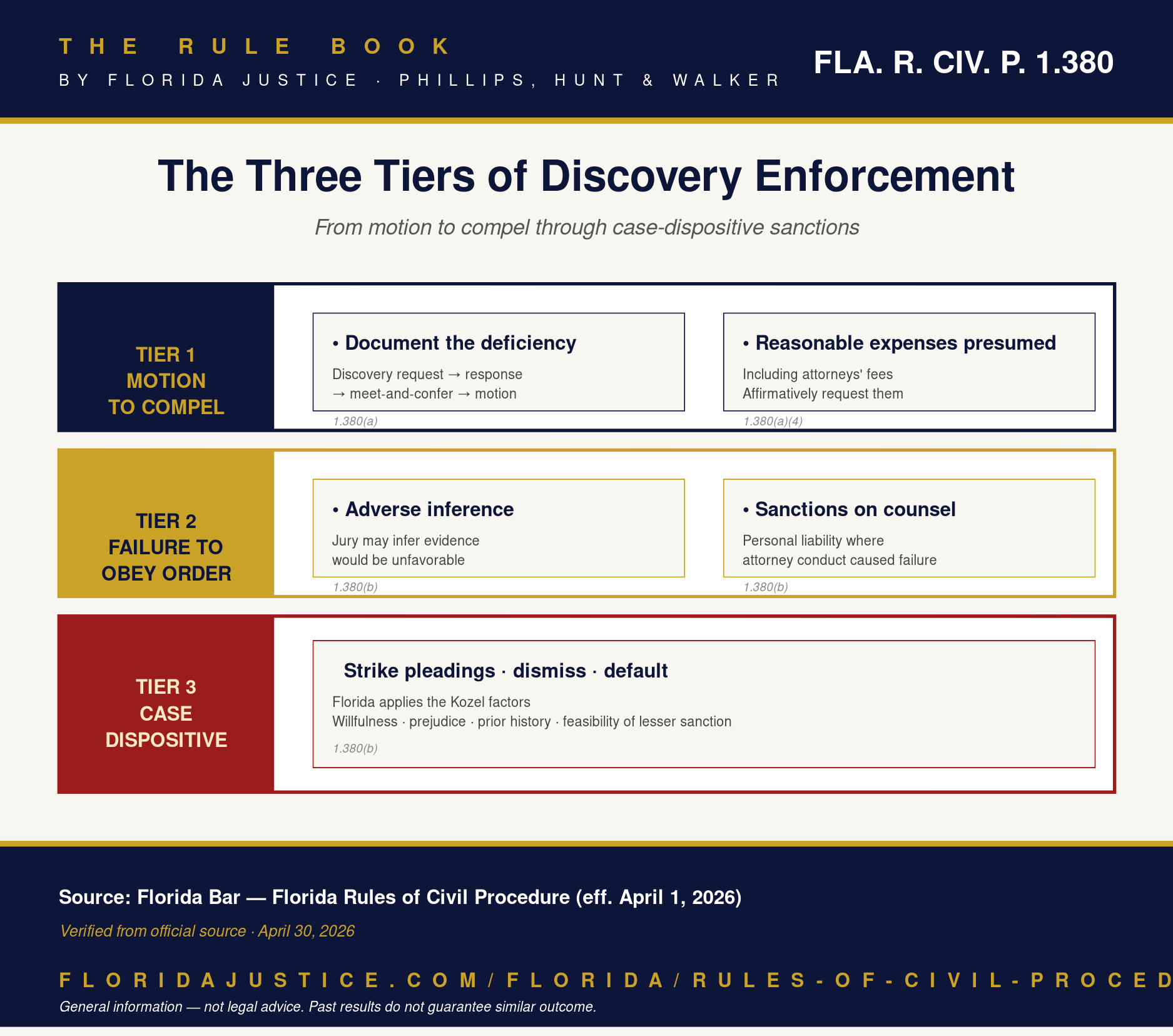
Document everything before you file. Before moving under 1.380, document the discovery request, the deficient response or non-response, your meet-and-confer effort, and the response you got. Trial courts want to see good-faith resolution attempts before issuing sanctions. A clean paper trail is the difference between a granted and denied motion.
Reasonable expenses are presumed on a granted motion. 1.380(a)(4) makes reasonable expenses, including attorneys’ fees, presumed when a motion to compel is granted. Affirmatively request fees in the motion. Don’t leave them to chance — many practitioners forget the fee request and lose the easiest leverage point in the rule.
Striking pleadings requires “willful” conduct. Florida courts apply the Kozel factors when considering case-dispositive sanctions: (1) attorney noncompliance, (2) prejudice to opposing party, (3) attorney willfulness, (4) prior history, (5) reasonableness of attorney’s explanation, (6) feasibility of lesser sanction. When facing dismissal or default, address each factor explicitly in your response. [VERIFY citation to Kozel v. Ostendorf — Florida Supreme Court case on civil sanctions factors]
Don’t combine 1.380(b) and 1.380(d). Subsection (b) deals with failure to comply with a court order. Subsection (d) deals with failure to appear or respond without prior order. The standards differ. Identify which applies before filing — citing the wrong subsection is a common error that draws unfavorable rulings.
Sanctions can be sought against counsel directly. 1.380(a)(4) and (b) authorize sanctions against the attorney personally, not just the party. When opposing counsel’s conduct is the cause of the noncompliance, name the attorney in the motion. This is how seasoned practitioners use the rule to discipline obstruction.
Adverse-inference instructions are an underused remedy. When a party destroys, fails to preserve, or fails to produce relevant evidence, an adverse-inference jury instruction is sometimes more valuable than monetary sanctions. Request it specifically in the motion. Trial judges frequently grant the instruction even when reluctant to dismiss.
Related Rules in The Rule Book
- Rule 1.280 — General Provisions Governing Discovery (underlying scope and proportionality)
- Rule 1.310 — Depositions on Oral Examination (deposition no-show triggers (d))
- Rule 1.340 — Interrogatories to Parties (interrogatory non-response)
- Rule 1.350 — Production of Documents (production failures)
Lawyer-to-Lawyer Co-Counsel Referrals
If you’re a lawyer with a Florida case outside your normal practice — complex civil, catastrophic injury, federal court litigation, multi-state coordination — co-counsel referrals are a core part of what we do. You keep the client. We take the trial-side work. Fee split per Fla. Bar Rule 4-1.5 with full client consent.
Call John directly: (904) 444-4444
This page summarizes a Florida Rule of Civil Procedure for educational purposes. The rule text and Committee Notes are mirrored from the Florida Bar’s official publication and are public domain. The plain-English summary, practitioner notes, and video commentary are the opinion of Phillips, Hunt & Walker and are general information only — not legal advice. Reading this page does not create an attorney-client relationship. Past results do not guarantee a similar outcome in your case.
Subsection-by-Subsection Practitioner Notes — Rule 1.380
Subsection (a) — Motion to Compel
(a) sets up the motion-to-compel mechanism. If a party fails to answer a deposition question, fails to respond to interrogatories, fails to permit inspection, or fails to comply with a subpoena, the requesting party may move for an order compelling the discovery. The movant must include a good-faith conferral certificate under Rule 1.202. (a)(4) has the fee-shifting bite: if the motion is granted (or the discovery is provided after the motion is filed), the court must award the movant’s reasonable expenses, including attorney’s fees, unless the opposing party’s position was substantially justified or other circumstances make an award unjust. This mandatory fee-shift is the primary leverage in Florida discovery practice.
Subsection (b) — Failure to Comply with Court Order
(b) is the sanctions ladder for willful disobedience of a court order on discovery. The available sanctions, in escalating order, include: prohibiting the introduction of designated evidence, striking pleadings, dismissing the action, rendering default judgment against the disobedient party, and treating the failure as contempt of court. The trial court has wide discretion in choosing among these — but the most severe sanctions (striking pleadings, default, dismissal) require the Kozel willfulness analysis: the court must find willful, deliberate, or contumacious disregard, not mere negligence, before imposing case-ending sanctions.
Subsection (c) — Expenses on Failure to Admit
(c) is the under-used companion to Rule 1.370. If a party denies a request for admission and the requesting party later proves the matter at trial, the requesting party may recover the reasonable expenses (including attorney’s fees) of making that proof — unless the request was objectionable, the admission sought was not substantially material, or there were good reasons for the denial. Frame requests for admission narrowly so denials are clearly unreasonable, and document the cost of proving the denied facts at trial.
Subsection (d) — Failure to Attend Deposition or Respond
(d) addresses the most basic discovery sins: failure to appear at a properly noticed deposition, failure to serve answers to interrogatories, or failure to respond to requests for production. These trigger fee-shifting and the (b) sanctions ladder without the intermediate motion-to-compel step in the right circumstances. Rule 1.310(d) has analogous provisions for depositions specifically.
The Kozel Framework
Florida appellate courts review the harshest sanctions under the framework articulated in Kozel v. Ostendorf, 629 So. 2d 817 (Fla. 1993). Before striking pleadings or dismissing for discovery violations, the trial court must consider whether the attorney’s disobedience was willful, whether the client was personally involved, whether the opposing party was prejudiced, whether the violation was previously sanctioned, whether reasonable justification existed, and whether the violation created significant problems for the judicial system. Lower courts that skip this analysis face reversal even when the underlying misconduct seems clear-cut.
Cross-references: See Rule 1.280 (scope of discovery), Rule 1.202 (meet-and-confer), Rule 1.310 (depositions), and Rule 1.370 (requests for admission).
Infographic
Rule Text (verbatim from the Florida Supreme Court)
(a) Motion for Order Compelling Discovery. On reasonable notice to other parties and all persons affected, a party may apply for an order compelling discovery as follows: (1) Appropriate Court. An application for an order to a party may be made to the court in which the action is pending or in accordance with rule 1.310(d). An application for an order to a deponent who is not a party must be made to the circuit court where the deposition is being taken. (2) Motion. (A) If a party fails to make a disclosure required by rule 1.280(a), any other party may move to compel disclosure and for appropriate sanctions.
(B) The discovering party may move for an order compelling an answer if: (i) a deponent fails to answer a question propounded or submitted under rule 1.310 or 1.320; or (ii) a party fails to answer an interrogatory submitted under rule 1.340. (C) The discovering party may move for an order compelling a designation if a corporation or other entity fails to make a designation under rule 1.310(b)(6) or 1.320(a). (D) The discovering party may move for an order compelling an inspection if a party in response to a request for inspection submitted under rule 1.350 fails to respond that inspection will be permitted as requested or fails to permit inspection as requested. (E) The discovering party may move for an order compelling an examination if a party: (i) in response to a request for examination of a person submitted under rule 1.360(a) objects to the examination; (ii) fails to respond that the examination will be permitted as requested; (iii) fails to submit to examination; or (iv) fails to produce a person in that party’s custody or legal control for examination (F) A discovering party may move for an order compelling a response if a party fails to produce documents and things under rule 1.350(b). (G) When taking a deposition on oral examination, the proponent of the question may complete or adjourn the examination before applying for an order.
(H) If the court denies the motion in whole or in part, it may make the protective order as it would have been empowered to make on a motion made under rule 1.280(d). (3) Evasive or Incomplete Answer. For purposes of this subdivision an evasive or incomplete answer is treated as a failure to answer. (4) Award of Expenses of Motion. (A) If the motion is granted and after opportunity for hearing, the court must require the party or deponent whose conduct necessitated the motion, or the party or counsel advising the conduct, to pay to the moving party the reasonable expenses incurred in obtaining the order that may include attorneys’ fees, unless the court finds that the opposition to the motion was substantially justified or that other circumstances make an award of expenses unjust. (B) If the motion is denied and after opportunity for hearing, the court must require the moving party to pay to the party or deponent who opposed the motion the reasonable expenses incurred in opposing the motion that may include attorneys’ fees, unless the court finds that the making of the motion was substantially justified or that other circumstances make an award of expenses unjust. (C) If the motion is granted in part and denied in part, the court may apportion the reasonable expenses incurred as a result of making the motion among the parties and persons. (b) Failure to Comply with Order. (1) If, after being ordered to do so by the court, a deponent fails to be sworn or to answer a question or produce documents, the failure may be considered a contempt of the court. (2) If a party or an officer, director, or managing agent of a party or a person designated under rule 1.310(b)(6) or 1.320(a) to testify on behalf of a party fails to obey an order to provide or
permit discovery, including an order made under subdivision (a) of this rule or rule 1.360, the court in which the action is pending may make any of the following orders: (A) An order that the matters regarding which the questions were asked or any other designated facts will be taken to be established for the purposes of the action in accordance with the claim of the party obtaining the order. (B) An order refusing to allow the disobedient party to support or oppose designated claims or defenses, or prohibiting that party from introducing designated matters in evidence. (C) An order striking out pleadings or parts of them or staying further proceedings until the order is obeyed, or dismissing the action or proceeding or any part of it, or rendering a judgment by default against the disobedient party. (D) Instead of any of the foregoing orders or in addition to them, an order treating as a contempt of court the failure to obey any orders except an order to submit to an examination made under rule 1.360(a)(1)(B) or subdivision (a)(2) of this rule. (E) When a party has failed to comply with an order under rule 1.360(a)(1)(B) requiring that party to produce another for examination, the orders listed in subdivisions (b)(2)(A), (b)(2)(B), (b)(2)(C), and (b)(2)(D) of this rule, unless the party failing to comply shows the inability to produce the person for examination. (3) Instead of any of the foregoing orders or in addition to them, the court must require the party failing to obey the order to pay the reasonable expenses caused by the failure, which may include attorneys’ fees, unless the court finds that the failure was substantially justified or that other circumstances make an award of expenses unjust.
(c) Expenses on Failure to Admit. If a party fails to admit the genuineness of any document or the truth of any matter as requested under rule 1.370 and if the party requesting the admissions thereafter proves the genuineness of the document or the truth of the matter, the requesting party may file a motion for an order requiring the other party to pay the requesting party the reasonable expenses incurred in making that proof, which may include attorneys’ fees. The court must issue the order at the time a party requesting the admissions proves the genuineness of the document or the truth of the matter, on motion by the requesting party, unless it finds that: (1) the request was held objectionable under rule 1.370(a); (2) the admission sought was of no substantial importance; or (3) there was other good reason for the failure to admit. (d) Failure to Disclose or to Supplement an Earlier Response. If a party fails to provide information or identify a witness as required by rule 1.280(a) or (g), the party is not allowed to use that information or witness to supply evidence on a motion, at a hearing, or at a trial, unless the failure was substantially justified or is harmless. In addition to or instead of this sanction, the court, on motion and after giving an opportunity to be heard: (1) may order payment of the reasonable expenses, including attorneys’ fees, caused by the failure; (2) may inform the jury of the party’s failure; and (3) may impose other appropriate sanctions, including any of the orders listed in rule 1.380(b)(2)(A)–(b)(2)(D). (e) Failure of Party to Attend at Own Deposition or Serve Answers to Interrogatories or Respond to Request for Inspection.
(1) The court in which the action is pending may take any action authorized under subdivisions (b)(2)(A)–(b)(2)(C) of this rule if a party or an officer, director, or managing agent of a party or a person designated under rule 1.310(b)(6) or 1.320(a) to testify on behalf of a party fails: (A) to appear before the officer who is to take the deposition after being served with a proper notice; (B) to serve answers or objections to interrogatories submitted under rule 1.340 after proper service of the interrogatories; or (C) to serve a written response to a request for inspection submitted under rule 1.350 after proper service of the request. (2) Instead of any order or in addition to it, the court must require the party failing to act to pay the reasonable expenses caused by the failure, which may include attorneys’ fees, unless the court finds that the failure was substantially justified or that other circumstances make an award of expenses unjust. (3) The failure to act described in this subdivision may not be excused on the ground that the discovery sought is objectionable unless the party failing to act has applied for a protective order as provided by rule 1.280(d). (f) Failure to Preserve Electronically Stored Information. If electronically stored information that should have been preserved in the anticipation or conduct of litigation is lost because a party failed to take reasonable steps to preserve it, and it cannot be restored or replaced through additional discovery, the court: (1) on finding prejudice to another party from loss of the information, may order measures no greater than necessary to cure the prejudice; or
(2) only on a finding that the party acted with the intent to deprive another party of the information’s use in the litigation may: (A) presume that the lost information was unfavorable to the party; (B) instruct the jury that it may or must presume the information was unfavorable to the party; or (C) dismiss the action or enter a default judgment.
Educational reference. This page summarizes a Florida Rule of Civil Procedure for educational purposes. The rule text and Committee Notes are mirrored from the Florida Bar's official publication and are public domain. The plain-English summary, practitioner notes, and video commentary are the opinion of Phillips, Hunt & Walker and are general information only — not legal advice. Reading this page does not create an attorney-client relationship. Past results do not guarantee a similar outcome in your case.
What this rule means in plain English
Florida Rule of Civil Procedure 1.380 is the enforcement rule. When a party refuses to answer, evades, or fails to comply with discovery, this rule supplies the procedural remedies — from motions to compel through case-dispositive sanctions.
Subsection (a) governs motions to compel discovery and the consequences when they’re granted. Subsection (b) addresses failure to comply with a court order — the heaviest sanctions live here, including striking pleadings, dismissing claims, entering default, and treating refusal as contempt. Subsection (c) covers expenses on motion. Subsection (d) addresses failure to appear at a deposition or respond to interrogatories without prior court order.
The rule’s structure is escalating. A first motion to compel typically yields an order plus reasonable expenses. Continued noncompliance unlocks the most severe sanctions in Florida civil practice. Florida courts have developed a substantial body of case law on what constitutes “willful” noncompliance versus excusable neglect — that case law fills in the rule’s broad standards.
Rule 1.380 is the threat that makes discovery work. Practitioners who lean on it — and document compliance failures carefully — control the discovery timeline.
Practitioner notes
Document everything before you file. Before moving under 1.380, document the discovery request, the deficient response or non-response, your meet-and-confer effort, and the response you got. Trial courts want to see good-faith resolution attempts before issuing sanctions. A clean paper trail is the difference between a granted and denied motion.
Reasonable expenses are presumed on a granted motion. 1.380(a)(4) makes reasonable expenses, including attorneys’ fees, presumed when a motion to compel is granted. Affirmatively request fees in the motion. Don’t leave them to chance — many practitioners forget the fee request and lose the easiest leverage point in the rule.
Striking pleadings requires “willful” conduct. Florida courts apply the Kozel factors when considering case-dispositive sanctions: (1) attorney noncompliance, (2) prejudice to opposing party, (3) attorney willfulness, (4) prior history, (5) reasonableness of attorney’s explanation, (6) feasibility of lesser sanction. When facing dismissal or default, address each factor explicitly in your response. [VERIFY citation to Kozel v. Ostendorf — Florida Supreme Court case on civil sanctions factors]
Don’t combine 1.380(b) and 1.380(d). Subsection (b) deals with failure to comply with a court order. Subsection (d) deals with failure to appear or respond without prior order. The standards differ. Identify which applies before filing — citing the wrong subsection is a common error that draws unfavorable rulings.
Sanctions can be sought against counsel directly. 1.380(a)(4) and (b) authorize sanctions against the attorney personally, not just the party. When opposing counsel’s conduct is the cause of the noncompliance, name the attorney in the motion. This is how seasoned practitioners use the rule to discipline obstruction.
Adverse-inference instructions are an underused remedy. When a party destroys, fails to preserve, or fails to produce relevant evidence, an adverse-inference jury instruction is sometimes more valuable than monetary sanctions. Request it specifically in the motion. Trial judges frequently grant the instruction even when reluctant to dismiss.
Committee Notes (verbatim)
1972 Amendment. Derived from Federal Rule of Civil Procedure 37 as amended in 1970. Subdivision (a)(3) is new and makes it clear that an evasive or incomplete answer is a failure to answer under the rule. Other clarifying changes have been made within the general scope of the rule to ensure that complete coverage of all discovery failures is afforded. 2003 Amendment. Subdivision (c) is amended to require a court to make a ruling on a request for reimbursement at the time of the hearing on the requesting party’s motion for entitlement to such relief. The court may, in its discretion, defer ruling on the amount of the costs or fees in order to hold an evidentiary hearing whenever convenient to the court and counsel. 2005 Amendment. Following the example of Federal Rule of Civil Procedure 37 as amended in 1993, language is included in subdivision (a)(2) that requires litigants to seek to resolve discovery disputes by informal means before filing a motion with the court. This requirement is based on successful experience with the federal rule as well as similar local rules of state trial courts. Subdivision (a)(4) is revised to provide that a party should not be awarded its expenses for filing a motion that might have been avoided by conferring with opposing counsel. Subdivision (d) is revised to require that, where a party failed to file any response to a rule 1.340 interrogatory or a rule 1.350 request, the discovering party
should attempt to obtain such responses before filing a motion for sanctions. 2012 Amendment. Subdivision (e) is added to make clear that a party should not be sanctioned for the loss of electronic evidence due to the good-faith operation of an electronic information system; the language mirrors that of Federal Rule of Civil Procedure 37(e). Nevertheless, the good-faith requirement contained in subdivision (e) should prevent a party from exploiting the routine operation of an information system to thwart discovery obligations by allowing that operation to destroy information that party is required to preserve or produce. In determining good faith, the court may consider any steps taken by the party to comply with court orders, party agreements, or requests to preserve such information. 2013 Amendment. This rule was amended to add “substantially” before “justified” in subdivisions (a)(4), (b)(2), and (d), to make the rule internally consistent and to make it more consistent with Federal Rule of Civil Procedure 37, from which it was derived. 2019 Amendment. Subdivision (e) of this rule was amended to make it consistent with Federal Rule of Civil Procedure 37(e).