



Fla. R. Civ. P. 1.340 — Interrogatories to Parties
Last verified from official source: April 30, 2026 · Source: Florida Bar — Florida Rules of Civil Procedure (eff. April 1, 2026), p. 107
Rule Text (Verbatim)
The text below is mirrored verbatim from the Florida Bar’s official publication, with FRCP’s hierarchical indentation preserved. Public domain.
(a) Procedure for Use.
(1) Without leave of court, any party may serve on any other party written interrogatories to be answered:
(A) by the party to whom the interrogatories are directed; or
(B) if that party is a public corporation, private corporation, partnership, association, or governmental agency, by any officer or agent, who must furnish the information available to that party.
(2) Interrogatories may be served on the plaintiff after commencement of the action and on any other party with or after service of the process and initial pleading on that party.
(3) The interrogatories must not exceed 30, including all subparts, unless the court permits a larger number on motion and notice and for good cause.
(4) If the supreme court has approved a form of interrogatories for the type of action, the initial interrogatories on a subject included within must be from the form approved by the court.
(5) A party may serve fewer than all of the approved interrogatories within a form.
(6) Other interrogatories may be added to the approved forms without leave of court, so long as the total of approved and additional interrogatories does not exceed 30.
(7) Each interrogatory must be answered separately and fully in writing under oath unless it is objected to, in which event the grounds for objection must be stated and signed by the attorney making it.
(8) The grounds for objecting to an interrogatory must be stated with specificity, including the reasons. Any ground not stated in a timely objection is waived unless the court, for good cause, excuses the failure.
(9) The party to whom the interrogatories are directed must serve the answers and any objections within 30 days after the service of the interrogatories, except that a defendant may serve answers or objections within 45 days after service of the process and initial pleading on that defendant. The court may allow a shorter or longer time.
(10) The party submitting the interrogatories may move for an order under rule 1.380(a) on any objection to or other failure to answer an interrogatory.
(b) Scope; Use at Trial.
(1) Interrogatories may relate to any matters that can be inquired into under rule 1.280(c), and the answers may be used to the extent permitted by the rules of evidence except as otherwise provided in subdivision (b).
(2) An interrogatory otherwise proper is not objectionable merely because an answer to the interrogatory involves an opinion or contention that relates to fact or calls for a conclusion or asks for information not within the personal knowledge of the party.
(3) A party must respond to an otherwise proper interrogatory by giving the information the party has and the source on which the information is based.
(4) A qualified answer may not be used as direct evidence for or impeachment against the party giving the answer unless the court finds it otherwise admissible under the rules of evidence.
(5) If a party introduces an answer to an interrogatory, any other party may require that party to introduce any other interrogatory and answer that in fairness ought to be considered with it.
(c) Option to Produce Records.
(1) When the answer to an interrogatory may be derived or ascertained from the records (including electronically stored information) of the party to whom the interrogatory is directed or from an examination, audit, or inspection of the records or from a compilation, abstract, or summary based on the records and the burden of deriving or ascertaining the answer is substantially the same for the party serving the interrogatory as for the party to whom it is directed, then an answer to the interrogatory specifying the records from which the answer may be derived or ascertained and offering to give the party serving the interrogatory a reasonable opportunity to examine, audit, or inspect the records and to make copies, compilations, abstracts, or summaries is a sufficient answer.
(2) An answer must be in sufficient detail to permit the interrogating party to locate and to identify, as readily as can the party interrogated, the records from which the answer may be derived or ascertained, or must identify a person or persons representing the interrogated party who will be available to assist the interrogating party in locating and identifying the records at the time they are produced.
(3) If the records to be produced consist of electronically stored information, the records must be produced in a form or forms in which they are ordinarily maintained or in a reasonably usable form or forms.
(d) Effect on Co-Party. Answers made by a party are not binding on a co-party.
(e) Service and Filing.
(1) Interrogatories must be served on the party to whom the interrogatories are directed and copies must be served on all other parties.
(2) A certificate of service of the interrogatories must be filed, giving the date of service and the name of the party to whom they were directed.
(3) The answers to the interrogatories must be served on the party originally propounding the interrogatories and a copy must be served on all other parties by the answering party.
(4) The answers to interrogatories may be filed in compliance with Florida Rule of General Practice Judicial Administration 2.425 and rule 1.280(h) by any party when the court should consider the answers to interrogatories in determining any matter pending before the court.
(5) The court may order that the answers to interrogatories be filed at any time when the court determines that examination of the answers to interrogatories is necessary to determine any matter pending before the court.
Committee Notes
View Committee Notes (legislative history)
1972 Amendment. Subdivisions (a), (b), and (c) are derived from Federal Rule of Civil Procedure 33 as amended in 1970. Changes from the existing rule expand the time for answering, permit interrogatories to be served with the initial pleading or at any time thereafter, and eliminate the requirement of a hearing on objections. If objections are made, the interrogating party has the responsibility of setting a hearing if that party wants an answer. If the interrogatories are not sufficiently important, the interrogating party may let the matter drop. Subdivision (b) covers the same matter as the present rule 1.340(b) except those parts that have been transferred to rule 1.280. It also eliminates the confusion between facts and opinions or contentions by requiring that all be given. Subdivision (c) gives the interrogated party an option to produce business records from which the interrogating party can derive the answers to questions. Subdivision (d) is former subdivision (c) without change. Former subdivision (d) is repealed because it is covered in rule 1.280(e). Subdivision (e) is derived from the New Jersey rules and is intended to place both the interrogatories and the answers to them in a convenient place in the court file so that they can be referred to with less confusion. The requirement for filing a copy before the answers are received is necessary in the event of a dispute concerning what was done or the appropriate times involved. 1988 Amendment. The word “initial” in the 1984 amendment to subdivision (a) resulted in some confusion, so it has been deleted. Also the total number of interrogatories which may be propounded without leave of court is enlarged to 30 from 25. Form interrogatories which have been approved by the supreme court must be used; and those so used, with their subparts, are included in the total number permitted. The amendments are not intended to change any other requirement of the rule.
2011 Amendment. A reference to Florida Rule of General Practice and Judicial Administration 2.425 and rule 1.280(f) is added to require persons filing discovery materials with the court to make sure that good cause exists prior to filing discovery materials and that certain specific personal information is redacted. 2012 Amendments. Subdivision (c) is amended to provide for the production of electronically stored information in answer to interrogatories and to set out a procedure for determining the form in which to produce electronically stored information. Court Commentary 1984 Amendment. Subdivision (a) is amended by adding the reference to approved forms of interrogatories. The intent is to eliminate the burden of unnecessary interrogatories. Subdivision (c) is amended to add the requirement of detail in identifying records when they are produced as an alternative to answering the interrogatory or to designate the persons who will locate the records. Subdivision (e) is changed to eliminate the requirement of serving an original and a copy of the interrogatories and of the answers in light of the 1981 amendment that no longer permits filing except in special circumstances. Subdivision (f) is deleted since the Medical Liability Mediation Proceedings have been eliminated. 2024 Amendment. Any use of standard interrogatories must be adjusted for proportional discovery.
Plain-English Summary
Florida Rule of Civil Procedure 1.340 governs written interrogatories — questions served on a party that must be answered in writing under oath. The rule sets the numerical limit, the deadline for response, and the procedure for raising objections.
Each party may serve up to 30 interrogatories on any other party, including discrete subparts, without leave of court. Additional interrogatories require court permission. The 30-day response deadline runs from service. Responses must be answered separately and fully in writing under oath, and any objection must be stated with specificity.
The rule also includes Florida-specific standard-form interrogatory provisions. Standard-form interrogatories listed in Form 1.977 do not count toward the 30-question limit when they relate to the case type. This is a substantive carve-out unique to Florida practice.
Rule 1.340 is the most cost-effective discovery tool for nailing down basic facts: identification of witnesses, contention narrowing, document inventory, and party admissions. Use it strategically and use it early — before the 30-question limit becomes binding.
Practitioner Notes — From the Trial Lawyers at Florida Justice
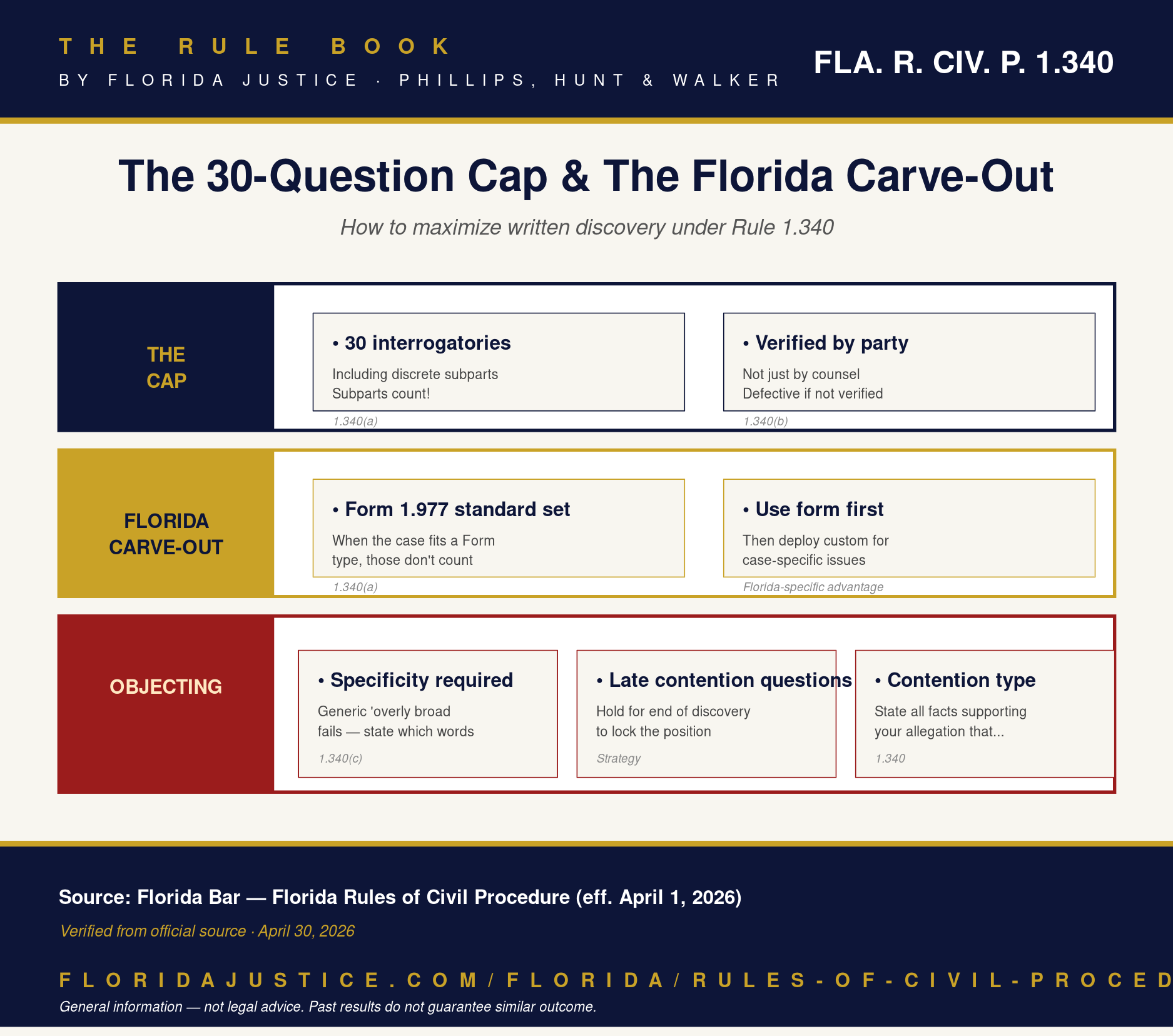
Count subparts. They count. 1.340(a) caps interrogatories at 30, including discrete subparts. “Identify all persons who witnessed the accident, and for each state name, address, employer, and relationship to the parties” is FIVE interrogatories, not one. Be deliberate about subpart count in drafting.
Standard-form interrogatories don’t count. When the case fits a Form 1.977 case type, those standard interrogatories don’t count toward the 30-question cap. This is a Florida-specific advantage. Use the form set first, then deploy custom interrogatories for case-specific issues.
Object with specificity. 1.340(c) requires objections to be stated with specificity. “Vague, overly broad, unduly burdensome” is a generic objection that fails. State the specific deficiency: which words are vague, what scope is overbroad, what specific burden the request creates.
Use contention interrogatories late, not early. Contention interrogatories (“State all facts supporting your allegation that defendant breached the contract”) are most powerful served toward the close of discovery. Early service draws standard “discovery is ongoing” responses. Late service forces the opposing party to commit to a position you can hold them to at trial.
Verify the verification. 1.340(b) requires answers to be signed under oath by the party, not just by counsel. A response signed only by counsel is defective. Catch this in opposing party’s response — if they didn’t include a verified signature page, move to compel a verified response before the issue gets stale.
Related Rules in The Rule Book
- Rule 1.280 — General Provisions Governing Discovery (objection grounds and proportionality)
- Rule 1.310 — Depositions on Oral Examination (complementary fact-development tool)
- Rule 1.350 — Production of Documents (document discovery counterpart)
- Rule 1.380 — Failure to Make Discovery; Sanctions (remedies for evasive answers)
Lawyer-to-Lawyer Co-Counsel Referrals
If you’re a lawyer with a Florida case outside your normal practice — complex civil, catastrophic injury, federal court litigation, multi-state coordination — co-counsel referrals are a core part of what we do. You keep the client. We take the trial-side work. Fee split per Fla. Bar Rule 4-1.5 with full client consent.
Call John directly: (904) 444-4444
This page summarizes a Florida Rule of Civil Procedure for educational purposes. The rule text and Committee Notes are mirrored from the Florida Bar’s official publication and are public domain. The plain-English summary, practitioner notes, and video commentary are the opinion of Phillips, Hunt & Walker and are general information only — not legal advice. Reading this page does not create an attorney-client relationship. Past results do not guarantee a similar outcome in your case.
Infographic
Rule Text (verbatim from the Florida Supreme Court)
(a) Procedure for Use. (1) Without leave of court, any party may serve on any other party written interrogatories to be answered: (A) by the party to whom the interrogatories are directed; or (B) if that party is a public corporation, private corporation, partnership, association, or governmental agency, by any officer or agent, who must furnish the information available to that party.
(2) Interrogatories may be served on the plaintiff after commencement of the action and on any other party with or after service of the process and initial pleading on that party. (3) The interrogatories must not exceed 30, including all subparts, unless the court permits a larger number on motion and notice and for good cause. (4) If the supreme court has approved a form of interrogatories for the type of action, the initial interrogatories on a subject included within must be from the form approved by the court. (5) A party may serve fewer than all of the approved interrogatories within a form. (6) Other interrogatories may be added to the approved forms without leave of court, so long as the total of approved and additional interrogatories does not exceed 30. (7) Each interrogatory must be answered separately and fully in writing under oath unless it is objected to, in which event the grounds for objection must be stated and signed by the attorney making it. (8) The grounds for objecting to an interrogatory must be stated with specificity, including the reasons. Any ground not stated in a timely objection is waived unless the court, for good cause, excuses the failure. (9) The party to whom the interrogatories are directed must serve the answers and any objections within 30 days after the service of the interrogatories, except that a defendant may serve answers or objections within 45 days after service of the process and initial pleading on that defendant. The court may allow a shorter or longer time. (10) The party submitting the interrogatories may move for an order under rule 1.380(a) on any objection to or other failure to answer an interrogatory.
(b) Scope; Use at Trial. (1) Interrogatories may relate to any matters that can be inquired into under rule 1.280(c), and the answers may be used to the extent permitted by the rules of evidence except as otherwise provided in subdivision (b). (2) An interrogatory otherwise proper is not objectionable merely because an answer to the interrogatory involves an opinion or contention that relates to fact or calls for a conclusion or asks for information not within the personal knowledge of the party. (3) A party must respond to an otherwise proper interrogatory by giving the information the party has and the source on which the information is based. (4) A qualified answer may not be used as direct evidence for or impeachment against the party giving the answer unless the court finds it otherwise admissible under the rules of evidence. (5) If a party introduces an answer to an interrogatory, any other party may require that party to introduce any other interrogatory and answer that in fairness ought to be considered with it. (c) Option to Produce Records. (1) When the answer to an interrogatory may be derived or ascertained from the records (including electronically stored information) of the party to whom the interrogatory is directed or from an examination, audit, or inspection of the records or from a compilation, abstract, or summary based on the records and the burden of deriving or ascertaining the answer is substantially the same for the party serving the interrogatory as for the party to whom it is directed, then an answer to the interrogatory specifying the records from which the answer may be derived or ascertained and offering to give the party serving the interrogatory a reasonable opportunity to examine, audit, or inspect the records and to make
copies, compilations, abstracts, or summaries is a sufficient answer. (2) An answer must be in sufficient detail to permit the interrogating party to locate and to identify, as readily as can the party interrogated, the records from which the answer may be derived or ascertained, or must identify a person or persons representing the interrogated party who will be available to assist the interrogating party in locating and identifying the records at the time they are produced. (3) If the records to be produced consist of electronically stored information, the records must be produced in a form or forms in which they are ordinarily maintained or in a reasonably usable form or forms. (d) Effect on Co-Party. Answers made by a party are not binding on a co-party. (e) Service and Filing. (1) Interrogatories must be served on the party to whom the interrogatories are directed and copies must be served on all other parties. (2) A certificate of service of the interrogatories must be filed, giving the date of service and the name of the party to whom they were directed. (3) The answers to the interrogatories must be served on the party originally propounding the interrogatories and a copy must be served on all other parties by the answering party. (4) The answers to interrogatories may be filed in compliance with Florida Rule of General Practice Judicial Administration 2.425 and rule 1.280(h) by any party when the court should consider the answers to interrogatories in determining any matter pending before the court.
(5) The court may order that the answers to interrogatories be filed at any time when the court determines that examination of the answers to interrogatories is necessary to determine any matter pending before the court.
Educational reference. This page summarizes a Florida Rule of Civil Procedure for educational purposes. The rule text and Committee Notes are mirrored from the Florida Bar's official publication and are public domain. The plain-English summary, practitioner notes, and video commentary are the opinion of Phillips, Hunt & Walker and are general information only — not legal advice. Reading this page does not create an attorney-client relationship. Past results do not guarantee a similar outcome in your case.
What this rule means in plain English
Florida Rule of Civil Procedure 1.340 governs written interrogatories — questions served on a party that must be answered in writing under oath. The rule sets the numerical limit, the deadline for response, and the procedure for raising objections.
Each party may serve up to 30 interrogatories on any other party, including discrete subparts, without leave of court. Additional interrogatories require court permission. The 30-day response deadline runs from service. Responses must be answered separately and fully in writing under oath, and any objection must be stated with specificity.
The rule also includes Florida-specific standard-form interrogatory provisions. Standard-form interrogatories listed in Form 1.977 do not count toward the 30-question limit when they relate to the case type. This is a substantive carve-out unique to Florida practice.
Rule 1.340 is the most cost-effective discovery tool for nailing down basic facts: identification of witnesses, contention narrowing, document inventory, and party admissions. Use it strategically and use it early — before the 30-question limit becomes binding.
Practitioner notes
Count subparts. They count. 1.340(a) caps interrogatories at 30, including discrete subparts. “Identify all persons who witnessed the accident, and for each state name, address, employer, and relationship to the parties” is FIVE interrogatories, not one. Be deliberate about subpart count in drafting.
Standard-form interrogatories don’t count. When the case fits a Form 1.977 case type, those standard interrogatories don’t count toward the 30-question cap. This is a Florida-specific advantage. Use the form set first, then deploy custom interrogatories for case-specific issues.
Object with specificity. 1.340(c) requires objections to be stated with specificity. “Vague, overly broad, unduly burdensome” is a generic objection that fails. State the specific deficiency: which words are vague, what scope is overbroad, what specific burden the request creates.
Use contention interrogatories late, not early. Contention interrogatories (“State all facts supporting your allegation that defendant breached the contract”) are most powerful served toward the close of discovery. Early service draws standard “discovery is ongoing” responses. Late service forces the opposing party to commit to a position you can hold them to at trial.
Verify the verification. 1.340(b) requires answers to be signed under oath by the party, not just by counsel. A response signed only by counsel is defective. Catch this in opposing party’s response — if they didn’t include a verified signature page, move to compel a verified response before the issue gets stale.
Committee Notes (verbatim)
1972 Amendment. Subdivisions (a), (b), and (c) are derived from Federal Rule of Civil Procedure 33 as amended in 1970. Changes from the existing rule expand the time for answering, permit interrogatories to be served with the initial pleading or at any time thereafter, and eliminate the requirement of a hearing on objections. If objections are made, the interrogating party has the responsibility of setting a hearing if that party wants an answer. If the interrogatories are not sufficiently important, the interrogating party may let the matter drop. Subdivision (b) covers the same matter as the present rule 1.340(b) except those parts that have been transferred to rule 1.280. It also eliminates the confusion between facts and opinions or contentions by requiring that all be given. Subdivision (c) gives the interrogated party an option to produce business records from which the interrogating party can derive the answers to questions. Subdivision (d) is former subdivision (c) without change. Former subdivision (d) is repealed because it is covered in rule 1.280(e). Subdivision (e) is derived from the New Jersey rules and is intended to place both the interrogatories and the answers to them in a convenient place in the court file so that they can be referred to with less confusion. The requirement for filing a copy before the answers are received is necessary in the event of a dispute concerning what was done or the appropriate times involved. 1988 Amendment. The word “initial” in the 1984 amendment to subdivision (a) resulted in some confusion, so it has been deleted. Also the total number of interrogatories which may be propounded without leave of court is enlarged to 30 from 25. Form interrogatories which have been approved by the supreme court must be used; and those so used, with their subparts, are included in the total number permitted. The amendments are not intended to change any other requirement of the rule.
2011 Amendment. A reference to Florida Rule of General Practice and Judicial Administration 2.425 and rule 1.280(f) is added to require persons filing discovery materials with the court to make sure that good cause exists prior to filing discovery materials and that certain specific personal information is redacted. 2012 Amendments. Subdivision (c) is amended to provide for the production of electronically stored information in answer to interrogatories and to set out a procedure for determining the form in which to produce electronically stored information. Court Commentary 1984 Amendment. Subdivision (a) is amended by adding the reference to approved forms of interrogatories. The intent is to eliminate the burden of unnecessary interrogatories. Subdivision (c) is amended to add the requirement of detail in identifying records when they are produced as an alternative to answering the interrogatory or to designate the persons who will locate the records. Subdivision (e) is changed to eliminate the requirement of serving an original and a copy of the interrogatories and of the answers in light of the 1981 amendment that no longer permits filing except in special circumstances. Subdivision (f) is deleted since the Medical Liability Mediation Proceedings have been eliminated. 2024 Amendment. Any use of standard interrogatories must be adjusted for proportional discovery.