



Fla. R. Civ. P. 1.170 — Counterclaims and Crossclaims
Last verified from official source: April 30, 2026 · Source: Florida Bar — Florida Rules of Civil Procedure (eff. April 1, 2026), p. 43
Rule Text (verbatim)
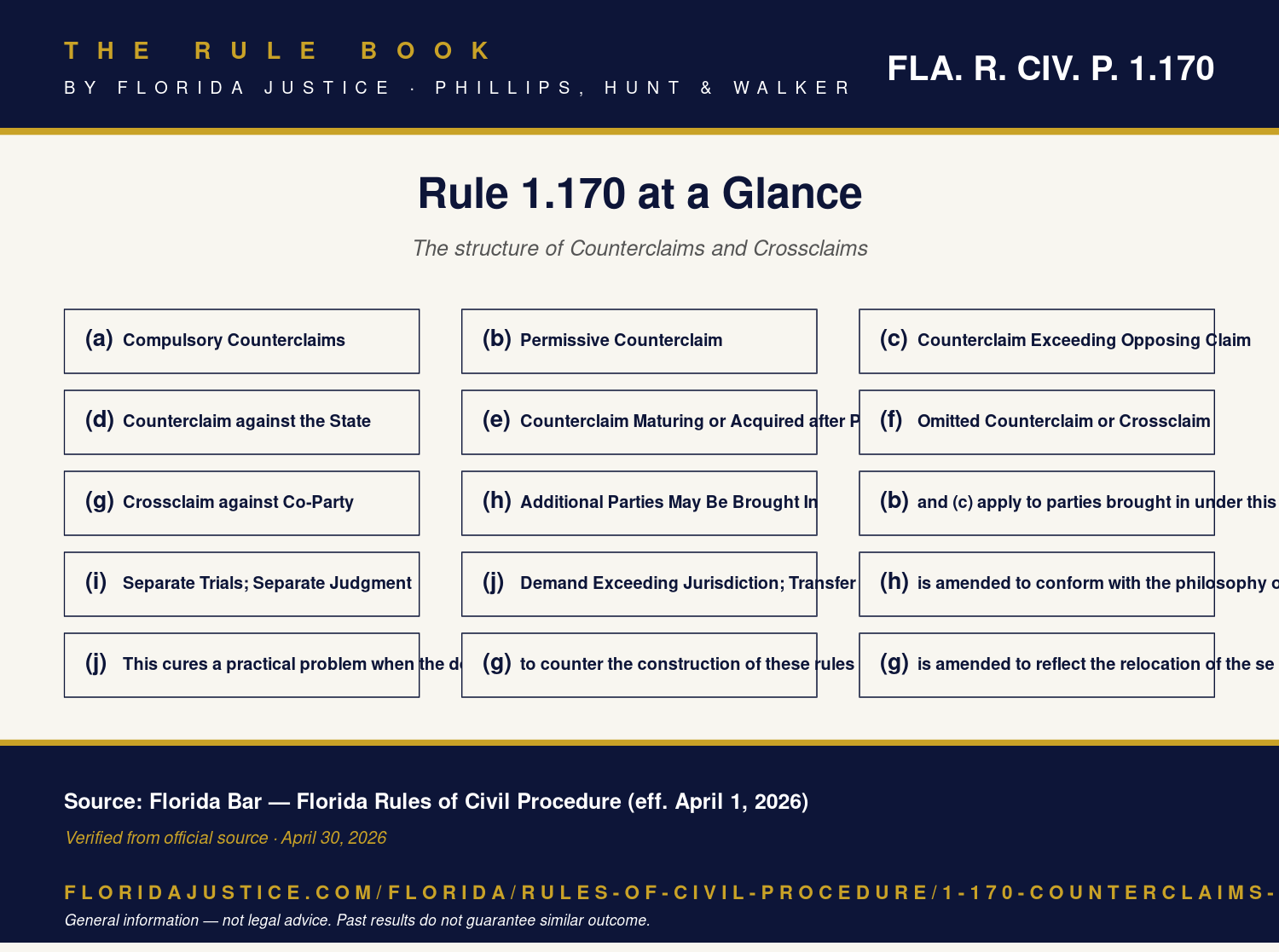
(a) Compulsory Counterclaims. A pleading must state as a counterclaim any claim which at the time of serving the pleading the pleader has against any opposing party, provided it arises out of the transaction or occurrence that is the subject matter of the opposing party’s claim and does not require for its adjudication the presence of third parties over whom the court cannot acquire jurisdiction. But the pleader need not state a claim if (1) at the time the action was commenced the claim was the subject of another pending action, or (2) the opposing party brought suit on that party’s claim by attachment or other process by which the court did not acquire jurisdiction to render a personal judgment on the claim and the pleader is not stating a counterclaim under this rule.
(b) Permissive Counterclaim. A pleading may state as a counterclaim any claim against an opposing party not arising out of the transaction or occurrence that is the subject matter of the opposing party’s claim.
(c) Counterclaim Exceeding Opposing Claim. A counterclaim may or may not diminish or defeat the recovery sought by the opposing party. It may claim relief exceeding in amount or different in kind from that sought in the pleading of the opposing party.
April 1, 2026 Florida Rules of Civil Procedure 43 (d) Counterclaim against the State. These rules shall not be construed to enlarge beyond the limits established by law the right to assert counterclaims or to claim credits against the state or any of its subdivisions or other governmental organizations thereof subject to suit or against a municipal corporation or against an officer, agency, or administrative board of the state.
(e) Counterclaim Maturing or Acquired after Pleading. A claim which matured or was acquired by the pleader after serving the pleading may be presented as a counterclaim by supplemental pleading with the permission of the court.
(f) Omitted Counterclaim or Crossclaim. When a pleader fails to set up a counterclaim or crossclaim through oversight, inadvertence, or excusable neglect, or when justice requires, the pleader may set up the counterclaim or crossclaim by amendment with leave of the court.
(g) Crossclaim against Co-Party. A pleading may state as a crossclaim any claim by one party against a co-party arising out of the transaction or occurrence that is the subject matter of either the original action or a counterclaim therein, or relating to any property that is the subject matter of the original action. The crossclaim may include a claim that the party against whom it is asserted is or may be liable to the crossclaimant for all or part of a claim asserted in the action against the crossclaimant. Service of a crossclaim on a party who has appeared in the action must be made under Florida Rule of General Practice and Judicial Administration. Service of a crossclaim against a party who has not appeared in the action must be made in the manner provided for service of summons.
(h) Additional Parties May Be Brought In. When the presence of parties other than those to the original action is required to grant complete relief in the determination of a counterclaim or crossclaim, they must be named in the counterclaim or crossclaim and be served with process and must be parties to the action thereafter if jurisdiction of them can be obtained and their joinder will not deprive the court of jurisdiction
April 1, 2026 Florida Rules of Civil Procedure 44 of the action. Rules 1.250(b) and (c) apply to parties brought in under this subdivision.
(i) Separate Trials; Separate Judgment. If the court orders separate trials as provided in rule 1.270(b), judgment on a counterclaim or crossclaim may be rendered when the court has jurisdiction to do so even if a claim of the opposing party has been dismissed or otherwise disposed of.
(j) Demand Exceeding Jurisdiction; Transfer of Action. If the demand of any counterclaim or crossclaim exceeds the jurisdiction of the court in which the action is pending, the action must be transferred immediately to the court of the same county having jurisdiction of the demand in the counterclaim or crossclaim with only such alterations in the pleadings as are essential. The court must order the transfer of the action and the transmittal of all documents in it to the proper court if the party asserting the demand exceeding the jurisdiction deposits with the court having jurisdiction a sum sufficient to pay the clerk’s service charge in the court to which the action is transferred at the time of filing the counterclaim or crossclaim. Thereupon the original documents and deposit must be transmitted and filed with a certified copy of the order. The court to which the action is transferred shall have full power and jurisdiction over the demands of all parties. Failure to make the service charge deposit at the time the counterclaim or crossclaim is filed, or within such further time as the court may allow, will reduce a claim for damages to an amount within the jurisdiction of the court where the action is pending and waive the claim in other cases.
Committee Notes
1972 Amendment. Subdivision (h) is amended to conform with the philosophy of the 1968 amendment to rule 1.250(c). No justification exists to require more restrictive joinder provisions for counterclaims and crossclaims than is required for the initial pleading. The only safeguard required is that joinder does not deprive the court of jurisdiction. Subdivision (j) is amended to require deposit of the service charge for transfer when a counterclaim or crossclaim exceeding the jurisdiction of the court in
April 1, 2026 Florida Rules of Civil Procedure 45 which the action is pending is filed. This cures a practical problem when the defendant files a counterclaim or crossclaim exceeding the jurisdiction but neglects to pay the service charge to the court to which the action is transferred. The matter then remains in limbo and causes procedural difficulties in progressing the action.
1988 Amendment. The last 2 sentences were added to subdivision (g) to counter the construction of these rules and section 48.031(1), Florida Statutes, by an appellate court in Fundaro v. Canadiana Corp., 409 So. 2d 1099 (Fla. 4th DCA 1982), to require service of all crossclaims with summons pursuant to rule 1.070. The purpose of this amendment is to make it clear that crossclaims must be served as initial pleadings only against a party who has not previously entered an appearance in the action.
2012 Amendment. Subdivision (g) is amended to reflect the relocation of the service rule from rule 1.080 to Fla. R. Jud. Admin. 2.516.
Plain-English Breakdown
Practitioner notes by John M. Phillips, Board Certified Civil Trial Lawyer — coming soon. Watch the video below for the plain-English breakdown.
Rule Text (Verbatim)
The text below is mirrored verbatim from the Florida Bar’s official publication. Public domain.
(a) Compulsory Counterclaims. A pleading must state as a counterclaim any claim which at the time of serving the pleading the pleader has against any opposing party, provided it arises out of the transaction or occurrence that is the subject matter of the opposing party’s claim and does not require for its adjudication the presence of third parties over whom the court cannot acquire jurisdiction. But the pleader need not state a claim if (1) at the time the action was commenced the claim was the subject of another pending action, or (2) the opposing party brought suit on that party’s claim by attachment or other process by which the court did not acquire jurisdiction to render a personal judgment on the claim and the pleader is not stating a counterclaim under this rule. (b) Permissive Counterclaim. A pleading may state as a counterclaim any claim against an opposing party not arising out of the transaction or occurrence that is the subject matter of the opposing party’s claim. (c) Counterclaim Exceeding Opposing Claim. A counterclaim may or may not diminish or defeat the recovery sought by the opposing party. It may claim relief exceeding in amount or different in kind from that sought in the pleading of the opposing party.
(d) Counterclaim against the State. These rules shall not be construed to enlarge beyond the limits established by law the right to assert counterclaims or to claim credits against the state or any of its subdivisions or other governmental organizations thereof subject to suit or against a municipal corporation or against an officer, agency, or administrative board of the state. (e) Counterclaim Maturing or Acquired after Pleading. A claim which matured or was acquired by the pleader after serving the pleading may be presented as a counterclaim by supplemental pleading with the permission of the court. (f) Omitted Counterclaim or Crossclaim. When a pleader fails to set up a counterclaim or crossclaim through oversight, inadvertence, or excusable neglect, or when justice requires, the pleader may set up the counterclaim or crossclaim by amendment with leave of the court. (g) Crossclaim against Co-Party. A pleading may state as a crossclaim any claim by one party against a co-party arising out of the transaction or occurrence that is the subject matter of either the original action or a counterclaim therein, or relating to any property that is the subject matter of the original action. The crossclaim may include a claim that the party against whom it is asserted is or may be liable to the crossclaimant for all or part of a claim asserted in the action against the crossclaimant. Service of a crossclaim on a party who has appeared in the action must be made under Florida Rule of General Practice and Judicial Administration. Service of a crossclaim against a party who has not appeared in the action must be made in the manner provided for service of summons. (h) Additional Parties May Be Brought In. When the presence of parties other than those to the original action is required to grant complete relief in the determination of a counterclaim or crossclaim, they must be named in the counterclaim or crossclaim and be served with process and must be parties to the action thereafter if jurisdiction of them can be obtained and their joinder will not deprive the court of jurisdiction
of the action. Rules 1.250(b) and (c) apply to parties brought in under this subdivision. (i) Separate Trials; Separate Judgment. If the court orders separate trials as provided in rule 1.270(b), judgment on a counterclaim or crossclaim may be rendered when the court has jurisdiction to do so even if a claim of the opposing party has been dismissed or otherwise disposed of. (j) Demand Exceeding Jurisdiction; Transfer of Action. If the demand of any counterclaim or crossclaim exceeds the jurisdiction of the court in which the action is pending, the action must be transferred immediately to the court of the same county having jurisdiction of the demand in the counterclaim or crossclaim with only such alterations in the pleadings as are essential. The court must order the transfer of the action and the transmittal of all documents in it to the proper court if the party asserting the demand exceeding the jurisdiction deposits with the court having jurisdiction a sum sufficient to pay the clerk’s service charge in the court to which the action is transferred at the time of filing the counterclaim or crossclaim. Thereupon the original documents and deposit must be transmitted and filed with a certified copy of the order. The court to which the action is transferred shall have full power and jurisdiction over the demands of all parties. Failure to make the service charge deposit at the time the counterclaim or crossclaim is filed, or within such further time as the court may allow, will reduce a claim for damages to an amount within the jurisdiction of the court where the action is pending and waive the claim in other cases.
Committee Notes
View Committee Notes (legislative history)
1972 Amendment. Subdivision (h) is amended to conform with the philosophy of the 1968 amendment to rule 1.250(c). No justification exists to require more restrictive joinder provisions for counterclaims and crossclaims than is required for the initial pleading. The only safeguard required is that joinder does not deprive the court of jurisdiction. Subdivision (j) is amended to require deposit of the service charge for transfer when a counterclaim or crossclaim exceeding the jurisdiction of the court in
which the action is pending is filed. This cures a practical problem when the defendant files a counterclaim or crossclaim exceeding the jurisdiction but neglects to pay the service charge to the court to which the action is transferred. The matter then remains in limbo and causes procedural difficulties in progressing the action. 1988 Amendment. The last 2 sentences were added to subdivision (g) to counter the construction of these rules and section 48.031(1), Florida Statutes, by an appellate court in Fundaro v. Canadiana Corp., 409 So. 2d 1099 (Fla. 4th DCA 1982), to require service of all crossclaims with summons pursuant to rule 1.070. The purpose of this amendment is to make it clear that crossclaims must be served as initial pleadings only against a party who has not previously entered an appearance in the action. 2012 Amendment. Subdivision (g) is amended to reflect the relocation of the service rule from rule 1.080 to Fla. R. Jud. Admin. 2.516.
Lawyer-to-Lawyer Co-Counsel Referrals
If you’re a lawyer with a Florida case outside your normal practice — complex civil, catastrophic injury, federal court litigation, multi-state coordination — co-counsel referrals are a core part of what we do. You keep the client. We take the trial-side work. Fee split per Fla. Bar Rule 4-1.5 with full client consent.
Call John directly: (904) 444-4444
Committee Notes (verbatim)
1972 Amendment. Subdivision (h) is amended to conform with the philosophy of the 1968 amendment to rule 1.250(c). No justification exists to require more restrictive joinder provisions for counterclaims and crossclaims than is required for the initial pleading. The only safeguard required is that joinder does not deprive the court of jurisdiction. Subdivision (j) is amended to require deposit of the service charge for transfer when a counterclaim or crossclaim exceeding the jurisdiction of the court in
which the action is pending is filed. This cures a practical problem when the defendant files a counterclaim or crossclaim exceeding the jurisdiction but neglects to pay the service charge to the court to which the action is transferred. The matter then remains in limbo and causes procedural difficulties in progressing the action. 1988 Amendment. The last 2 sentences were added to subdivision (g) to counter the construction of these rules and section 48.031(1), Florida Statutes, by an appellate court in Fundaro v. Canadiana Corp., 409 So. 2d 1099 (Fla. 4th DCA 1982), to require service of all crossclaims with summons pursuant to rule 1.070. The purpose of this amendment is to make it clear that crossclaims must be served as initial pleadings only against a party who has not previously entered an appearance in the action. 2012 Amendment. Subdivision (g) is amended to reflect the relocation of the service rule from rule 1.080 to Fla. R. Jud. Admin. 2.516.