


Educational reference. This page summarizes a Florida Rule of Civil Procedure for educational purposes. The rule text and Committee Notes are mirrored from the Florida Bar's official publication and are public domain. The plain-English summary is the opinion of Phillips, Hunt & Walker and is general information only — not legal advice. Reading this page does not create an attorney-client relationship. Past results do not guarantee a similar outcome in your case.
What this rule means in plain English
Florida Rule of Civil Procedure 1.710 — Mediation Rules — sets out the procedural requirements for this aspect of Florida civil practice. (a) Completion of Mediation. Mediation shall be completed within 45 days of the first mediation conference unless extended by order of the court or by stipulation of the parties. (b) Exclusions from Mediation. A civil action shall be ordered to mediation or mediation in conjunction with arbitration upon stipulation of the parties.
Rule Text (verbatim from the Florida Supreme Court)
(a) Completion of Mediation. Mediation shall be completed within 45 days of the first mediation conference unless extended by order of the court or by stipulation of the parties. (b) Exclusions from Mediation. A civil action shall be ordered to mediation or mediation in conjunction with arbitration upon stipulation of the parties. A civil action may be ordered to mediation or mediation in conjunction with arbitration upon motion of any party or by the court, if the judge determines the action to be of such a nature that mediation could be of benefit to the litigants or the court. Under no circumstances may the following categories of actions be referred to mediation: (1) Bond estreatures. (2) Habeas corpus and extraordinary writs. (3) Bond validations. (4) Civil or criminal contempt. (5) Other matters as may be specified by administrative order of the chief judge in the circuit. (c) Discovery. Unless stipulated by the parties or ordered by the court, the mediation process shall not suspend discovery.
Florida Rule 1.710 governs mediation in Florida civil cases — the procedural framework for court-ordered mediation, including the order, the mediator’s role, and the scope of the mediation session.
▶ Watch: Rule 1.710 — Mediation Rules

Fla. R. Civ. P. 1.710 — Mediation Rules
Last verified from official source: April 30, 2026 · Source: Florida Bar — Florida Rules of Civil Procedure (eff. April 1, 2026), p. 196
Rule Text (verbatim)
(a) Completion of Mediation. Mediation shall be completed within 45 days of the first mediation conference unless extended by order of the court or by stipulation of the parties.
(b) Exclusions from Mediation. A civil action shall be ordered to mediation or mediation in conjunction with arbitration upon stipulation of the parties. A civil action may be ordered to mediation or mediation in conjunction with arbitration upon motion of any party or by the court, if the judge determines the action to be of such a nature that mediation could be of benefit to the litigants or the court. Under no circumstances may the following categories of actions be referred to mediation:
(1) Bond estreatures.
(2) Habeas corpus and extraordinary writs.
(3) Bond validations.
(4) Civil or criminal contempt.
(5) Other matters as may be specified by administrative order of the chief judge in the circuit.
(c) Discovery. Unless stipulated by the parties or ordered by the court, the mediation process shall not suspend discovery.
Committee Notes
1994 Amendment. The Supreme Court Committee on Mediation and Arbitration Rules encourages crafting a combination of dispute resolution processes without creating an unreasonable barrier to the traditional court system.
April 1, 2026 Florida Rules of Civil Procedure 196
Plain-English Breakdown
Practitioner notes by John M. Phillips, Board Certified Civil Trial Lawyer — coming soon. Watch the video at the top of this page for the plain-English breakdown.
Rule Text (Verbatim)
The text below is mirrored verbatim from the Florida Bar’s official publication. Public domain.
(a) Completion of Mediation. Mediation shall be completed within 45 days of the first mediation conference unless extended by order of the court or by stipulation of the parties. (b) Exclusions from Mediation. A civil action shall be ordered to mediation or mediation in conjunction with arbitration upon stipulation of the parties. A civil action may be ordered to mediation or mediation in conjunction with arbitration upon motion of any party or by the court, if the judge determines the action to be of such a nature that mediation could be of benefit to the litigants or the court. Under no circumstances may the following categories of actions be referred to mediation: (1) Bond estreatures. (2) Habeas corpus and extraordinary writs. (3) Bond validations. (4) Civil or criminal contempt. (5) Other matters as may be specified by administrative order of the chief judge in the circuit. (c) Discovery. Unless stipulated by the parties or ordered by the court, the mediation process shall not suspend discovery.
Committee Notes
View Committee Notes (legislative history)
1994 Amendment. The Supreme Court Committee on Mediation and Arbitration Rules encourages crafting a combination of dispute resolution processes without creating an unreasonable barrier to the traditional court system.
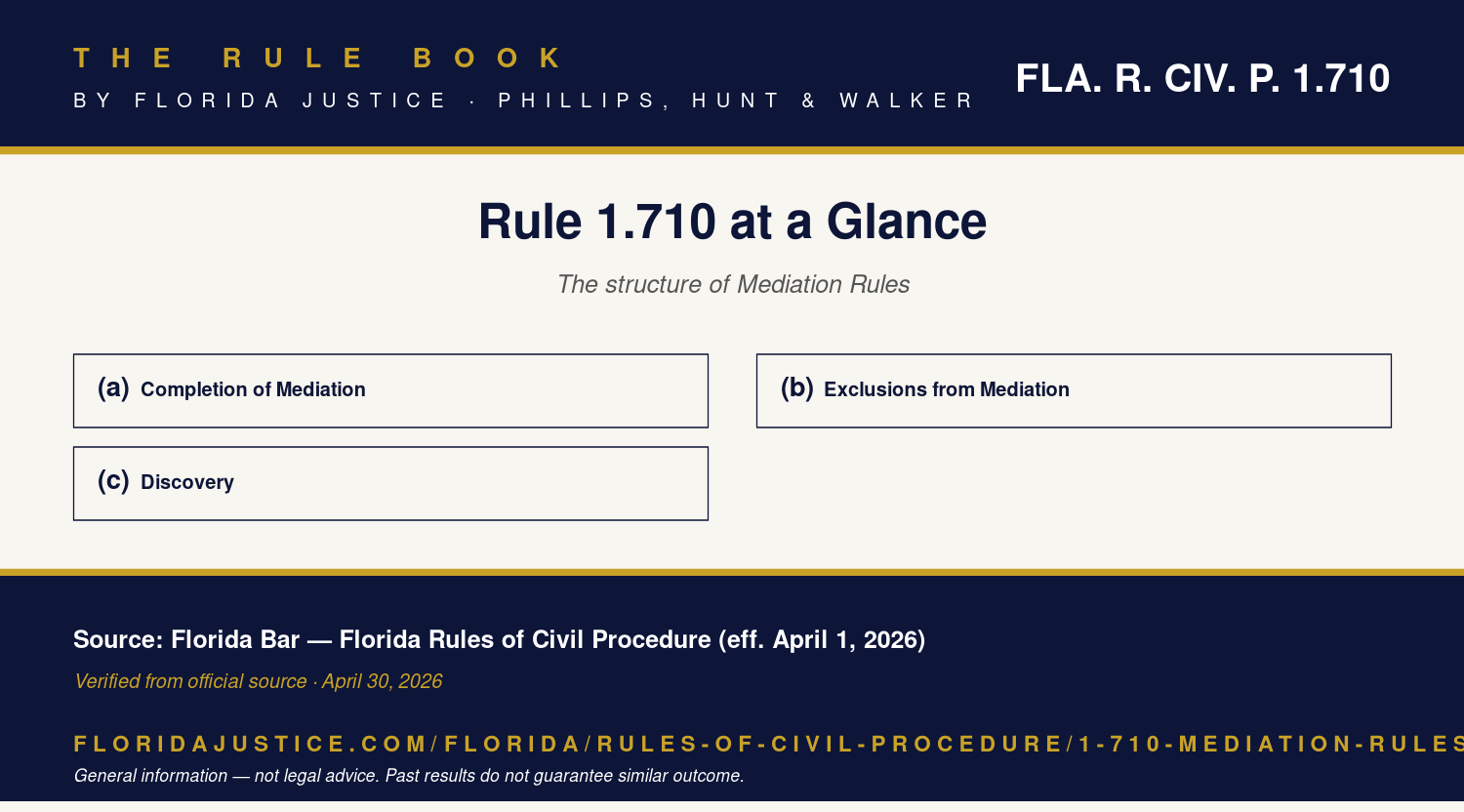
Infographic — Rule 1.710 at a Glance
Lawyer-to-Lawyer Co-Counsel Referrals
If you’re a lawyer with a Florida case outside your normal practice — complex civil, catastrophic injury, federal court litigation, multi-state coordination — co-counsel referrals are a core part of what we do. You keep the client. We take the trial-side work. Fee split per Fla. Bar Rule 4-1.5 with full client consent.
Call John directly: (904) 444-4444
This page summarizes a Florida Rule of Civil Procedure for educational purposes. The rule text and Committee Notes are mirrored from the Florida Bar’s official publication and are public domain. The plain-English summary is the opinion of Phillips, Hunt & Walker and is general information only — not legal advice. Reading this page does not create an attorney-client relationship. Past results do not guarantee a similar outcome in your case.
Committee Notes (verbatim)
1994 Amendment. The Supreme Court Committee on Mediation and Arbitration Rules encourages crafting a combination of dispute resolution processes without creating an unreasonable barrier to the traditional court system.