


Florida Rule 1.720 governs mediation procedures in Florida civil cases — how a court-ordered mediation actually runs, who must attend with full settlement authority, and the consequences of bad-faith participation.
▶ Watch: Rule 1.720 — Mediation Procedures

Fla. R. Civ. P. 1.720 — Mediation Procedures
Last verified from official source: April 30, 2026 · Source: Florida Bar — Florida Rules of Civil Procedure (eff. April 1, 2026), p. 197
Rule Text (verbatim)
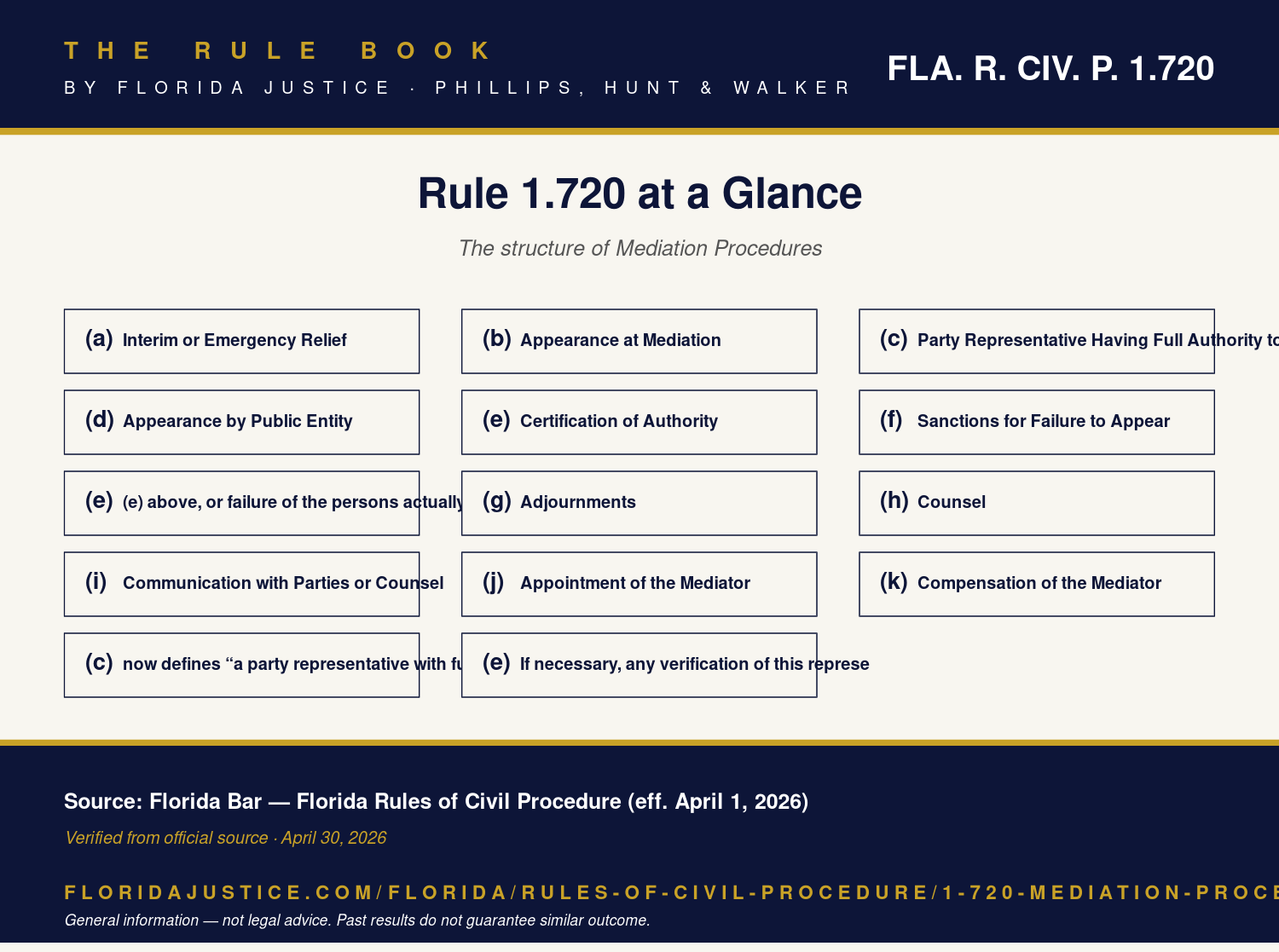
(a) Interim or Emergency Relief. A party may apply to the court for interim or emergency relief at any time. Mediation shall continue while such a motion is pending absent a contrary order of the court, or a decision of the mediator to adjourn pending disposition of the motion. Time for completing mediation shall be tolled during any periods when mediation is interrupted pending resolution of such a motion.
(b) Appearance at Mediation. A party is deemed to appear at a mediation conference if the following persons are physically present, or if authorized under rule 1.700(a), participating through the use of communication technology:
(1) The party or a party representative having full authority to settle without further consultation; and
(2) The party’s counsel of record, if any; and
(3) A representative of the insurance carrier for any insured party who is not such carrier’s outside counsel and who has full authority to settle in an amount up to the amount of the plaintiff’s last demand or policy limits, whichever is less, without further consultation.
(c) Party Representative Having Full Authority to Settle. A “party representative having full authority to settle” shall mean the final decision maker with respect to all issues presented by the case who has the legal capacity to execute a binding settlement agreement on behalf of the party. Nothing herein shall be deemed to require any party or party representative who appears at a mediation conference in compliance with this rule to enter into a settlement agreement.
(d) Appearance by Public Entity. If a party to mediation is a public entity required to operate in compliance with chapter 286, Florida Statutes, that party is deemed to appear at a mediation conference by the presence of a representative with full authority to negotiate on behalf of the entity and to recommend settlement to
April 1, 2026 Florida Rules of Civil Procedure 197 the appropriate decision-making body of the entity. Such representative may be physically present or, if authorized under rule 1.700 (a), may participate through the use of communication technology.
(e) Certification of Authority. Unless otherwise stipulated by the parties, each party, 10 days prior to appearing at a mediation conference, must file with the court and serve all parties a written notice identifying the person or persons who will appear at the mediation conference as a party representative or as an insurance carrier representative, and confirming that those persons have the authority required by subdivision (b).
(f) Sanctions for Failure to Appear. If a party fails to appear at a duly noticed mediation conference without good cause, the court, upon motion, shall impose sanctions, including award of mediation fees, attorneys’ fees, and costs, against the party failing to appear. The failure to file a confirmation of authority required under subdivision (e) above, or failure of the persons actually identified in the confirmation to appear at the mediation conference, shall create a rebuttable presumption of a failure to appear.
(g) Adjournments. The mediator may adjourn the mediation conference at any time and may set times for reconvening the adjourned conference notwithstanding rule 1.710(a). No further notification is required for parties present at the adjourned conference.
(h) Counsel. The mediator shall at all times be in control of the mediation and the procedures to be followed in the mediation. Counsel shall be permitted to communicate privately with their clients. In the discretion of the mediator and with the agreement of the parties, mediation may proceed in the absence of counsel unless otherwise ordered by the court.
(i) Communication with Parties or Counsel. The mediator may meet and consult privately with any party or parties or their counsel.
(j) Appointment of the Mediator.
April 1, 2026 Florida Rules of Civil Procedure 198 (1) Within 10 days of the order of referral, the parties may agree upon a stipulation with the court designating:
(A) a certified mediator, other than a senior judge presiding over civil cases as a judge in that circuit; or
(B) a mediator, other than a senior judge, who is not certified as a mediator but who, in the opinion of the parties and upon review by the presiding judge, is otherwise qualified by training or experience to mediate all or some of the issues in the particular case.
(2) If the parties cannot agree upon a mediator within 10 days of the order of referral, the plaintiff or petitioner shall so notify the court within 10 days of the expiration of the period to agree on a mediator, and the court shall appoint a certified mediator selected by rotation or by such other procedures as may be adopted by administrative order of the chief judge in the circuit in which the action is pending. At the request of either party, the court shall appoint a certified circuit court mediator who is a member of The Florida Bar.
(3) If a mediator agreed upon by the parties or appointed by a court cannot serve, a substitute mediator can be agreed upon or appointed in the same manner as the original mediator. A mediator shall not mediate a case assigned to another mediator without the agreement of the parties or approval of the court. A substitute mediator shall have the same qualifications as the original mediator.
(k) Compensation of the Mediator. The mediator may be compensated or uncompensated. When the mediator is compensated in whole or part by the parties, the presiding judge may determine the reasonableness of the fees charged by the mediator. In the absence of a written agreement providing for the mediator’s compensation, the mediator shall be compensated at the hourly rate set by the presiding judge in the referral order. Where appropriate, each party shall pay a proportionate share of the total charges of the mediator. Parties may object to the rate of the
April 1, 2026 Florida Rules of Civil Procedure 199 mediator’s compensation within 15 days of the order of referral by serving an objection on all other parties and the mediator.
Committee Notes
2011 Amendment. Mediated settlement conferences pursuant to this rule are meant to be conducted when the participants actually engaged in the settlement negotiations have full authority to settle the case without further consultation. New language in subdivision (c) now defines “a party representative with full authority to settle” in two parts. First, the party representative must be the final decision maker with respect to all issues presented by the case in question. Second, the party representative must have the legal capacity to execute a binding agreement on behalf of the settling party. These are objective standards. Whether or not these standards have been met can be determined without reference to any confidential mediation communications. A decision by a party representative not to settle does not, in and of itself, signify the absence of full authority to settle. A party may delegate full authority to settle to more than one person, each of whom can serve as the final decision maker. A party may also designate multiple persons to serve together as the final decision maker, all of whom must appear at mediation.
New subdivision (e) provides a process for parties to identify party representative and representatives of insurance carriers who will be attending the mediation conference on behalf of parties and insurance carriers and to confirm their respective settlement authority by means of a direct representation to the court. If necessary, any verification of this representation would be upon motion by a party or inquiry by the court without involvement of the mediator and would not require disclosure of confidential mediation communications. Nothing in this rule shall be deemed to impose any duty or obligation on the mediator selected by the parties or appointed by the court to ensure compliance.
The concept of self determination in mediation also contemplates the parties’ free choice in structuring and organizing their mediation sessions, including those who are to participate.
April 1, 2026 Florida Rules of Civil Procedure 200 Accordingly, elements of this rule are subject to revision or qualification with the mutual consent of the parties.
Plain-English Breakdown
Practitioner notes by John M. Phillips, Board Certified Civil Trial Lawyer — coming soon. Watch the video at the top of this page for the plain-English breakdown.
Rule Text (Verbatim)
The text below is mirrored verbatim from the Florida Bar’s official publication. Public domain.
(a) Interim or Emergency Relief. A party may apply to the court for interim or emergency relief at any time. Mediation shall continue while such a motion is pending absent a contrary order of the court, or a decision of the mediator to adjourn pending disposition of the motion. Time for completing mediation shall be tolled during any periods when mediation is interrupted pending resolution of such a motion. (b) Appearance at Mediation. A party is deemed to appear at a mediation conference if the following persons are physically present, or if authorized under rule 1.700(a), participating through the use of communication technology: (1) The party or a party representative having full authority to settle without further consultation; and (2) The party’s counsel of record, if any; and (3) A representative of the insurance carrier for any insured party who is not such carrier’s outside counsel and who has full authority to settle in an amount up to the amount of the plaintiff’s last demand or policy limits, whichever is less, without further consultation. (c) Party Representative Having Full Authority to Settle. A “party representative having full authority to settle” shall mean the final decision maker with respect to all issues presented by the case who has the legal capacity to execute a binding settlement agreement on behalf of the party. Nothing herein shall be deemed to require any party or party representative who appears at a mediation conference in compliance with this rule to enter into a settlement agreement. (d) Appearance by Public Entity. If a party to mediation is a public entity required to operate in compliance with chapter 286, Florida Statutes, that party is deemed to appear at a mediation conference by the presence of a representative with full authority to negotiate on behalf of the entity and to recommend settlement to
the appropriate decision-making body of the entity. Such representative may be physically present or, if authorized under rule 1.700 (a), may participate through the use of communication technology. (e) Certification of Authority. Unless otherwise stipulated by the parties, each party, 10 days prior to appearing at a mediation conference, must file with the court and serve all parties a written notice identifying the person or persons who will appear at the mediation conference as a party representative or as an insurance carrier representative, and confirming that those persons have the authority required by subdivision (b). (f) Sanctions for Failure to Appear. If a party fails to appear at a duly noticed mediation conference without good cause, the court, upon motion, shall impose sanctions, including award of mediation fees, attorneys’ fees, and costs, against the party failing to appear. The failure to file a confirmation of authority required under subdivision (e) above, or failure of the persons actually identified in the confirmation to appear at the mediation conference, shall create a rebuttable presumption of a failure to appear. (g) Adjournments. The mediator may adjourn the mediation conference at any time and may set times for reconvening the adjourned conference notwithstanding rule 1.710(a). No further notification is required for parties present at the adjourned conference. (h) Counsel. The mediator shall at all times be in control of the mediation and the procedures to be followed in the mediation. Counsel shall be permitted to communicate privately with their clients. In the discretion of the mediator and with the agreement of the parties, mediation may proceed in the absence of counsel unless otherwise ordered by the court. (i) Communication with Parties or Counsel. The mediator may meet and consult privately with any party or parties or their counsel. (j) Appointment of the Mediator.
(1) Within 10 days of the order of referral, the parties may agree upon a stipulation with the court designating: (A) a certified mediator, other than a senior judge presiding over civil cases as a judge in that circuit; or (B) a mediator, other than a senior judge, who is not certified as a mediator but who, in the opinion of the parties and upon review by the presiding judge, is otherwise qualified by training or experience to mediate all or some of the issues in the particular case. (2) If the parties cannot agree upon a mediator within 10 days of the order of referral, the plaintiff or petitioner shall so notify the court within 10 days of the expiration of the period to agree on a mediator, and the court shall appoint a certified mediator selected by rotation or by such other procedures as may be adopted by administrative order of the chief judge in the circuit in which the action is pending. At the request of either party, the court shall appoint a certified circuit court mediator who is a member of The Florida Bar. (3) If a mediator agreed upon by the parties or appointed by a court cannot serve, a substitute mediator can be agreed upon or appointed in the same manner as the original mediator. A mediator shall not mediate a case assigned to another mediator without the agreement of the parties or approval of the court. A substitute mediator shall have the same qualifications as the original mediator. (k) Compensation of the Mediator. The mediator may be compensated or uncompensated. When the mediator is compensated in whole or part by the parties, the presiding judge may determine the reasonableness of the fees charged by the mediator. In the absence of a written agreement providing for the mediator’s compensation, the mediator shall be compensated at the hourly rate set by the presiding judge in the referral order. Where appropriate, each party shall pay a proportionate share of the total charges of the mediator. Parties may object to the rate of the
mediator’s compensation within 15 days of the order of referral by serving an objection on all other parties and the mediator.
Committee Notes
View Committee Notes (legislative history)
2011 Amendment. Mediated settlement conferences pursuant to this rule are meant to be conducted when the participants actually engaged in the settlement negotiations have full authority to settle the case without further consultation. New language in subdivision (c) now defines “a party representative with full authority to settle” in two parts. First, the party representative must be the final decision maker with respect to all issues presented by the case in question. Second, the party representative must have the legal capacity to execute a binding agreement on behalf of the settling party. These are objective standards. Whether or not these standards have been met can be determined without reference to any confidential mediation communications. A decision by a party representative not to settle does not, in and of itself, signify the absence of full authority to settle. A party may delegate full authority to settle to more than one person, each of whom can serve as the final decision maker. A party may also designate multiple persons to serve together as the final decision maker, all of whom must appear at mediation. New subdivision (e) provides a process for parties to identify party representative and representatives of insurance carriers who will be attending the mediation conference on behalf of parties and insurance carriers and to confirm their respective settlement authority by means of a direct representation to the court. If necessary, any verification of this representation would be upon motion by a party or inquiry by the court without involvement of the mediator and would not require disclosure of confidential mediation communications. Nothing in this rule shall be deemed to impose any duty or obligation on the mediator selected by the parties or appointed by the court to ensure compliance. The concept of self determination in mediation also contemplates the parties’ free choice in structuring and organizing their mediation sessions, including those who are to participate.
Accordingly, elements of this rule are subject to revision or qualification with the mutual consent of the parties.
Lawyer-to-Lawyer Co-Counsel Referrals
If you’re a lawyer with a Florida case outside your normal practice — complex civil, catastrophic injury, federal court litigation, multi-state coordination — co-counsel referrals are a core part of what we do. You keep the client. We take the trial-side work. Fee split per Fla. Bar Rule 4-1.5 with full client consent.
Call John directly: (904) 444-4444
Committee Notes (verbatim)
2011 Amendment. Mediated settlement conferences pursuant to this rule are meant to be conducted when the participants actually engaged in the settlement negotiations have full authority to settle the case without further consultation. New language in subdivision (c) now defines “a party representative with full authority to settle” in two parts. First, the party representative must be the final decision maker with respect to all issues presented by the case in question. Second, the party representative must have the legal capacity to execute a binding agreement on behalf of the settling party. These are objective standards. Whether or not these standards have been met can be determined without reference to any confidential mediation communications. A decision by a party representative not to settle does not, in and of itself, signify the absence of full authority to settle. A party may delegate full authority to settle to more than one person, each of whom can serve as the final decision maker. A party may also designate multiple persons to serve together as the final decision maker, all of whom must appear at mediation. New subdivision (e) provides a process for parties to identify party representative and representatives of insurance carriers who will be attending the mediation conference on behalf of parties and insurance carriers and to confirm their respective settlement authority by means of a direct representation to the court. If necessary, any verification of this representation would be upon motion by a party or inquiry by the court without involvement of the mediator and would not require disclosure of confidential mediation communications. Nothing in this rule shall be deemed to impose any duty or obligation on the mediator selected by the parties or appointed by the court to ensure compliance. The concept of self determination in mediation also contemplates the parties’ free choice in structuring and organizing their mediation sessions, including those who are to participate.
Accordingly, elements of this rule are subject to revision or qualification with the mutual consent of the parties.