

Skip to Main Content

Fla. R. Civ. P. 1.120 — Pleading Special Matters

The Rule Book — Florida Rules of Civil Procedure, by Florida Justice / Phillips, Hunt & Walker


The Rule Book → Florida → Civil Procedure → 1.120

Fla. R. Civ. P. 1.120 — Pleading Special Matters

Last verified from official source: April 30, 2026 · Source: Florida Bar — Florida Rules of Civil Procedure (eff. April 1, 2026), p. 37

Rule Text (verbatim)

(a) Capacity. It is not necessary to aver the capacity of a party to sue or be sued, the authority of a party to sue or be sued in a representative capacity, or the legal existence of an organized association of persons that is made a party, except to the extent required to show the jurisdiction of the court. The initial pleading served on behalf of a minor party shall specifically aver the age of the minor party. When a party desires to raise an issue as to the legal existence of any party, the capacity of any party to sue or be sued, or the authority of a party to sue or be sued in a representative capacity, that party shall do so by specific negative averment which shall include such supporting particulars as are peculiarly within the pleader’s knowledge.

(b) Fraud, Mistake, Condition of the Mind. In all averments of fraud or mistake, the circumstances constituting fraud or mistake shall be stated with such particularity as the circumstances may permit. Malice, intent, knowledge, mental attitude, and other condition of mind of a person may be averred generally.

(c) Conditions Precedent. In pleading the performance or occurrence of conditions precedent, it is sufficient to aver generally that all conditions precedent have been performed or have occurred. A denial of performance or occurrence shall be made specifically and with particularity.

(d) Official Document or Act. In pleading an official document or official act it is sufficient to aver that the document was issued or the act done in compliance with law.

April 1, 2026 Florida Rules of Civil Procedure 37 (e) Judgment or Decree. In pleading a judgment or decree of a domestic or foreign court, a judicial or quasi-judicial tribunal, or a board or officer, it is sufficient to aver the judgment or decree without setting forth matter showing jurisdiction to render it.

(f) Time and Place. For the purpose of testing the sufficiency of a pleading, averments of time and place are material and shall be considered like all other averments of material matter.

(g) Special Damage. When items of special damage are claimed, they shall be specifically stated.

Plain-English Breakdown

Practitioner notes by John M. Phillips, Board Certified Civil Trial Lawyer — coming soon. Watch the video below for the plain-English breakdown.

Rule Text (Verbatim)

The text below is mirrored verbatim from the Florida Bar’s official publication. Public domain.

(a) Capacity. It is not necessary to aver the capacity of a party to sue or be sued, the authority of a party to sue or be sued in a representative capacity, or the legal existence of an organized association of persons that is made a party, except to the extent required to show the jurisdiction of the court. The initial pleading served on behalf of a minor party shall specifically aver the age of the minor party. When a party desires to raise an issue as to the legal existence of any party, the capacity of any party to sue or be sued, or the authority of a party to sue or be sued in a representative capacity, that party shall do so by specific negative averment which shall include such supporting particulars as are peculiarly within the pleader’s knowledge. (b) Fraud, Mistake, Condition of the Mind. In all averments of fraud or mistake, the circumstances constituting fraud or mistake shall be stated with such particularity as the circumstances may permit. Malice, intent, knowledge, mental attitude, and other condition of mind of a person may be averred generally. (c) Conditions Precedent. In pleading the performance or occurrence of conditions precedent, it is sufficient to aver generally that all conditions precedent have been performed or have occurred. A denial of performance or occurrence shall be made specifically and with particularity. (d) Official Document or Act. In pleading an official document or official act it is sufficient to aver that the document was issued or the act done in compliance with law.

(e) Judgment or Decree. In pleading a judgment or decree of a domestic or foreign court, a judicial or quasi-judicial tribunal, or a board or officer, it is sufficient to aver the judgment or decree without setting forth matter showing jurisdiction to render it. (f) Time and Place. For the purpose of testing the sufficiency of a pleading, averments of time and place are material and shall be considered like all other averments of material matter. (g) Special Damage. When items of special damage are claimed, they shall be specifically stated.

▶ Watch: Rule 1.120 — Pleading Special Matters

Part of The Rule Book — full FRCP playlist. Plain-English breakdown by John M. Phillips, Board Certified Civil Trial Lawyer.

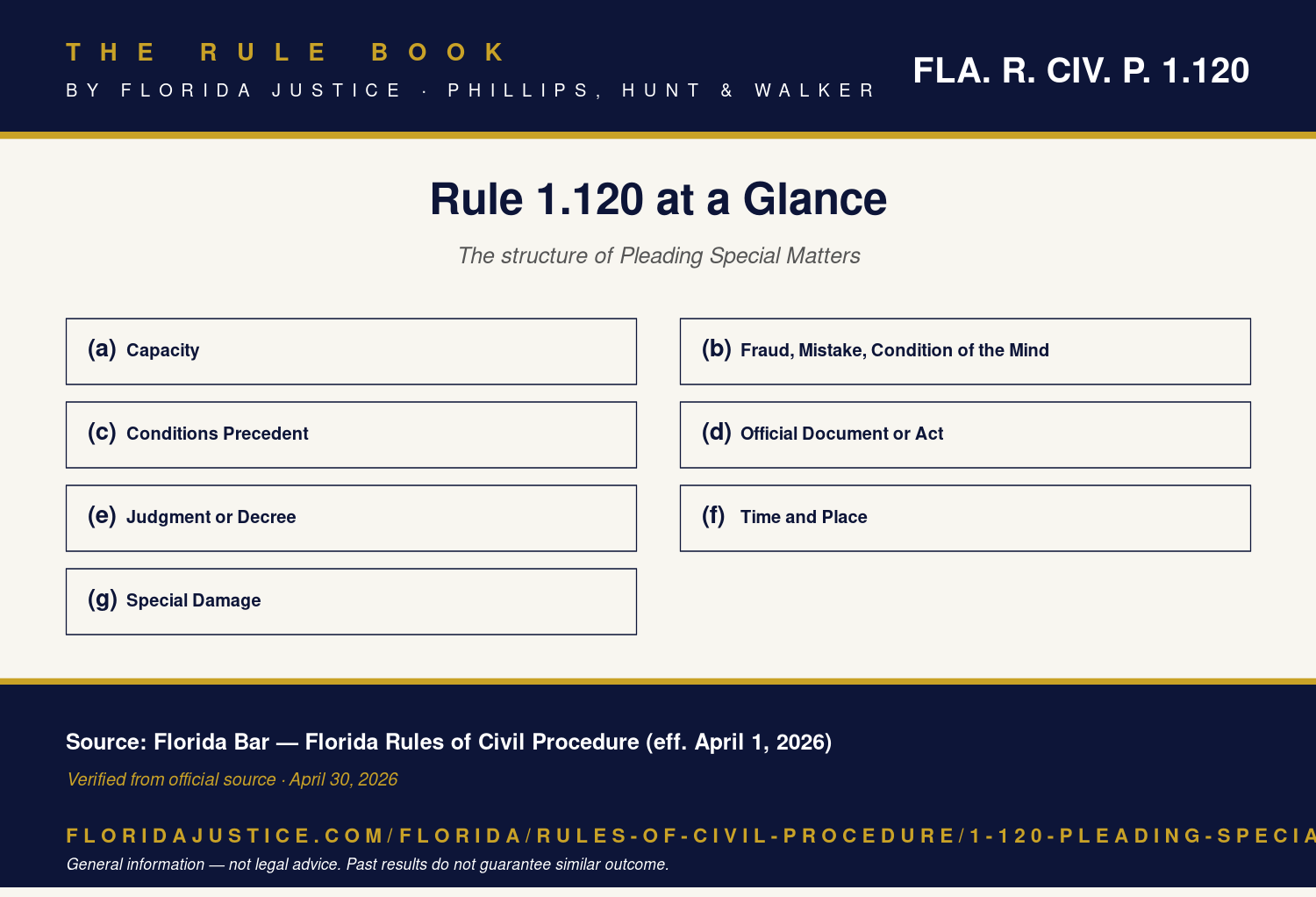
Infographic — Rule 1.120 at a Glance

Florida Rule 1.120 infographic

Committee Notes

View Committee Notes (legislative history)

No Committee Notes for this rule version.

Lawyer-to-Lawyer Co-Counsel Referrals

If you’re a lawyer with a Florida case outside your normal practice — complex civil, catastrophic injury, federal court litigation, multi-state coordination — co-counsel referrals are a core part of what we do. You keep the client. We take the trial-side work. Fee split per Fla. Bar Rule 4-1.5 with full client consent.

Call John directly: (904) 444-4444
This page summarizes a Florida Rule of Civil Procedure for educational purposes. The rule text and Committee Notes are mirrored from the Florida Bar’s official publication and are public domain. The plain-English summary is the opinion of Phillips, Hunt & Walker and is general information only — not legal advice. Reading this page does not create an attorney-client relationship. Past results do not guarantee a similar outcome in your case.

Rule Text (verbatim from the Florida Supreme Court)

(a) Capacity. It is not necessary to aver the capacity of a party to sue or be sued, the authority of a party to sue or be sued in a representative capacity, or the legal existence of an organized association of persons that is made a party, except to the extent required to show the jurisdiction of the court. The initial pleading served on behalf of a minor party shall specifically aver the age of the minor party. When a party desires to raise an issue as to the legal existence of any party, the capacity of any party to sue or be sued, or the authority of a party to sue or be sued in a representative capacity, that party shall do so by specific negative averment which shall include such supporting particulars as are peculiarly within the pleader’s knowledge. (b) Fraud, Mistake, Condition of the Mind. In all averments of fraud or mistake, the circumstances constituting fraud or mistake shall be stated with such particularity as the circumstances may permit. Malice, intent, knowledge, mental attitude, and other condition of mind of a person may be averred generally. (c) Conditions Precedent. In pleading the performance or occurrence of conditions precedent, it is sufficient to aver generally that all conditions precedent have been performed or have occurred. A denial of performance or occurrence shall be made specifically and with particularity. (d) Official Document or Act. In pleading an official document or official act it is sufficient to aver that the document was issued or the act done in compliance with law.

(e) Judgment or Decree. In pleading a judgment or decree of a domestic or foreign court, a judicial or quasi-judicial tribunal, or a board or officer, it is sufficient to aver the judgment or decree without setting forth matter showing jurisdiction to render it. (f) Time and Place. For the purpose of testing the sufficiency of a pleading, averments of time and place are material and shall be considered like all other averments of material matter. (g) Special Damage. When items of special damage are claimed, they shall be specifically stated.

Educational reference. This page summarizes a Florida Rule of Civil Procedure for educational purposes. The rule text and Committee Notes are mirrored from the Florida Bar's official publication and are public domain. The plain-English summary is the opinion of Phillips, Hunt & Walker and is general information only — not legal advice. Reading this page does not create an attorney-client relationship. Past results do not guarantee a similar outcome in your case.

What this rule means in plain English

Florida Rule of Civil Procedure 1.120 — Pleading Special Matters — sets out the procedural requirements for this aspect of Florida civil practice. (a) Capacity. It is not necessary to aver the capacity of a party to sue or be sued, the authority of a party to sue or be sued in a representative capacity, or the legal existence of an organized association of persons that is made a party, except to the extent required to show the jurisdiction of the court.

X