



Fla. R. Civ. P. 1.110 — General Rules of Pleading
Last verified from official source: April 30, 2026 · Source: Florida Bar — Florida Rules of Civil Procedure (eff. April 1, 2026), p. 32
Rule Text (verbatim)
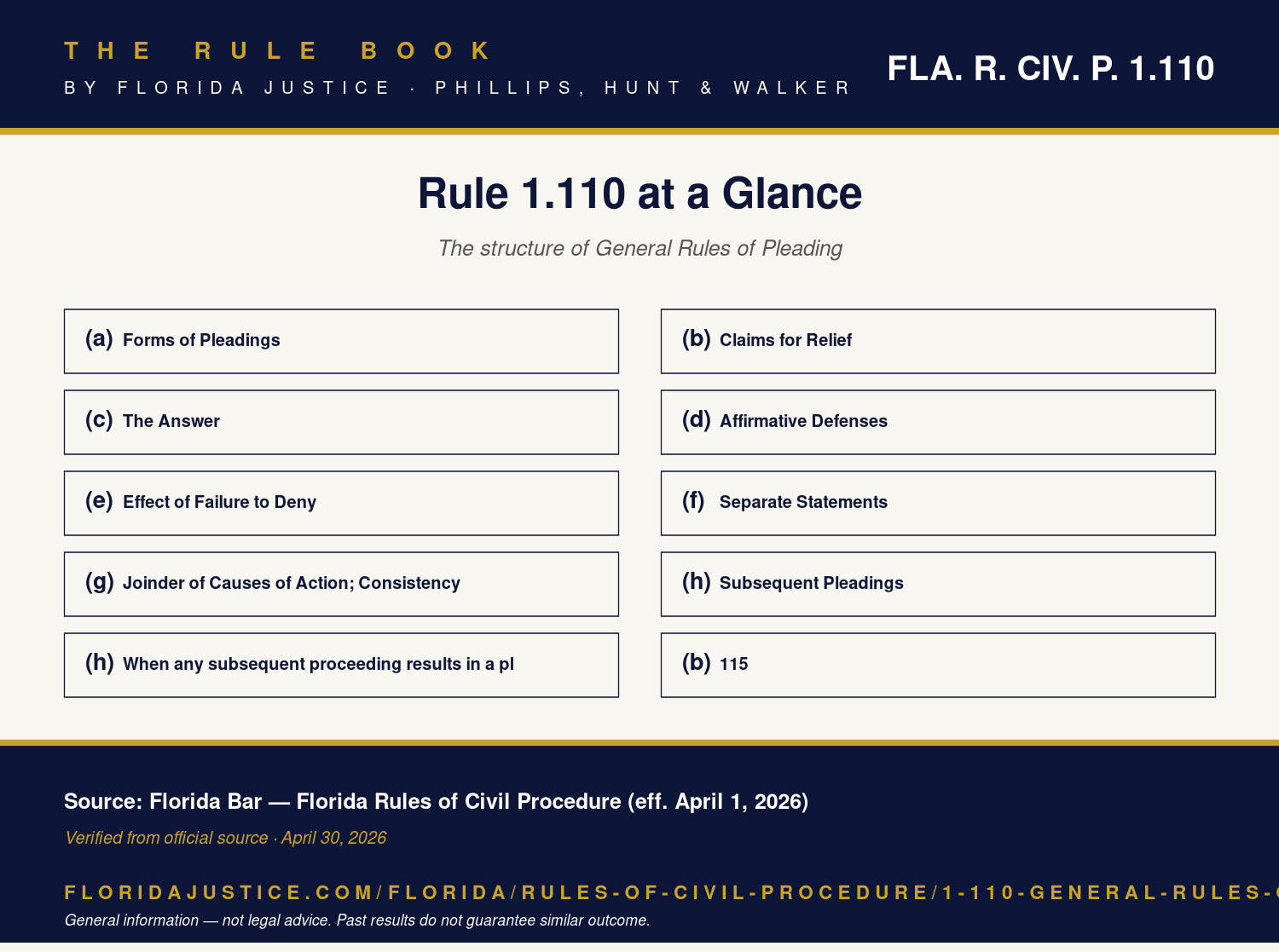
(a) Forms of Pleadings. Forms of action and technical forms for seeking relief and of pleas, pleadings, or motions are abolished.
(b) Claims for Relief. A pleading which sets forth a claim for relief, whether an original claim, counterclaim, crossclaim, or third- party claim, must state a cause of action and must contain:
(1) a short and plain statement of the grounds on which the court’s jurisdiction depends, unless the court already has jurisdiction and the claim needs no new grounds of jurisdiction to support it;
(2) a short and plain statement of the ultimate facts showing that the pleader is entitled to relief; and
(3) a demand for judgment for the relief to which the pleader deems the pleader entitled.
April 1, 2026 Florida Rules of Civil Procedure 32 Relief in the alternative or of several different types may be demanded. Every complaint will be considered to pray for general relief.
(c) The Answer. In the answer, a pleader must state in short and plain terms the pleader’s defenses to each claim asserted and must admit or deny the averments on which the adverse party relies. If the defendant is without knowledge, the defendant must so state, and such statement will operate as a denial. Denial must fairly meet the substance of the averments denied. When a pleader intends in good faith to deny only a part of an averment, the pleader must specify so much of it as is true and must deny the remainder. Unless the pleader intends in good faith to controvert all of the averments of the preceding pleading, the pleader may make denials as specific denials of designated averments or may generally deny all of the averments except such designated averments as the pleader expressly admits. When the pleader does so intend to controvert all of its averments, including averments of the grounds on which the court’s jurisdiction depends, the pleader may do so by general denial.
(d) Affirmative Defenses. In pleading to a preceding pleading, a party must set forth affirmatively: accord and satisfaction, arbitration and award, assumption of risk, contributory negligence, discharge in bankruptcy, duress, estoppel, failure of consideration, fraud, illegality, injury by fellow servant, laches, license, payment, release, res judicata, statute of frauds, statute of limitations, waiver, and any other matter constituting an avoidance or affirmative defense. A pleading that sets forth an affirmative defense must contain a short and plain statement of the ultimate facts supporting the avoidance or affirmative defense. When a party has mistakenly designated a defense as a counterclaim or a counterclaim as a defense, the court, on terms if justice so requires, must treat the pleading as if there had been a proper designation. Affirmative defenses appearing on the face of a prior pleading may be asserted as grounds for a motion or defense under rule 1.140(b), provided this does not limit amendments under rule 1.190 even if such ground is sustained.
April 1, 2026 Florida Rules of Civil Procedure 33 (e) Effect of Failure to Deny. Averments in a pleading to which a responsive pleading is required, other than those as to the amount of damages, are admitted when not denied in the responsive pleading. Averments in a pleading to which no responsive pleading is required or permitted must be taken as denied or avoided.
(f) Separate Statements. All averments of claim or defense must be made in consecutively numbered paragraphs. The contents of each paragraph must be limited as far as practicable to a statement of a single set of circumstances, and a paragraph may be referred to by number in all subsequent pleadings. Each claim founded on a separate transaction or occurrence and each defense other than denials must be stated in a separate count or defense when a separation facilitates the clear presentation of the matter set forth.
(g) Joinder of Causes of Action; Consistency. A pleader may set up in the same action as many claims or causes of action or defenses in the same right as the pleader has, and claims for relief may be stated in the alternative if separate items make up the cause of action, or if 2 or more causes of action are joined. A party may also set forth 2 or more statements of a claim or defense alternatively, either in 1 count or defense or in separate counts or defenses. When 2 or more statements are made in the alternative and 1 of them, if made independently, would be sufficient, the pleading is not made insufficient by the insufficiency of 1 or more of the alternative statements. A party may also state as many separate claims or defenses as that party has, regardless of consistency and whether based on legal or equitable grounds or both. All pleadings must be construed so as to do substantial justice.
(h) Subsequent Pleadings. When the nature of an action permits pleadings subsequent to final judgment, and the jurisdiction of the court over the parties has not terminated, the initial pleading subsequent to final judgment must be designated a supplemental complaint or petition. The action must then proceed in the same manner and time as though the supplemental complaint or petition were the initial pleading in the action,
April 1, 2026 Florida Rules of Civil Procedure 34 including the issuance of any needed process. This subdivision does not apply to proceedings that may be initiated by motion under these rules.
Committee Notes
1971 Amendment. Subdivision (h) is added to cover a situation usually arising in divorce judgment modifications, supplemental declaratory relief actions, or trust supervision. When any subsequent proceeding results in a pleading in the strict technical sense under rule 1.100(a), response by opposing parties will follow in the same course as though the new pleading were the initial pleading in the action. The time for answering and authority for defenses under rule 1.140 will apply. The last sentence exempts post judgment motions under rules 1.480(c), 1.530, and 1.540, and similar proceedings from its purview.
2014 Amendment. The last two paragraphs of rule 1.110(b) regarding pleading requirements for certain mortgage foreclosure actions were deleted and incorporated in new rule 1.115.
Plain-English Breakdown
Practitioner notes by John M. Phillips, Board Certified Civil Trial Lawyer — coming soon. Watch the video below for the plain-English breakdown.
Rule Text (Verbatim)
The text below is mirrored verbatim from the Florida Bar’s official publication. Public domain.
(a) Forms of Pleadings. Forms of action and technical forms for seeking relief and of pleas, pleadings, or motions are abolished. (b) Claims for Relief. A pleading which sets forth a claim for relief, whether an original claim, counterclaim, crossclaim, or third- party claim, must state a cause of action and must contain: (1) a short and plain statement of the grounds on which the court’s jurisdiction depends, unless the court already has jurisdiction and the claim needs no new grounds of jurisdiction to support it; (2) a short and plain statement of the ultimate facts showing that the pleader is entitled to relief; and (3) a demand for judgment for the relief to which the pleader deems the pleader entitled.
Relief in the alternative or of several different types may be demanded. Every complaint will be considered to pray for general relief. (c) The Answer. In the answer, a pleader must state in short and plain terms the pleader’s defenses to each claim asserted and must admit or deny the averments on which the adverse party relies. If the defendant is without knowledge, the defendant must so state, and such statement will operate as a denial. Denial must fairly meet the substance of the averments denied. When a pleader intends in good faith to deny only a part of an averment, the pleader must specify so much of it as is true and must deny the remainder. Unless the pleader intends in good faith to controvert all of the averments of the preceding pleading, the pleader may make denials as specific denials of designated averments or may generally deny all of the averments except such designated averments as the pleader expressly admits. When the pleader does so intend to controvert all of its averments, including averments of the grounds on which the court’s jurisdiction depends, the pleader may do so by general denial. (d) Affirmative Defenses. In pleading to a preceding pleading, a party must set forth affirmatively: accord and satisfaction, arbitration and award, assumption of risk, contributory negligence, discharge in bankruptcy, duress, estoppel, failure of consideration, fraud, illegality, injury by fellow servant, laches, license, payment, release, res judicata, statute of frauds, statute of limitations, waiver, and any other matter constituting an avoidance or affirmative defense. A pleading that sets forth an affirmative defense must contain a short and plain statement of the ultimate facts supporting the avoidance or affirmative defense. When a party has mistakenly designated a defense as a counterclaim or a counterclaim as a defense, the court, on terms if justice so requires, must treat the pleading as if there had been a proper designation. Affirmative defenses appearing on the face of a prior pleading may be asserted as grounds for a motion or defense under rule 1.140(b), provided this does not limit amendments under rule 1.190 even if such ground is sustained.
(e) Effect of Failure to Deny. Averments in a pleading to which a responsive pleading is required, other than those as to the amount of damages, are admitted when not denied in the responsive pleading. Averments in a pleading to which no responsive pleading is required or permitted must be taken as denied or avoided. (f) Separate Statements. All averments of claim or defense must be made in consecutively numbered paragraphs. The contents of each paragraph must be limited as far as practicable to a statement of a single set of circumstances, and a paragraph may be referred to by number in all subsequent pleadings. Each claim founded on a separate transaction or occurrence and each defense other than denials must be stated in a separate count or defense when a separation facilitates the clear presentation of the matter set forth. (g) Joinder of Causes of Action; Consistency. A pleader may set up in the same action as many claims or causes of action or defenses in the same right as the pleader has, and claims for relief may be stated in the alternative if separate items make up the cause of action, or if 2 or more causes of action are joined. A party may also set forth 2 or more statements of a claim or defense alternatively, either in 1 count or defense or in separate counts or defenses. When 2 or more statements are made in the alternative and 1 of them, if made independently, would be sufficient, the pleading is not made insufficient by the insufficiency of 1 or more of the alternative statements. A party may also state as many separate claims or defenses as that party has, regardless of consistency and whether based on legal or equitable grounds or both. All pleadings must be construed so as to do substantial justice. (h) Subsequent Pleadings. When the nature of an action permits pleadings subsequent to final judgment, and the jurisdiction of the court over the parties has not terminated, the initial pleading subsequent to final judgment must be designated a supplemental complaint or petition. The action must then proceed in the same manner and time as though the supplemental complaint or petition were the initial pleading in the action,
including the issuance of any needed process. This subdivision does not apply to proceedings that may be initiated by motion under these rules.
Committee Notes
View Committee Notes (legislative history)
1971 Amendment. Subdivision (h) is added to cover a situation usually arising in divorce judgment modifications, supplemental declaratory relief actions, or trust supervision. When any subsequent proceeding results in a pleading in the strict technical sense under rule 1.100(a), response by opposing parties will follow in the same course as though the new pleading were the initial pleading in the action. The time for answering and authority for defenses under rule 1.140 will apply. The last sentence exempts post judgment motions under rules 1.480(c), 1.530, and 1.540, and similar proceedings from its purview. 2014 Amendment. The last two paragraphs of rule 1.110(b) regarding pleading requirements for certain mortgage foreclosure actions were deleted and incorporated in new rule 1.115.
Lawyer-to-Lawyer Co-Counsel Referrals
If you’re a lawyer with a Florida case outside your normal practice — complex civil, catastrophic injury, federal court litigation, multi-state coordination — co-counsel referrals are a core part of what we do. You keep the client. We take the trial-side work. Fee split per Fla. Bar Rule 4-1.5 with full client consent.
Call John directly: (904) 444-4444
Committee Notes (verbatim)
1971 Amendment. Subdivision (h) is added to cover a situation usually arising in divorce judgment modifications, supplemental declaratory relief actions, or trust supervision. When any subsequent proceeding results in a pleading in the strict technical sense under rule 1.100(a), response by opposing parties will follow in the same course as though the new pleading were the initial pleading in the action. The time for answering and authority for defenses under rule 1.140 will apply. The last sentence exempts post judgment motions under rules 1.480(c), 1.530, and 1.540, and similar proceedings from its purview. 2014 Amendment. The last two paragraphs of rule 1.110(b) regarding pleading requirements for certain mortgage foreclosure actions were deleted and incorporated in new rule 1.115.