(a) Computation. Computation of time shall be governed by Florida Rule of General Practice and Judicial Administration 2.514.
(b) Extending Time.
(1) In General. When an act may or must be done within a specified time, the court may, for good cause, extend the time:
(A) with or without motion or notice if the court acts, or if a request is made, before the original time or its extension expires; or
(B) on motion made after the time has expired if the party failed to act because of excusable neglect.
(2) Exceptions. The court may not extend the time for making a motion for new trial, for rehearing, or to alter or amend a judgment; making a motion for relief from a judgment under rule 1.540(b); taking an appeal or filing a petition for certiorari; or making a motion for a directed verdict. Extensions of deadlines in case management orders are governed by rule 1.200 or rule 1.201, and trial continuances are governed by rule 1.460.
(c) Unaffected by Expiration of Term. The period of time provided for the doing of any act or the taking of any proceeding shall not be affected or limited by the continued existence or expiration of a term of court. The continued existence or expiration of a term of court in no way affects the power of a court to do any act or take any proceeding in any action which is or has been pending before it.
April 1, 2026 Florida Rules of Civil Procedure 29 (d) For Motions. A copy of any written motion which may not be heard ex parte and a copy of the notice of the hearing thereof shall be served a reasonable time before the time specified for the hearing.
Plain-English Breakdown
Practitioner notes by John M. Phillips, Board Certified Civil Trial Lawyer — coming soon. Watch the video below for the plain-English breakdown.
Committee Notes
View Committee Notes (legislative history)
No Committee Notes for this rule version.
Lawyer-to-Lawyer Co-Counsel Referrals
If you’re a lawyer with a Florida case outside your normal practice — complex civil, catastrophic injury, federal court litigation, multi-state coordination — co-counsel referrals are a core part of what we do. You keep the client. We take the trial-side work. Fee split per Fla. Bar Rule 4-1.5 with full client consent.
Call John directly: (904) 444-4444
This page summarizes a Florida Rule of Civil Procedure for educational purposes. The rule text and Committee Notes are mirrored from the Florida Bar’s official publication and are public domain. The plain-English summary is the opinion of Phillips, Hunt & Walker and is general information only — not legal advice. Reading this page does not create an attorney-client relationship. Past results do not guarantee a similar outcome in your case.
(a) tells you how to count days. The day of the act, event, or default that begins the period is excluded. The last day is included. If the last day falls on a Saturday, Sunday, or court holiday, the period runs until the next day that is not one of those. Florida adopted the federal-style “all days count” approach by reference to Rule 2.514 of the Florida Rules of General Practice and Judicial Administration — meaning weekends and holidays in the middle of the period are no longer skipped. Lawyers used to the old “skip weekends if period is less than 7 days” rule have to retrain. Calendar everything off the rendition or service date and let the calendar tool do the math.
Subsection (b) — Enlargement
(b) is the workhorse — extensions of time. Before the deadline, the court may for cause shown extend the period for filing or serving any document. After the deadline, the court may extend only on motion showing excusable neglect. The two-tier standard matters: a routine extension request before the deadline is generally granted; a request after the deadline requires a sworn factual explanation of why the deadline was missed. Conclusory affidavits that say “press of business” or “calendar oversight” are routinely denied.
Subsection (b)(2) — The Jurisdictional Cliff
(b)(2) lists the deadlines the court has no authority to extend. These include the 15-day post-trial motion deadlines under Rule 1.530, the 15-day notice of appeal deadline under the Florida Rules of Appellate Procedure, the deadlines for motions for relief from judgment under Rule 1.540 in their substantive grounds, and certain other rule-specified jurisdictional periods. Miss one of these and no court — trial or appellate — can give the time back. This subsection is why post-trial calendaring is the highest-stakes calendar discipline in Florida civil practice.
Subsection (c) — Motions for Continuance
(c) directs that motions for continuance be filed reasonably in advance of the date affected. Motions filed the day before a hearing or trial are routinely denied unless the moving party can show truly emergent circumstances. Best practice: file at the moment the conflict arises and explain the timing in the motion.
Subsection (d) — Service Add-On
(d) recognizes the additional time when service is by mail. Florida’s default service is electronic under Rule 2.516, and the mail-service add-on under (d) is rarely the operative provision today — but it still applies in the limited situations where mail service is authorized.
Cross-references: See Rule 1.080 (service and filing), Rule 1.530 (15-day post-trial motions), and Rule 1.540 (relief from judgment grounds and timing).
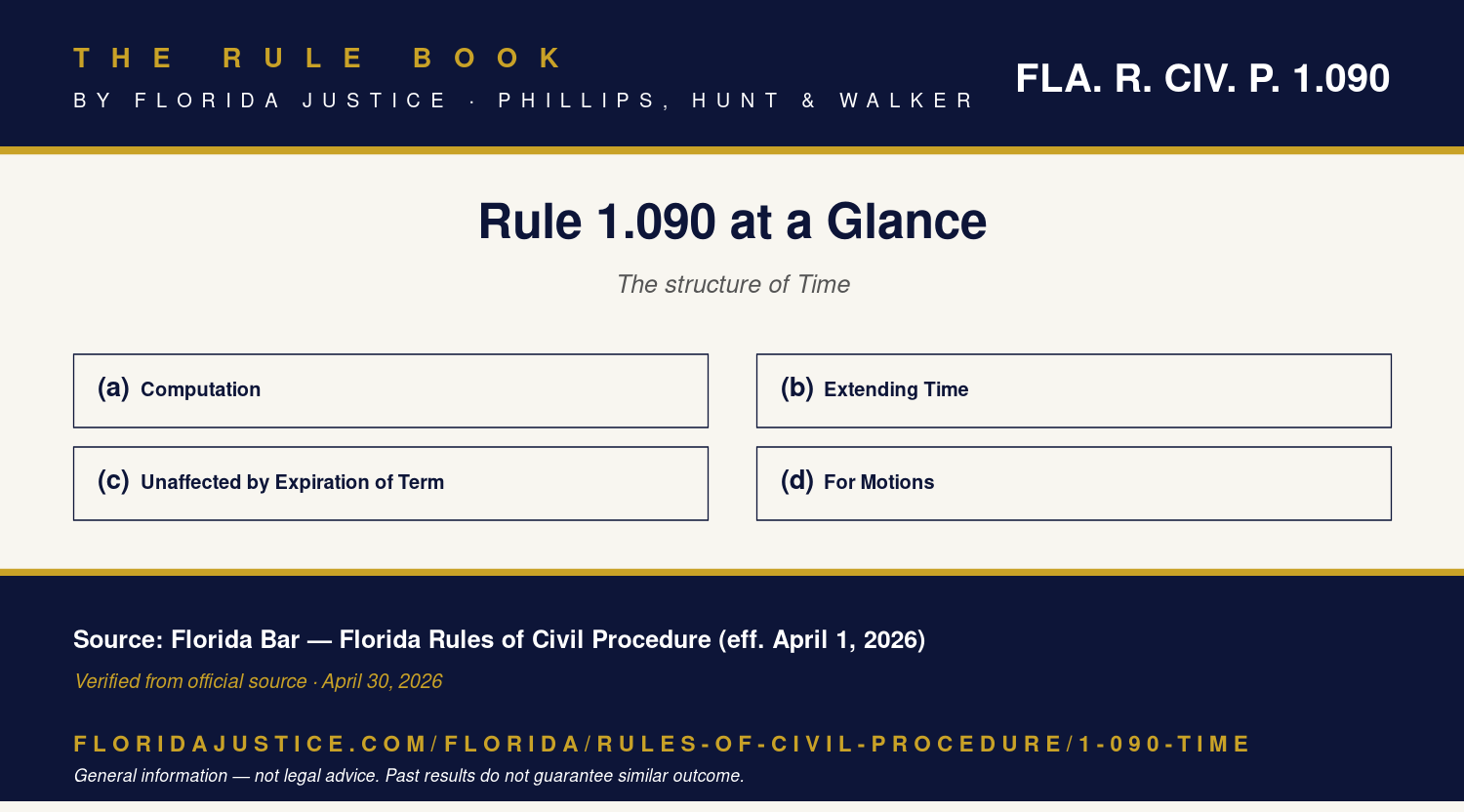
Infographic — Rule 1.090 at a Glance
Rule Text (verbatim from the Florida Supreme Court)
(a) Computation. Computation of time shall be governed by Florida Rule of General Practice and Judicial Administration 2.514. (b) Extending Time. (1) In General. When an act may or must be done within a specified time, the court may, for good cause, extend the time: (A) with or without motion or notice if the court acts, or if a request is made, before the original time or its extension expires; or (B) on motion made after the time has expired if the party failed to act because of excusable neglect. (2) Exceptions. The court may not extend the time for making a motion for new trial, for rehearing, or to alter or amend a judgment; making a motion for relief from a judgment under rule 1.540(b); taking an appeal or filing a petition for certiorari; or making a motion for a directed verdict. Extensions of deadlines in case management orders are governed by rule 1.200 or rule 1.201, and trial continuances are governed by rule 1.460. (c) Unaffected by Expiration of Term. The period of time provided for the doing of any act or the taking of any proceeding shall not be affected or limited by the continued existence or expiration of a term of court. The continued existence or expiration of a term of court in no way affects the power of a court to do any act or take any proceeding in any action which is or has been pending before it.
(d) For Motions. A copy of any written motion which may not be heard ex parte and a copy of the notice of the hearing thereof shall be served a reasonable time before the time specified for the hearing.
Educational reference. This page summarizes a Florida Rule of Civil Procedure for educational purposes. The rule text and Committee Notes are mirrored from the Florida Bar's official publication and are public domain. The plain-English summary is the opinion of Phillips, Hunt & Walker and is general information only — not legal advice. Reading this page does not create an attorney-client relationship. Past results do not guarantee a similar outcome in your case.
What this rule means in plain English
Florida Rule of Civil Procedure 1.090 — Time — sets out the procedural requirements for this aspect of Florida civil practice. (a) Computation. Computation of time shall be governed by Florida Rule of General Practice and Judicial Administration 2.514. (b) Extending Time. (1) In General.
X
Manage Consent
To provide the best experiences, we use technologies like cookies to store and/or access device information. Consenting to these technologies will allow us to process data such as browsing behavior or unique IDs on this site. Not consenting or withdrawing consent, may adversely affect certain features and functions.
Functional
Always active
The technical storage or access is strictly necessary for the legitimate purpose of enabling the use of a specific service explicitly requested by the subscriber or user, or for the sole purpose of carrying out the transmission of a communication over an electronic communications network.
Preferences
The technical storage or access is necessary for the legitimate purpose of storing preferences that are not requested by the subscriber or user.
Statistics
The technical storage or access that is used exclusively for statistical purposes.The technical storage or access that is used exclusively for anonymous statistical purposes. Without a subpoena, voluntary compliance on the part of your Internet Service Provider, or additional records from a third party, information stored or retrieved for this purpose alone cannot usually be used to identify you.
Marketing
The technical storage or access is required to create user profiles to send advertising, or to track the user on a website or across several websites for similar marketing purposes.