



Fla. R. Civ. P. 1.440 — Setting Action for Trial
Last verified from official source: April 30, 2026 · Source: Florida Bar — Florida Rules of Civil Procedure (eff. April 1, 2026), p. 147
⚠ RECENT AMENDMENTS — READ BEFORE RELYING ON OLDER PRACTICE NOTES
1.440 was substantially restructured by the Florida Supreme Court in In re Amendments to Florida Rules of Civil Procedure, 386 So. 3d 497 (Fla. 2024) (effective Jan. 1, 2025), and further amended by SC2022-0575 (effective Jan. 1, 2026).
What changed in plain English: The old “at issue” requirement is gone. Under (a), the court can now set trial even when pleadings are not closed. Under (b)–(c), any party can move for an earlier trial than the projected period in the case management order. Practical effect: cases now get set for trial much earlier in the litigation lifecycle than under prior practice.
If you are reading older treatises or earlier practitioner commentary on this rule, treat them with caution. The current text on this page is verified from the April 1, 2026 Florida Bar publication.
Rule Text (Verbatim)
The text below is mirrored verbatim from the Florida Bar’s official publication, with FRCP’s hierarchical indentation preserved. Public domain.
(a) Pleadings. The failure of the pleadings to be closed will not preclude the court from setting a case for trial.
(b) Motion for Trial. For any case not subject to rule 1.200 or rule 1.201 or for any case in which any party seeks a trial for a date earlier than the projected or actual trial period specified in a case management order, any party may file and serve a motion to set the action for trial. The motion must include an estimate of the time required, whether there is a basis for expedited trial, whether it is to be a jury or non-jury trial, whether the trial is on the original action or a subsequent proceeding, and, if applicable, indicate that the court has authorized the participation of prospective jurors or empaneled jurors through audio-video communication technology under rule 1.430(d). The moving party must serve a copy of the motion on the presiding judge at the time the motion is filed.
(c) Setting Trial Period.
(1) On a party’s motion or upon the court’s own initiative, if the court finds the action ready to be set for a trial period earlier than the projected or actual trial period specified in the case management order entered under rule 1.200 or rule 1.201, the court may enter an order setting an earlier trial period.
(2) For any case subject to rule 1.200 with a projected trial period in the case management order, not later than 45 days before the projected trial period set forth in the case management order, the court must enter an order setting the trial period.
(3) For any case not subject to rule 1.200 or 1.201, on a party’s motion or upon the court’s own initiative, if the court finds the action ready to be set for trial, the court must enter an order setting the trial period.
(4) Any order setting a trial period must set the trial period to begin at least 30 days after the date of the court’s service of the order, unless all parties agree otherwise.
(d) Service on Defaulted Parties. In actions in which the damages are not liquidated and when otherwise required by rule 1.500(e), the order setting an action for trial must be served on parties against whom a default has been entered in accordance with Florida Rule of General Practice and Judicial Administration 2.516.
(e) Applicability. This rule does not apply to actions to under chapter 51, Florida Statutes.
Committee Notes
View Committee Notes (legislative history)
1972 Amendment. All references to the pretrial conference are deleted because these are covered in rule 1.200. 1980 Amendment. Subdivision (b) is amended to specify whether the trial will be on the original pleadings or subsequent pleadings under rule 1.110(h). 1988 Amendment. Subdivision (c) was amended to clarify a confusion regarding the notice for trial which resulted from a 1968 amendment. 2012 Amendment. Subdivision (c) is amended to reflect the relocation of the service rule from rule 1.080 to Fla. R. Jud. Admin. 2.516.
Court Commentary 1984 Amendment. Subdivision (a) is amended by adding a sentence to emphasize the authority given in rule 1.270(b) for the severing of issues for trial. Subdivision (c) is amended to delete the reference to law actions so that the rule will apply to all actions in which unliquidated damages are sought. 2024 Amendment. This rule has been substantially amended. It no longer requires that a case be “at issue” before the case can be set for trial, and it ties the date of trial directly to any projected trial period set forth in a case management order.
Plain-English Summary
Florida Rule of Civil Procedure 1.440 governs the procedural step that converts a litigated case into a trial-ready case. It sets the trial-readiness standard, the notice procedure, and the consequences of premature trial settings.
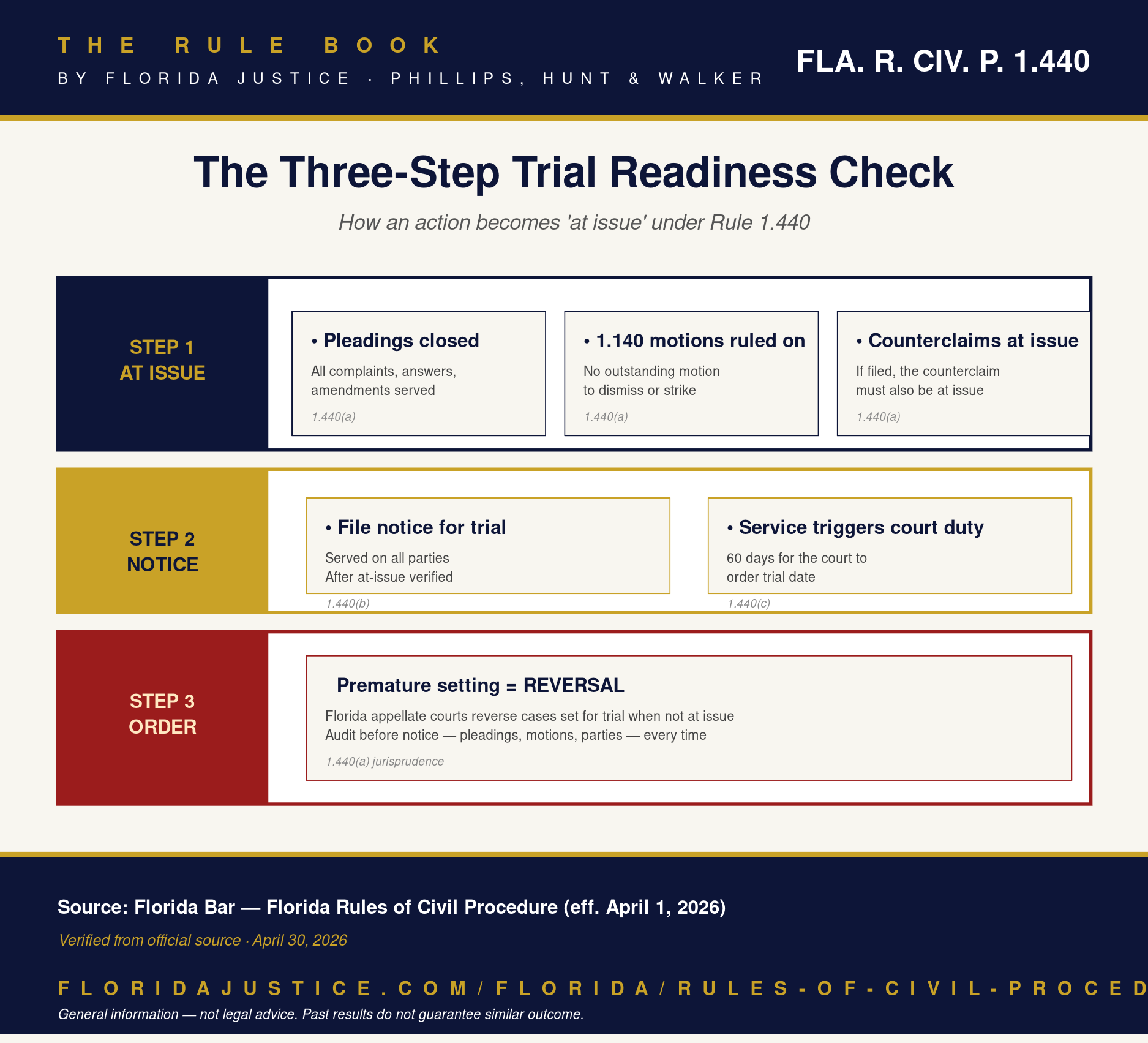
Under 1.440(a), an action is set for trial only when the action is at issue — meaning the pleadings are closed and any motions directed at the pleadings have been resolved. Subsection (b) provides for service of a notice for trial when the action is at issue. Subsection (c) gives the court 60 days to enter an order setting the case for trial after the notice for trial is served, with sufficient lead time before the trial date.
“At issue” is not optional or discretionary — Florida courts have held that an action set for trial when not at issue is reversible error. Cases routinely get reversed on appeal because the trial court set them prematurely. The procedural integrity of the rule matters.
For litigators, 1.440 is the gate between discovery and trial. Notice the wrong moment and the trial date is invalid; notice the right moment and the case moves toward verdict. The rule’s mechanics define case-management timing for the entire defense or plaintiff side.
Practitioner Notes — From the Trial Lawyers at Florida Justice
Trials get set far earlier under the new 1.440 — plan accordingly. Under the post-2024 rule, the court can set a trial period before pleadings are even closed (see (a)) and any party can move for a trial date earlier than the period projected in the case management order under rule 1.200. In our experience, cases that under the old rule sat for a year or more before being set are now getting trial dates much sooner. The discovery cushion you used to plan around no longer exists. Build your case as if the trial date is on top of you from day one.
The “at issue” defense is gone — do not rely on it. The pre-2024 version of this rule required pleadings closed and outstanding motions ruled on before a case could be set. That is no longer the bar. If your strategy depends on stalling trial-setting by leaving 1.140 motions or amendments outstanding, that lever no longer works. Older treatises and practitioner guides that lead with “at issue” analysis are stale.
The motion for trial is now strategic, not procedural. Subdivision (b) requires the motion to include a time estimate, jury vs. non-jury, basis for expedited trial, and whether AV technology is contemplated under rule 1.430(d). Treat this as a substantive filing — the court will rely on what you say. Underestimating trial length is the most common error; overestimating slows the docket and irritates the bench. Talk to opposing counsel about a joint estimate before filing if the relationship allows.
Plaintiffs: move for an earlier setting when discovery is complete. Subdivision (c) gives the court the power to set a trial period earlier than the projected period on its own initiative or on motion. If you have a clean discovery record and a defendant dragging the case, file the motion. The new rule was written to give judges this exact lever.
Defendants: counter-move for sufficient lead time, with specifics. The rule still requires “sufficient time” between order and trial — but with earlier dates becoming the norm, defendants should be prepared to make a record on what “sufficient” means in this case. Tie your continuance request to specific outstanding discovery, scheduled expert depositions, or third-party subpoenas — not generic complexity.
Default-party notice — the SC2022-0575 cleanup. The Jan. 1, 2026 amendment to subdivision (d) harmonizes notice-of-trial procedures with rule 1.500 for parties in default. If you have a defaulted party in your case, double-check service of the trial notice against current 1.500 requirements; the old practice may not satisfy the amended rule.
Counterclaims and crossclaims still matter — but for trial scope, not trial-setting. The new rule lets the court set the case for trial even if a counterclaim is still being pleaded. But the court can carve scope. If a counterclaim isn’t ready, ask the court to set the main claims and reserve the counterclaim, rather than letting trial be delayed across the board.
Related Rules in The Rule Book
- Rule 1.140 — Defenses (Motion to Dismiss) (must be ruled on before at-issue)
- Rule 1.150 — Sham Pleadings (pleading challenges that affect at-issue status)
- Rule 1.510 — Summary Judgment (may resolve case before trial-setting)
- Rule 1.460 — Motions to Continue Trial (extensions of trial date once set)
Lawyer-to-Lawyer Co-Counsel Referrals
If you’re a lawyer with a Florida case outside your normal practice — complex civil, catastrophic injury, federal court litigation, multi-state coordination — co-counsel referrals are a core part of what we do. You keep the client. We take the trial-side work. Fee split per Fla. Bar Rule 4-1.5 with full client consent.
Call John directly: (904) 444-4444
This page summarizes a Florida Rule of Civil Procedure for educational purposes. The rule text and Committee Notes are mirrored from the Florida Bar’s official publication and are public domain. The plain-English summary, practitioner notes, and video commentary are the opinion of Phillips, Hunt & Walker and are general information only — not legal advice. Reading this page does not create an attorney-client relationship. Past results do not guarantee a similar outcome in your case.
Subsection-by-Subsection Practitioner Notes — Rule 1.440
The 2024 Rewrite — “At Issue” Is Gone
The 2024 amendments removed the historical “at issue” requirement that delayed trial setting until all pleadings closed and certain conditions were met. Under the post-2024 framework, the court may set the action for trial at any time consistent with the case management order. The CMO drives the trial setting.
Subsection (a) — Setting for Trial
(a) authorizes the court to set the action for trial. Setting may be on the court’s own motion or on motion of any party. The trial setting is driven by the case management track and the CMO trial period.
Subsection (b) — Motion for Earlier Trial
(b) provides the procedural path for a party to seek a trial setting earlier than the CMO contemplates. The motion requires a showing of why an earlier setting is appropriate.
Subsection (d) — Default Party Notice (Jan. 1, 2026 Amendment)
(d) was amended effective January 1, 2026, by Florida Supreme Court order in SC2022-0575. A defaulted party who has filed any paper in the case is entitled to notice of trial setting. The notice protects the constitutional due-process interest of the defaulted defendant in the damages phase.
Cross-references: See Rule 1.200, Rule 1.460, and Rule 1.500.
Infographic
Rule Text (verbatim from the Florida Supreme Court)
(a) Pleadings. The failure of the pleadings to be closed will not preclude the court from setting a case for trial. (b) Motion for Trial. For any case not subject to rule 1.200 or rule 1.201 or for any case in which any party seeks a trial for a date earlier than the projected or actual trial period specified in a case management order, any party may file and serve a motion to set the action for trial. The motion must include an estimate of the time required, whether there is a basis for expedited trial, whether it is to be a jury or non-jury trial, whether the trial is on the original action or a subsequent proceeding, and, if applicable, indicate that the court has authorized the participation of prospective jurors or empaneled jurors through audio-video communication technology under rule 1.430(d). The moving party must serve a copy of the motion on the presiding judge at the time the motion is filed. (c) Setting Trial Period. (1) On a party’s motion or upon the court’s own initiative, if the court finds the action ready to be set for a trial period earlier than the projected or actual trial period specified in the case management order entered under rule 1.200 or rule 1.201, the court may enter an order setting an earlier trial period.
(2) For any case subject to rule 1.200 with a projected trial period in the case management order, not later than 45 days before the projected trial period set forth in the case management order, the court must enter an order setting the trial period. (3) For any case not subject to rule 1.200 or 1.201, on a party’s motion or upon the court’s own initiative, if the court finds the action ready to be set for trial, the court must enter an order setting the trial period. (4) Any order setting a trial period must set the trial period to begin at least 30 days after the date of the court’s service of the order, unless all parties agree otherwise. (d) Service on Defaulted Parties. In actions in which the damages are not liquidated and when otherwise required by rule 1.500(e), the order setting an action for trial must be served on parties against whom a default has been entered in accordance with Florida Rule of General Practice and Judicial Administration 2.516. (e) Applicability. This rule does not apply to actions to under chapter 51, Florida Statutes.
Educational reference. This page summarizes a Florida Rule of Civil Procedure for educational purposes. The rule text and Committee Notes are mirrored from the Florida Bar's official publication and are public domain. The plain-English summary, practitioner notes, and video commentary are the opinion of Phillips, Hunt & Walker and are general information only — not legal advice. Reading this page does not create an attorney-client relationship. Past results do not guarantee a similar outcome in your case.
What this rule means in plain English
Florida Rule of Civil Procedure 1.440 governs the procedural step that converts a litigated case into a trial-ready case. It sets the trial-readiness standard, the notice procedure, and the consequences of premature trial settings.
Under 1.440(a), an action is set for trial only when the action is at issue — meaning the pleadings are closed and any motions directed at the pleadings have been resolved. Subsection (b) provides for service of a notice for trial when the action is at issue. Subsection (c) gives the court 60 days to enter an order setting the case for trial after the notice for trial is served, with sufficient lead time before the trial date.
“At issue” is not optional or discretionary — Florida courts have held that an action set for trial when not at issue is reversible error. Cases routinely get reversed on appeal because the trial court set them prematurely. The procedural integrity of the rule matters.
For litigators, 1.440 is the gate between discovery and trial. Notice the wrong moment and the trial date is invalid; notice the right moment and the case moves toward verdict. The rule’s mechanics define case-management timing for the entire defense or plaintiff side.
Practitioner notes
“At issue” is jurisdictional — verify before noticing. 1.440(a) requires that the case be at issue — pleadings closed and motions directed at the pleadings ruled on — before the action is set for trial. Premature trial-setting is reversible. Before filing notice for trial, audit: (i) all pleadings filed and served, (ii) all 1.140 motions and 1.150 motions ruled on, (iii) all amendments closed.
Outstanding motions to dismiss bar trial-setting. An undecided motion to dismiss under 1.140 or motion for more definite statement under 1.140(e) means the case is not at issue. Resist trial-setting until those motions are ruled on. If opposing counsel notices for trial while motions are outstanding, file an objection promptly — silence may be treated as waiver.
Counterclaim and crossclaim pleadings count. If a defendant files a counterclaim or crossclaim, the case is not at issue until the counterclaim/crossclaim is also at issue. New parties brought in by amended pleadings reset the at-issue analysis. A frequent error is treating the original claim as at issue while a counterclaim remains open.
60-day rule for setting trial. Once the notice for trial is served, 1.440(c) requires the court to enter an order fixing the trial date within 60 days. Track this on every case where you’ve filed notice. If the court fails to set a date, file a motion to compel an order setting trial — judges typically respond promptly.
Sufficient lead time matters for trial preparation. 1.440(c) requires sufficient time between order and trial. “Sufficient” depends on case complexity. In a complex commercial or medical malpractice case, sufficient lead time is months; in a simple contract dispute, weeks may be enough. If the court’s set date doesn’t allow adequate preparation, move to continue with specific reasons tied to remaining discovery, expert availability, or trial logistics.
Committee Notes (verbatim)
1972 Amendment. All references to the pretrial conference are deleted because these are covered in rule 1.200. 1980 Amendment. Subdivision (b) is amended to specify whether the trial will be on the original pleadings or subsequent pleadings under rule 1.110(h). 1988 Amendment. Subdivision (c) was amended to clarify a confusion regarding the notice for trial which resulted from a 1968 amendment. 2012 Amendment. Subdivision (c) is amended to reflect the relocation of the service rule from rule 1.080 to Fla. R. Jud. Admin. 2.516.
Court Commentary 1984 Amendment. Subdivision (a) is amended by adding a sentence to emphasize the authority given in rule 1.270(b) for the severing of issues for trial. Subdivision (c) is amended to delete the reference to law actions so that the rule will apply to all actions in which unliquidated damages are sought. 2024 Amendment. This rule has been substantially amended. It no longer requires that a case be “at issue” before the case can be set for trial, and it ties the date of trial directly to any projected trial period set forth in a case management order.