



Fla. R. Civ. P. 1.540 — Relief from Judgment, Decrees, or Orders
Last verified from official source: April 30, 2026 · Source: Florida Bar — Florida Rules of Civil Procedure (eff. April 1, 2026), p. 176
Rule Text (Verbatim)
The text below is mirrored verbatim from the Florida Bar’s official publication, with FRCP’s hierarchical indentation preserved. Public domain.
(a) Clerical Mistakes. Clerical mistakes in judgments, decrees, or other parts of the record and errors therein arising from oversight or omission may be corrected by the court at any time on its own initiative or on the motion of any party and after such notice, if any, as the court orders. During the pendency of an appeal such mistakes may be so corrected before the record on appeal is docketed in the appellate court, and thereafter while the appeal is pending may be so corrected with leave of the appellate court.
(b) Mistakes; Inadvertence; Excusable Neglect; Newly Discovered Evidence; Fraud; etc. On motion and upon such terms as are just, the court may relieve a party or a party’s legal representative from a final judgment, decree, order, or proceeding for the following reasons:
(1) mistake, inadvertence, surprise, or excusable neglect;
(2) newly discovered evidence which by due diligence could not have been discovered in time to move for a new trial or rehearing;
(3) fraud (whether heretofore denominated intrinsic or extrinsic), misrepresentation, or other misconduct of an adverse party;
(4) that the judgment, decree, or order is void; or
(5) that the judgment, decree, or order has been satisfied, released, or discharged, or a prior judgment, decree, or order upon which it is based has been reversed or otherwise vacated, or it is no longer equitable that the judgment, decree, or order should have prospective application. The motion shall be filed within a reasonable time, and for reasons (1), (2), and
(3) not more than 1 year after the judgment, decree, order, or proceeding was entered or taken. A motion under this subdivision does not affect the finality of a judgment, decree, or order or suspend its operation. This rule does not limit the power of a court to entertain an independent action to relieve a party from a judgment, decree, order, or proceeding or to set aside a judgment, decree, or order for fraud upon the court. Writs of coram nobis, coram vobis, audita querela, and bills of review and bills in the nature of a bill of review are abolished, and the procedure for obtaining any relief from a judgment or decree shall be by motion as prescribed in these rules or by an independent action.
Committee Notes
View Committee Notes (legislative history)
1992 Amendment. Subdivision (b) is amended to remove the 1 year limitation for a motion under this rule based on fraudulent financial affidavits in marital cases. 2003 Amendment. Subdivision (b) is amended to clarify that motions must be filed.
Plain-English Summary
Florida Rule of Civil Procedure 1.540 is the post-judgment remedy rule — the procedural mechanism for setting aside a final judgment after the time for appeal or rehearing has run.
Subsection (a) covers clerical mistakes — errors arising from oversight or omission that the court can correct at any time on its own initiative or by motion. These corrections do not affect the substance of the judgment.
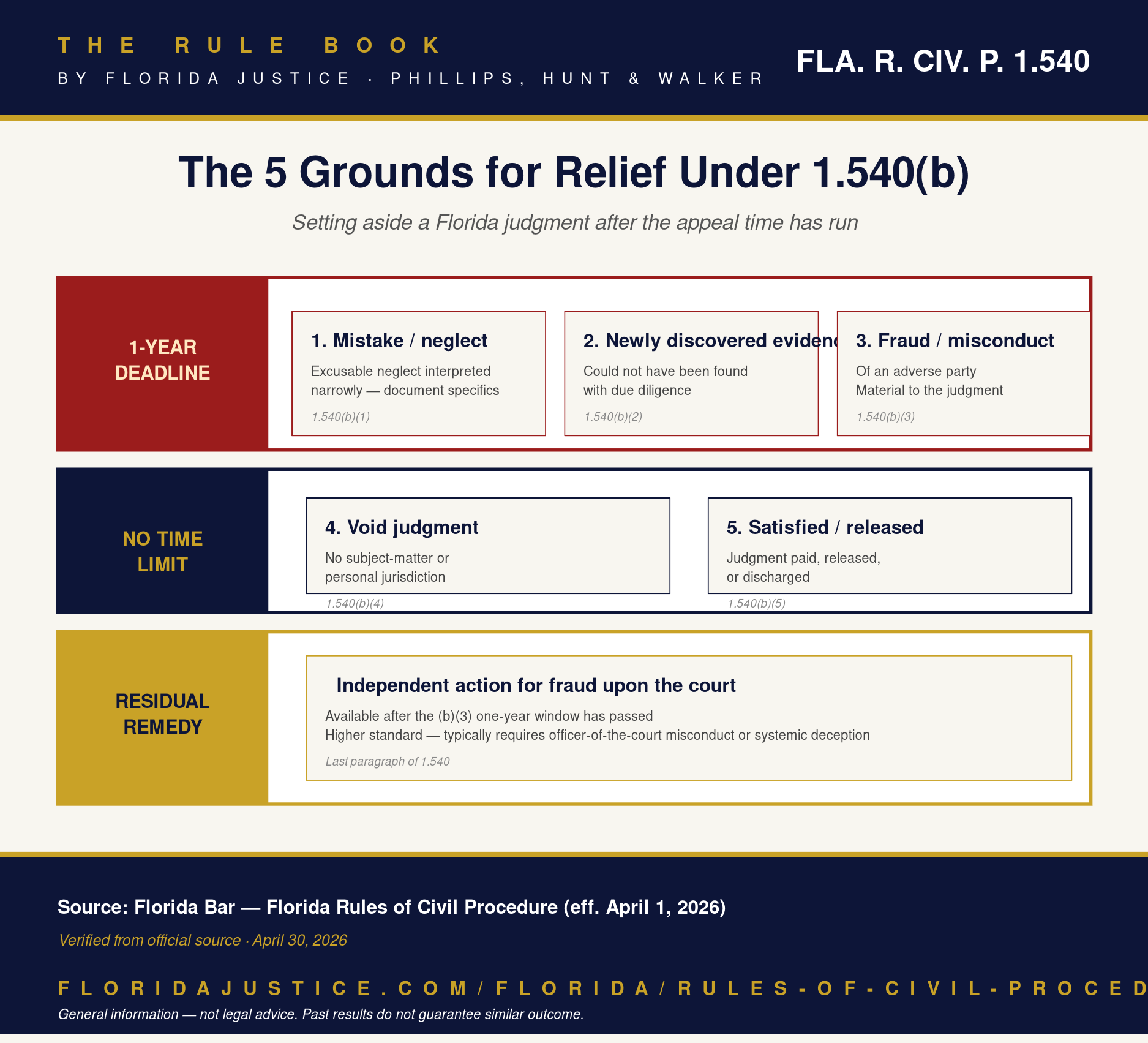
Subsection (b) is the substantive remedy. It permits relief from a final judgment, decree, order, or proceeding for: (1) mistake, inadvertence, surprise, or excusable neglect; (2) newly discovered evidence that by due diligence could not have been discovered earlier; (3) fraud, misrepresentation, or other misconduct of an adverse party; (4) the judgment is void; (5) the judgment has been satisfied, released, or discharged. Motions under (b)(1), (b)(2), and (b)(3) must be filed within one year of the judgment. The other grounds have no such limit.
The rule also preserves the court’s power to entertain an independent action to set aside a judgment for fraud upon the court — a residual equitable remedy invoked when the one-year window for (b)(3) has passed. The writs of coram nobis, coram vobis, audita querela, and bills of review are abolished; relief is by motion under this rule or by independent action.
Practitioner Notes — From the Trial Lawyers at Florida Justice
One-year deadline for (b)(1)–(b)(3) is jurisdictional in effect. Motions for relief based on mistake, newly discovered evidence, or fraud must be filed within one year of the judgment. After one year, those grounds are foreclosed. Track the one-year deadline from the date of the judgment, not from the date the moving party became aware of the basis for relief.
Excusable neglect is interpreted narrowly. Florida courts treat “excusable neglect” as the failure to act due to a reason that is neither willful nor the result of inadvertence by counsel. Calendar errors and missed deadlines often do not qualify. When moving under (b)(1), document specific facts establishing the neglect was excusable — prior similar cases, attorney illness, or genuine misunderstanding.
Newly discovered evidence requires diligence. Under (b)(2), the evidence must be newly discovered AND could not have been discovered earlier with due diligence. Counsel must show specifically what was done during discovery that could not have surfaced the evidence. “We didn’t think to ask” is not diligence.
Independent action for fraud upon the court is the residual remedy. When the one-year deadline for (b)(3) has passed, the court retains power under the rule’s last paragraph to entertain an independent action to set aside a judgment for fraud upon the court. “Fraud upon the court” is a higher standard than (b)(3) fraud — typically requires showing officer-of-the-court misconduct or systemic deception. Plead the elements specifically.
Void judgments under (b)(4) have no time bar. A judgment is void if the court lacked jurisdiction over the subject matter, lacked personal jurisdiction over the defendant, or violated due process. Motions to set aside void judgments under (b)(4) are not time-limited. This is the strongest basis when available.
Stay of execution is not automatic. Filing a motion under 1.540 does not automatically stay execution of the judgment. Concurrent with the motion, request a stay under Florida Rule of Appellate Procedure 9.310 if a stay is needed to prevent execution while the motion is pending.
Related Rules in The Rule Book
- Rule 1.420 — Dismissal of Actions (may be the underlying judgment to set aside)
- Rule 1.510 — Summary Judgment (judgments most often challenged under (b))
- Rule 1.530 — Motions for New Trial and Rehearing (earlier-stage post-judgment relief)
- Rule 1.140 — Defenses (Motion to Dismiss) (void-judgment grounds often arise from (b)(4))
Lawyer-to-Lawyer Co-Counsel Referrals
If you’re a lawyer with a Florida case outside your normal practice — complex civil, catastrophic injury, federal court litigation, multi-state coordination — co-counsel referrals are a core part of what we do. You keep the client. We take the trial-side work. Fee split per Fla. Bar Rule 4-1.5 with full client consent.
Call John directly: (904) 444-4444
This page summarizes a Florida Rule of Civil Procedure for educational purposes. The rule text and Committee Notes are mirrored from the Florida Bar’s official publication and are public domain. The plain-English summary, practitioner notes, and video commentary are the opinion of Phillips, Hunt & Walker and are general information only — not legal advice. Reading this page does not create an attorney-client relationship. Past results do not guarantee a similar outcome in your case.
Subsection-by-Subsection Practitioner Notes — Rule 1.540
Subsection (a) — Clerical Mistakes
(a) addresses clerical mistakes in judgments, orders, or other parts of the record. The court may correct these on motion of any party or on its own initiative at any time. Examples include arithmetic errors in a damages calculation, transcription errors in a property description, or omitted parties in the case caption. (a) is not a vehicle for substantive challenges — only for fixing scrivener-level errors.
Subsection (b) — The Five Substantive Grounds
(b) lists five substantive grounds for relief from a final judgment, order, or decree. Each ground has its own timing and standard:
(b)(1) Mistake, inadvertence, surprise, or excusable neglect. The classic post-judgment escape hatch. Subject to a one-year time limit. Requires a sworn factual showing of why the deadline or response was missed. Conclusory affidavits do not satisfy this ground.
(b)(2) Newly discovered evidence. Evidence that, with due diligence, could not have been discovered in time to move for new trial under Rule 1.530. Subject to a one-year time limit. The evidence must be material, not merely cumulative or impeaching.
(b)(3) Fraud, misrepresentation, or other misconduct. By an adverse party. Subject to a one-year time limit. The fraud must have prevented the moving party from fully and fairly presenting its case.
(b)(4) Void judgment. No time limit. A judgment is void when the court lacked subject-matter jurisdiction or personal jurisdiction, or when the judgment violates due process. Void judgments can be collaterally attacked at any time, in any proceeding.
(b)(5) Judgment satisfied, released, or discharged. No time limit. Used when post-judgment events render the judgment unenforceable.
The Fraud-Upon-the-Court Doctrine
Florida recognizes a separate equitable doctrine — fraud upon the court — that operates outside the (b) grounds and has no time limit. The standard is higher than (b)(3) fraud: the fraud must have corrupted the judicial process itself, not merely deceived the opposing party. Examples that have been recognized include manufactured evidence offered to the court and bribery of a judicial officer. The doctrine is narrow but powerful — it is the rare path to setting aside a judgment years or decades after entry.
Subsection (c) — Independent Action
(c) preserves the court’s power to entertain an independent action to relieve a party from a judgment. This is rarely used because the (b) grounds cover most circumstances, but it remains available where the (b) grounds do not fit.
Cross-references: See Rule 1.530 (15-day post-trial motion), Rule 1.090 (jurisdictional deadlines), and Rule 1.500 (vacating defaults under separate excusable neglect standard).
Infographic
Rule Text (verbatim from the Florida Supreme Court)
(a) Clerical Mistakes. Clerical mistakes in judgments, decrees, or other parts of the record and errors therein arising from oversight or omission may be corrected by the court at any time on its own initiative or on the motion of any party and after such notice, if any, as the court orders. During the pendency of an appeal such mistakes may be so corrected before the record on appeal is docketed in the appellate court, and thereafter while the appeal is pending may be so corrected with leave of the appellate court.
(b) Mistakes; Inadvertence; Excusable Neglect; Newly Discovered Evidence; Fraud; etc. On motion and upon such terms as are just, the court may relieve a party or a party’s legal representative from a final judgment, decree, order, or proceeding for the following reasons: (1) mistake, inadvertence, surprise, or excusable neglect; (2) newly discovered evidence which by due diligence could not have been discovered in time to move for a new trial or rehearing; (3) fraud (whether heretofore denominated intrinsic or extrinsic), misrepresentation, or other misconduct of an adverse party; (4) that the judgment, decree, or order is void; or (5) that the judgment, decree, or order has been satisfied, released, or discharged, or a prior judgment, decree, or order upon which it is based has been reversed or otherwise vacated, or it is no longer equitable that the judgment, decree, or order should have prospective application. The motion shall be filed within a reasonable time, and for reasons (1), (2), and (3) not more than 1 year after the judgment, decree, order, or proceeding was entered or taken. A motion under this subdivision does not affect the finality of a judgment, decree, or order or suspend its operation. This rule does not limit the power of a court to entertain an independent action to relieve a party from a judgment, decree, order, or proceeding or to set aside a judgment, decree, or order for fraud upon the court. Writs of coram nobis, coram vobis, audita querela, and bills of review and bills in the nature of a bill of review are abolished, and the procedure for obtaining any relief from a judgment or decree shall be by motion as prescribed in these rules or by an independent action.
Educational reference. This page summarizes a Florida Rule of Civil Procedure for educational purposes. The rule text and Committee Notes are mirrored from the Florida Bar's official publication and are public domain. The plain-English summary, practitioner notes, and video commentary are the opinion of Phillips, Hunt & Walker and are general information only — not legal advice. Reading this page does not create an attorney-client relationship. Past results do not guarantee a similar outcome in your case.
What this rule means in plain English
Florida Rule of Civil Procedure 1.540 is the post-judgment remedy rule — the procedural mechanism for setting aside a final judgment after the time for appeal or rehearing has run.
Subsection (a) covers clerical mistakes — errors arising from oversight or omission that the court can correct at any time on its own initiative or by motion. These corrections do not affect the substance of the judgment.
Subsection (b) is the substantive remedy. It permits relief from a final judgment, decree, order, or proceeding for: (1) mistake, inadvertence, surprise, or excusable neglect; (2) newly discovered evidence that by due diligence could not have been discovered earlier; (3) fraud, misrepresentation, or other misconduct of an adverse party; (4) the judgment is void; (5) the judgment has been satisfied, released, or discharged. Motions under (b)(1), (b)(2), and (b)(3) must be filed within one year of the judgment. The other grounds have no such limit.
The rule also preserves the court’s power to entertain an independent action to set aside a judgment for fraud upon the court — a residual equitable remedy invoked when the one-year window for (b)(3) has passed. The writs of coram nobis, coram vobis, audita querela, and bills of review are abolished; relief is by motion under this rule or by independent action.
Practitioner notes
One-year deadline for (b)(1)–(b)(3) is jurisdictional in effect. Motions for relief based on mistake, newly discovered evidence, or fraud must be filed within one year of the judgment. After one year, those grounds are foreclosed. Track the one-year deadline from the date of the judgment, not from the date the moving party became aware of the basis for relief.
Excusable neglect is interpreted narrowly. Florida courts treat “excusable neglect” as the failure to act due to a reason that is neither willful nor the result of inadvertence by counsel. Calendar errors and missed deadlines often do not qualify. When moving under (b)(1), document specific facts establishing the neglect was excusable — prior similar cases, attorney illness, or genuine misunderstanding.
Newly discovered evidence requires diligence. Under (b)(2), the evidence must be newly discovered AND could not have been discovered earlier with due diligence. Counsel must show specifically what was done during discovery that could not have surfaced the evidence. “We didn’t think to ask” is not diligence.
Independent action for fraud upon the court is the residual remedy. When the one-year deadline for (b)(3) has passed, the court retains power under the rule’s last paragraph to entertain an independent action to set aside a judgment for fraud upon the court. “Fraud upon the court” is a higher standard than (b)(3) fraud — typically requires showing officer-of-the-court misconduct or systemic deception. Plead the elements specifically.
Void judgments under (b)(4) have no time bar. A judgment is void if the court lacked jurisdiction over the subject matter, lacked personal jurisdiction over the defendant, or violated due process. Motions to set aside void judgments under (b)(4) are not time-limited. This is the strongest basis when available.
Stay of execution is not automatic. Filing a motion under 1.540 does not automatically stay execution of the judgment. Concurrent with the motion, request a stay under Florida Rule of Appellate Procedure 9.310 if a stay is needed to prevent execution while the motion is pending.
Committee Notes (verbatim)
1992 Amendment. Subdivision (b) is amended to remove the 1 year limitation for a motion under this rule based on fraudulent financial affidavits in marital cases. 2003 Amendment. Subdivision (b) is amended to clarify that motions must be filed.