


Educational reference. This page summarizes a Florida Rule of Civil Procedure for educational purposes. The rule text and Committee Notes are mirrored from the Florida Bar's official publication and are public domain. The plain-English summary is the opinion of Phillips, Hunt & Walker and is general information only — not legal advice. Reading this page does not create an attorney-client relationship. Past results do not guarantee a similar outcome in your case.
What this rule means in plain English
Florida Rule of Civil Procedure 1.060 — Transfers of Actions — sets out the procedural requirements for this aspect of Florida civil practice. (a) Transfers of Courts. If it should appear at any time that an action is pending in the wrong court of any county, it may be transferred to the proper court within said county by the same method as provided in rule 1.170(j). (b) Wrong Venue.
Rule Text (verbatim from the Florida Supreme Court)
(a) Transfers of Courts. If it should appear at any time that an action is pending in the wrong court of any county, it may be transferred to the proper court within said county by the same method as provided in rule 1.170(j). (b) Wrong Venue. When any action is filed laying venue in the wrong county, the court may transfer the action in the manner provided in rule 1.170(j) to the proper court in any county where it might have been brought in accordance with the venue statutes. When the venue might have been laid in 2 or more counties, the person bringing the action may select the county to which the action is transferred, but if no such selection is made, the matter shall be determined by the court. (c) Method. The service charge of the clerk of the court to which an action is transferred under this rule shall be paid by the party who commenced the action within 30 days from the date the order of transfer is entered, subject to taxation as provided by law when the action is determined. If the service charge is not paid within the 30 days, the action shall be dismissed without prejudice by the court that entered the order of transfer. Court Commentary 1984 Amendment. Because of confusion in some circuits, subdivision (c) is added: (a) to specify who is to pay the clerk’s service charge on transfer;
(b) to provide for the circumstance in which the service charge is not paid; and (c) to require the dismissal to be by the court which entered the order of transfer.

Fla. R. Civ. P. 1.060 — Transfers of Actions
Last verified from official source: April 30, 2026 · Source: Florida Bar — Florida Rules of Civil Procedure (eff. April 1, 2026), p. 17
Rule Text (verbatim)
(a) Transfers of Courts. If it should appear at any time that an action is pending in the wrong court of any county, it may be transferred to the proper court within said county by the same method as provided in rule 1.170(j).
(b) Wrong Venue. When any action is filed laying venue in the wrong county, the court may transfer the action in the manner provided in rule 1.170(j) to the proper court in any county where it might have been brought in accordance with the venue statutes. When the venue might have been laid in 2 or more counties, the person bringing the action may select the county to which the action is transferred, but if no such selection is made, the matter shall be determined by the court.
(c) Method. The service charge of the clerk of the court to which an action is transferred under this rule shall be paid by the party who commenced the action within 30 days from the date the order of transfer is entered, subject to taxation as provided by law when the action is determined. If the service charge is not paid within the 30 days, the action shall be dismissed without prejudice by the court that entered the order of transfer.
Court Commentary
1984 Amendment. Because of confusion in some circuits, subdivision (c) is added:
(a) to specify who is to pay the clerk’s service charge on transfer;
April 1, 2026 Florida Rules of Civil Procedure 17 (b) to provide for the circumstance in which the service charge is not paid; and
(c) to require the dismissal to be by the court which entered the order of transfer.
Plain-English Breakdown
Practitioner notes by John M. Phillips, Board Certified Civil Trial Lawyer — coming soon. Watch the video below for the plain-English breakdown.
Rule Text (Verbatim)
The text below is mirrored verbatim from the Florida Bar’s official publication. Public domain.
(a) Transfers of Courts. If it should appear at any time that an action is pending in the wrong court of any county, it may be transferred to the proper court within said county by the same method as provided in rule 1.170(j). (b) Wrong Venue. When any action is filed laying venue in the wrong county, the court may transfer the action in the manner provided in rule 1.170(j) to the proper court in any county where it might have been brought in accordance with the venue statutes. When the venue might have been laid in 2 or more counties, the person bringing the action may select the county to which the action is transferred, but if no such selection is made, the matter shall be determined by the court. (c) Method. The service charge of the clerk of the court to which an action is transferred under this rule shall be paid by the party who commenced the action within 30 days from the date the order of transfer is entered, subject to taxation as provided by law when the action is determined. If the service charge is not paid within the 30 days, the action shall be dismissed without prejudice by the court that entered the order of transfer. Court Commentary 1984 Amendment. Because of confusion in some circuits, subdivision (c) is added: (a) to specify who is to pay the clerk’s service charge on transfer;
(b) to provide for the circumstance in which the service charge is not paid; and (c) to require the dismissal to be by the court which entered the order of transfer.
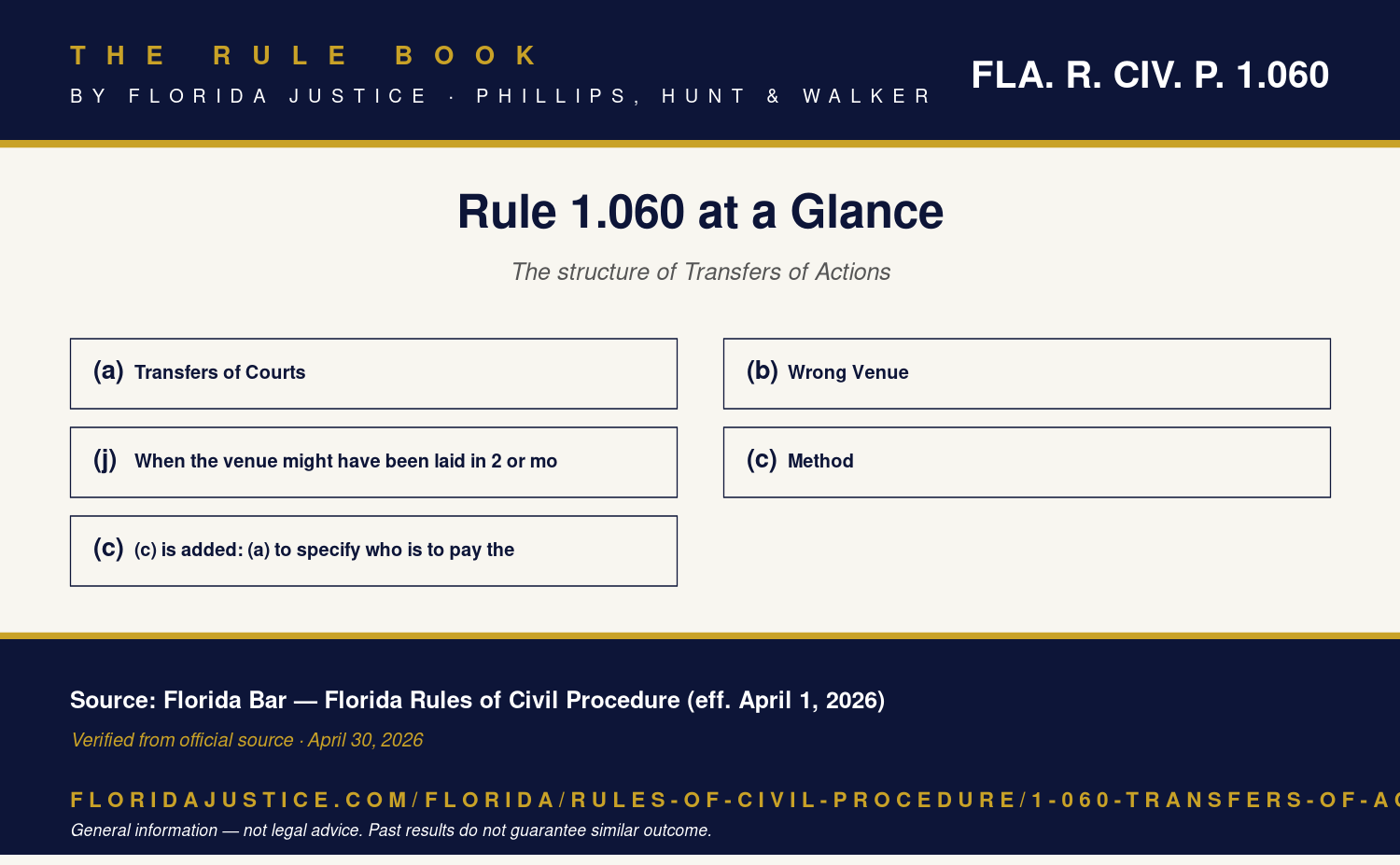
Infographic — Rule 1.060 at a Glance
Committee Notes
View Committee Notes (legislative history)
No Committee Notes for this rule version.
Lawyer-to-Lawyer Co-Counsel Referrals
If you’re a lawyer with a Florida case outside your normal practice — complex civil, catastrophic injury, federal court litigation, multi-state coordination — co-counsel referrals are a core part of what we do. You keep the client. We take the trial-side work. Fee split per Fla. Bar Rule 4-1.5 with full client consent.
Call John directly: (904) 444-4444
This page summarizes a Florida Rule of Civil Procedure for educational purposes. The rule text and Committee Notes are mirrored from the Florida Bar’s official publication and are public domain. The plain-English summary is the opinion of Phillips, Hunt & Walker and is general information only — not legal advice. Reading this page does not create an attorney-client relationship. Past results do not guarantee a similar outcome in your case.
Subsection-by-Subsection Practitioner Notes — Rule 1.060
Subsection (a) — Transfer Between Divisions
(a) authorizes the trial court to transfer an action filed in the wrong division of the court to the proper division. The court may do so on its own motion or on motion of a party. The transfer is between divisions of the same court, not between counties or to a different court entirely. A common context: a probate matter mistakenly filed in the civil division gets transferred to probate without dismissing and refiling.
Subsection (b) — Transfer to Another County
(b) governs transfer between counties for improper venue. The defendant who believes venue is improper must raise the objection by motion under Rule 1.140(b)(3). Failing to raise venue in the first motion or, if no motion is filed, in the answer typically waives the defense. The court that finds venue improper may either dismiss without prejudice or transfer the action — most commonly transfers, since dismissal would re-trigger limitations issues.
Forum Non Conveniens — § 47.122
Section 47.122, Florida Statutes, authorizes transfer for the convenience of parties and witnesses, in the interest of justice. The court weighs the relative inconvenience of the current forum against the proposed forum, considering witness access, document access, ability to view the scene, local interest in resolving the dispute, and crowding of the dockets.
Practical Timing
Move for transfer early. Late-stage transfer motions face a much harder convenience analysis because the parties have already invested in the current forum.
Cross-references: See Rule 1.061, Rule 1.140, and Rule 1.070.