


Educational reference. This page summarizes a Florida Rule of Civil Procedure for educational purposes. The rule text and Committee Notes are mirrored from the Florida Bar's official publication and are public domain. The plain-English summary is the opinion of Phillips, Hunt & Walker and is general information only — not legal advice. Reading this page does not create an attorney-client relationship. Past results do not guarantee a similar outcome in your case.
What this rule means in plain English
Florida Rule of Civil Procedure 1.390 — Depositions of Expert Witnesses — sets out the procedural requirements for this aspect of Florida civil practice. (a) Definition. The term “expert witness” as used herein applies exclusively to a person duly and regularly engaged in the practice of a profession who holds a professional degree from a university or college and has had special professional training and experience, or one possessed of special knowl…
Rule Text (verbatim from the Florida Supreme Court)
(a) Definition. The term “expert witness” as used herein applies exclusively to a person duly and regularly engaged in the practice of a profession who holds a professional degree from a university or college and has had special professional training and experience, or one possessed of special knowledge or skill about the subject upon which called to testify. (b) Procedure. The testimony of an expert or skilled witness may be taken at any time before the trial in accordance with the rules for taking depositions and may be used at trial, regardless of the place of residence of the witness or whether the witness is within the distance prescribed by rule 1.330(a)(3). No special form of notice need be given that the deposition will be used for trial.
(c) Fee. An expert or skilled witness whose deposition is taken shall be allowed a witness fee in such reasonable amount as the court may determine. The court shall also determine a reasonable time within which payment must be made, if the deponent and party cannot agree. All parties and the deponent shall be served with notice of any hearing to determine the fee. Any reasonable fee paid to an expert or skilled witness may be taxed as costs. (d) Applicability. Nothing in this rule shall prevent the taking of any deposition as otherwise provided by law.

Fla. R. Civ. P. 1.390 — Depositions of Expert Witnesses
Last verified from official source: April 30, 2026 · Source: Florida Bar — Florida Rules of Civil Procedure (eff. April 1, 2026), p. 131
Rule Text (verbatim)
(a) Definition. The term “expert witness” as used herein applies exclusively to a person duly and regularly engaged in the practice of a profession who holds a professional degree from a university or college and has had special professional training and experience, or one possessed of special knowledge or skill about the subject upon which called to testify.
(b) Procedure. The testimony of an expert or skilled witness may be taken at any time before the trial in accordance with the rules for taking depositions and may be used at trial, regardless of the place of residence of the witness or whether the witness is within the distance prescribed by rule 1.330(a)(3). No special form of notice need be given that the deposition will be used for trial.
April 1, 2026 Florida Rules of Civil Procedure 131 (c) Fee. An expert or skilled witness whose deposition is taken shall be allowed a witness fee in such reasonable amount as the court may determine. The court shall also determine a reasonable time within which payment must be made, if the deponent and party cannot agree. All parties and the deponent shall be served with notice of any hearing to determine the fee. Any reasonable fee paid to an expert or skilled witness may be taxed as costs.
(d) Applicability. Nothing in this rule shall prevent the taking of any deposition as otherwise provided by law.
Committee Notes
1972 Amendment. This rule has caused more difficulty in recent years than any other discovery rule. It was enacted as a statute originally to make the presentation of expert testimony less expensive and less onerous to the expert and to admit the expert’s deposition at trial regardless of the expert’s residence. In spite of its intent, courts seem determined to misconstrue the plain language of the rule and cause complications that the committee and the legislature did not envisage. See Owca v. Zemzicki, 137 So. 2d 876 (Fla. 2d DCA 1962); Cook v. Lichtblau, 176 So. 2d 523 (Fla. 2d DCA 1965); and Bondy v. West, 219 So. 2d 117 (Fla. 2d DCA 1969). The committee hopes the amendment to subdivision (b) will show that the intent of the rule is to permit a deposition taken of an expert in conformity with any rule for the taking of a deposition to be admitted, if otherwise admissible under the rules of evidence, regardless of the residence of the expert. In short, the rule eliminates the necessity of any of the requirements of rule 1.330(a)(3) when the deposition offered is that of an expert.
1988 Amendment. Subdivision (c) has been amended to clarify the procedure to be used in paying an expert witness for his or her appearance at a deposition.
Plain-English Breakdown
Practitioner notes by John M. Phillips, Board Certified Civil Trial Lawyer — coming soon. Watch the video below for the plain-English breakdown.
Rule Text (Verbatim)
The text below is mirrored verbatim from the Florida Bar’s official publication. Public domain.
(a) Definition. The term “expert witness” as used herein applies exclusively to a person duly and regularly engaged in the practice of a profession who holds a professional degree from a university or college and has had special professional training and experience, or one possessed of special knowledge or skill about the subject upon which called to testify. (b) Procedure. The testimony of an expert or skilled witness may be taken at any time before the trial in accordance with the rules for taking depositions and may be used at trial, regardless of the place of residence of the witness or whether the witness is within the distance prescribed by rule 1.330(a)(3). No special form of notice need be given that the deposition will be used for trial.
(c) Fee. An expert or skilled witness whose deposition is taken shall be allowed a witness fee in such reasonable amount as the court may determine. The court shall also determine a reasonable time within which payment must be made, if the deponent and party cannot agree. All parties and the deponent shall be served with notice of any hearing to determine the fee. Any reasonable fee paid to an expert or skilled witness may be taxed as costs. (d) Applicability. Nothing in this rule shall prevent the taking of any deposition as otherwise provided by law.
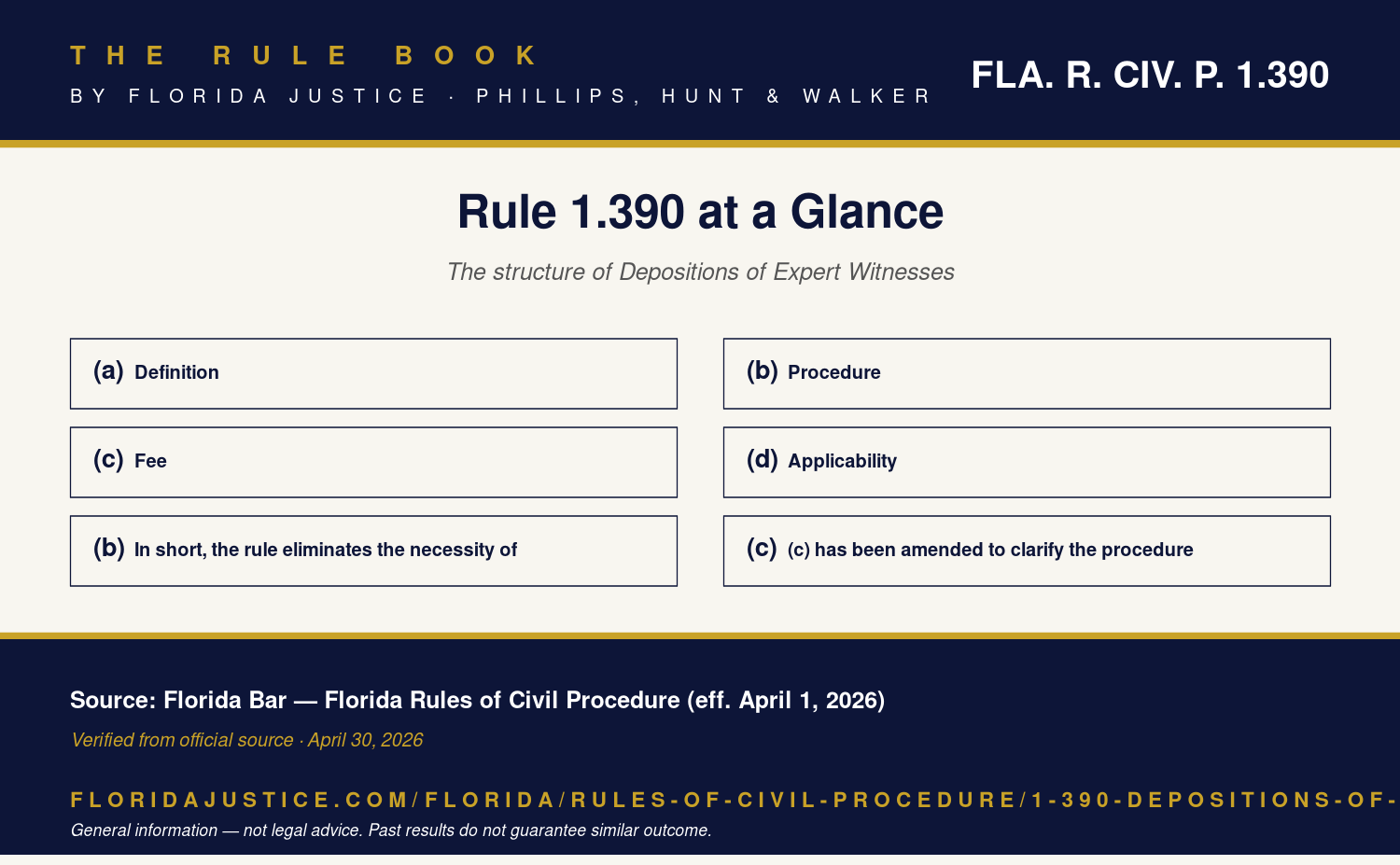
Infographic — Rule 1.390 at a Glance
Committee Notes
View Committee Notes (legislative history)
1972 Amendment. This rule has caused more difficulty in recent years than any other discovery rule. It was enacted as a statute originally to make the presentation of expert testimony less expensive and less onerous to the expert and to admit the expert’s deposition at trial regardless of the expert’s residence. In spite of its intent, courts seem determined to misconstrue the plain language of the rule and cause complications that the committee and the legislature did not envisage. See Owca v. Zemzicki, 137 So. 2d 876 (Fla. 2d DCA 1962); Cook v. Lichtblau, 176 So. 2d 523 (Fla. 2d DCA 1965); and Bondy v. West, 219 So. 2d 117 (Fla. 2d DCA 1969). The committee hopes the amendment to subdivision (b) will show that the intent of the rule is to permit a deposition taken of an expert in conformity with any rule for the taking of a deposition to be admitted, if otherwise admissible under the rules of evidence, regardless of the residence of the expert. In short, the rule eliminates the necessity of any of the requirements of rule 1.330(a)(3) when the deposition offered is that of an expert. 1988 Amendment. Subdivision (c) has been amended to clarify the procedure to be used in paying an expert witness for his or her appearance at a deposition.
Lawyer-to-Lawyer Co-Counsel Referrals
If you’re a lawyer with a Florida case outside your normal practice — complex civil, catastrophic injury, federal court litigation, multi-state coordination — co-counsel referrals are a core part of what we do. You keep the client. We take the trial-side work. Fee split per Fla. Bar Rule 4-1.5 with full client consent.
Call John directly: (904) 444-4444
This page summarizes a Florida Rule of Civil Procedure for educational purposes. The rule text and Committee Notes are mirrored from the Florida Bar’s official publication and are public domain. The plain-English summary is the opinion of Phillips, Hunt & Walker and is general information only — not legal advice. Reading this page does not create an attorney-client relationship. Past results do not guarantee a similar outcome in your case.
Committee Notes (verbatim)
1972 Amendment. This rule has caused more difficulty in recent years than any other discovery rule. It was enacted as a statute originally to make the presentation of expert testimony less expensive and less onerous to the expert and to admit the expert’s deposition at trial regardless of the expert’s residence. In spite of its intent, courts seem determined to misconstrue the plain language of the rule and cause complications that the committee and the legislature did not envisage. See Owca v. Zemzicki, 137 So. 2d 876 (Fla. 2d DCA 1962); Cook v. Lichtblau, 176 So. 2d 523 (Fla. 2d DCA 1965); and Bondy v. West, 219 So. 2d 117 (Fla. 2d DCA 1969). The committee hopes the amendment to subdivision (b) will show that the intent of the rule is to permit a deposition taken of an expert in conformity with any rule for the taking of a deposition to be admitted, if otherwise admissible under the rules of evidence, regardless of the residence of the expert. In short, the rule eliminates the necessity of any of the requirements of rule 1.330(a)(3) when the deposition offered is that of an expert. 1988 Amendment. Subdivision (c) has been amended to clarify the procedure to be used in paying an expert witness for his or her appearance at a deposition.