

Skip to Main Content

Fla. R. Civ. P. 1.570 — Enforcement of Final Judgments

Educational reference. This page summarizes a Florida Rule of Civil Procedure for educational purposes. The rule text and Committee Notes are mirrored from the Florida Bar's official publication and are public domain. The plain-English summary is the opinion of Phillips, Hunt & Walker and is general information only — not legal advice. Reading this page does not create an attorney-client relationship. Past results do not guarantee a similar outcome in your case.

What this rule means in plain English

Florida Rule of Civil Procedure 1.570 — Enforcement of Final Judgments — sets out the procedural requirements for this aspect of Florida civil practice. (a) Money Judgments. Final process to enforce a judgment solely for the payment of money shall be by execution, writ of garnishment, or other appropriate process or proceedings. (b) Property Recovery.

Rule Text (verbatim from the Florida Supreme Court)

(a) Money Judgments. Final process to enforce a judgment solely for the payment of money shall be by execution, writ of garnishment, or other appropriate process or proceedings. (b) Property Recovery. Final process to enforce a judgment for the recovery of property shall be by a writ of possession for real property and by a writ of replevin, distress writ, writ of

garnishment, or other appropriate process or proceedings for other property. (c) Performance of an Act. If judgment is for the performance of a specific act or contract: (1) the judgment shall specify the time within which the act shall be performed. If the act is not performed within the time specified, the party seeking enforcement of the judgment shall make an affidavit that the judgment has not been complied with within the prescribed time and the clerk shall issue a writ of attachment against the delinquent party. The delinquent party shall not be released from the writ of attachment until that party has complied with the judgment and paid all costs accruing because of the failure to perform the act. If the delinquent party cannot be found, the party seeking enforcement of the judgment shall file an affidavit to this effect and the court shall issue a writ of sequestration against the delinquent party’s property. The writ of sequestration shall not be dissolved until the delinquent party complies with the judgment; (2) the court may hold the disobedient party in contempt; or (3) the court may appoint some person, not a party to the action, to perform the act insofar as practicable. The performance of the act by the person appointed shall have the same effect as if performed by the party against whom the judgment was entered. (d) Vesting Title. If the judgment is for a conveyance, transfer, release, or acquittance of real or personal property, the judgment shall have the effect of a duly executed conveyance, transfer, release, or acquittance that is recorded in the county where the judgment is recorded. A judgment under this subdivision shall be effective notwithstanding any disability of a party. (e) Proceedings Supplementary. Proceedings supplementary to execution and related discovery shall proceed as provided by chapter 56, Florida Statutes. Notices to Appear, as

defined by law, and supplemental complaints in proceedings supplementary must be served as provided by the law and rules of procedure for service of process.

Committee Notes (verbatim)

1980 Amendment. This rule has been subdivided and amended to make it more easily understood. No change in the substance of the rule is intended. Subdivision (d) is partly derived from Federal Rule of Civil Procedure 70. 2018 Amendment. Subdivision (e) has been added to address legislative amendments to chapter 56, Florida Statutes (2016).

The Rule Book — Florida Rules of Civil Procedure, by Florida Justice / Phillips, Hunt & Walker

The Rule Book → Florida → Civil Procedure → 1.570

Fla. R. Civ. P. 1.570 — Enforcement of Final Judgments

Last verified from official source: April 30, 2026 · Source: Florida Bar — Florida Rules of Civil Procedure (eff. April 1, 2026), p. 180

Rule Text (verbatim)

(a) Money Judgments. Final process to enforce a judgment solely for the payment of money shall be by execution, writ of garnishment, or other appropriate process or proceedings.

(b) Property Recovery. Final process to enforce a judgment for the recovery of property shall be by a writ of possession for real property and by a writ of replevin, distress writ, writ of

April 1, 2026 Florida Rules of Civil Procedure 180 garnishment, or other appropriate process or proceedings for other property.

(c) Performance of an Act. If judgment is for the performance of a specific act or contract:

(1) the judgment shall specify the time within which the act shall be performed. If the act is not performed within the time specified, the party seeking enforcement of the judgment shall make an affidavit that the judgment has not been complied with within the prescribed time and the clerk shall issue a writ of attachment against the delinquent party. The delinquent party shall not be released from the writ of attachment until that party has complied with the judgment and paid all costs accruing because of the failure to perform the act. If the delinquent party cannot be found, the party seeking enforcement of the judgment shall file an affidavit to this effect and the court shall issue a writ of sequestration against the delinquent party’s property. The writ of sequestration shall not be dissolved until the delinquent party complies with the judgment;

(2) the court may hold the disobedient party in contempt; or

(3) the court may appoint some person, not a party to the action, to perform the act insofar as practicable. The performance of the act by the person appointed shall have the same effect as if performed by the party against whom the judgment was entered.

(d) Vesting Title. If the judgment is for a conveyance, transfer, release, or acquittance of real or personal property, the judgment shall have the effect of a duly executed conveyance, transfer, release, or acquittance that is recorded in the county where the judgment is recorded. A judgment under this subdivision shall be effective notwithstanding any disability of a party.

(e) Proceedings Supplementary. Proceedings supplementary to execution and related discovery shall proceed as provided by chapter 56, Florida Statutes. Notices to Appear, as

April 1, 2026 Florida Rules of Civil Procedure 181 defined by law, and supplemental complaints in proceedings supplementary must be served as provided by the law and rules of procedure for service of process.

Committee Notes

1980 Amendment. This rule has been subdivided and amended to make it more easily understood. No change in the substance of the rule is intended. Subdivision (d) is partly derived from Federal Rule of Civil Procedure 70.

2018 Amendment. Subdivision (e) has been added to address legislative amendments to chapter 56, Florida Statutes (2016).

Plain-English Breakdown

Practitioner notes by John M. Phillips, Board Certified Civil Trial Lawyer — coming soon. Watch the video below for the plain-English breakdown.

Rule Text (Verbatim)

The text below is mirrored verbatim from the Florida Bar’s official publication. Public domain.

(a) Money Judgments. Final process to enforce a judgment solely for the payment of money shall be by execution, writ of garnishment, or other appropriate process or proceedings. (b) Property Recovery. Final process to enforce a judgment for the recovery of property shall be by a writ of possession for real property and by a writ of replevin, distress writ, writ of

garnishment, or other appropriate process or proceedings for other property. (c) Performance of an Act. If judgment is for the performance of a specific act or contract: (1) the judgment shall specify the time within which the act shall be performed. If the act is not performed within the time specified, the party seeking enforcement of the judgment shall make an affidavit that the judgment has not been complied with within the prescribed time and the clerk shall issue a writ of attachment against the delinquent party. The delinquent party shall not be released from the writ of attachment until that party has complied with the judgment and paid all costs accruing because of the failure to perform the act. If the delinquent party cannot be found, the party seeking enforcement of the judgment shall file an affidavit to this effect and the court shall issue a writ of sequestration against the delinquent party’s property. The writ of sequestration shall not be dissolved until the delinquent party complies with the judgment; (2) the court may hold the disobedient party in contempt; or (3) the court may appoint some person, not a party to the action, to perform the act insofar as practicable. The performance of the act by the person appointed shall have the same effect as if performed by the party against whom the judgment was entered. (d) Vesting Title. If the judgment is for a conveyance, transfer, release, or acquittance of real or personal property, the judgment shall have the effect of a duly executed conveyance, transfer, release, or acquittance that is recorded in the county where the judgment is recorded. A judgment under this subdivision shall be effective notwithstanding any disability of a party. (e) Proceedings Supplementary. Proceedings supplementary to execution and related discovery shall proceed as provided by chapter 56, Florida Statutes. Notices to Appear, as

defined by law, and supplemental complaints in proceedings supplementary must be served as provided by the law and rules of procedure for service of process.

▶ Watch: Rule 1.570 — Enforcement of Final Judgments

Part of The Rule Book — full FRCP playlist. Plain-English breakdown by John M. Phillips, Board Certified Civil Trial Lawyer.

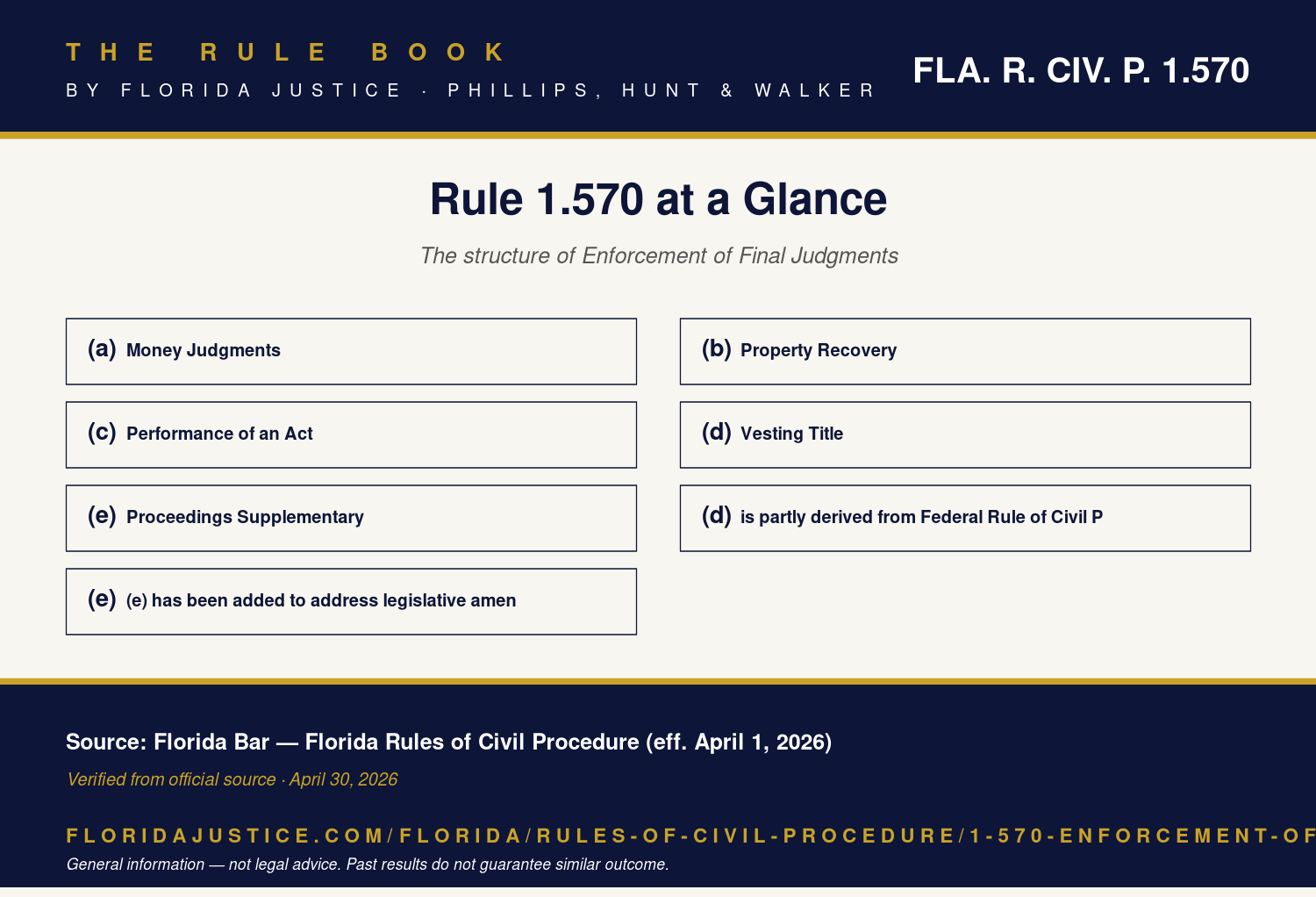
Infographic — Rule 1.570 at a Glance

Florida Rule 1.570 infographic

Committee Notes

View Committee Notes (legislative history)

1980 Amendment. This rule has been subdivided and amended to make it more easily understood. No change in the substance of the rule is intended. Subdivision (d) is partly derived from Federal Rule of Civil Procedure 70. 2018 Amendment. Subdivision (e) has been added to address legislative amendments to chapter 56, Florida Statutes (2016).

Lawyer-to-Lawyer Co-Counsel Referrals

If you’re a lawyer with a Florida case outside your normal practice — complex civil, catastrophic injury, federal court litigation, multi-state coordination — co-counsel referrals are a core part of what we do. You keep the client. We take the trial-side work. Fee split per Fla. Bar Rule 4-1.5 with full client consent.

Call John directly: (904) 444-4444
This page summarizes a Florida Rule of Civil Procedure for educational purposes. The rule text and Committee Notes are mirrored from the Florida Bar’s official publication and are public domain. The plain-English summary is the opinion of Phillips, Hunt & Walker and is general information only — not legal advice. Reading this page does not create an attorney-client relationship. Past results do not guarantee a similar outcome in your case.

X